
By Rodrigo Uchoa, special for Brazil Stock Guide
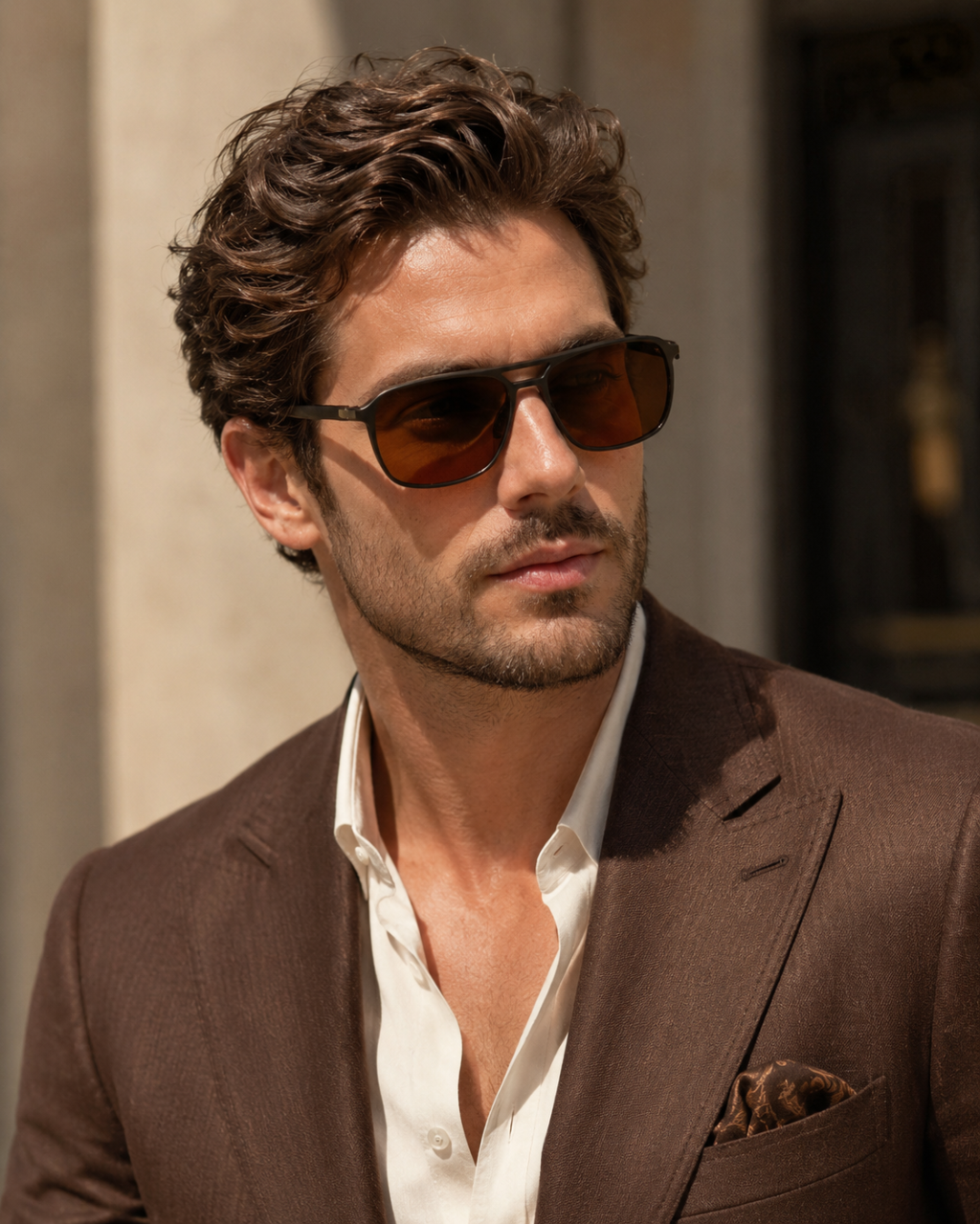
And there he came, in the middle of the European summer, nearly 40°C in the shade, in a full brown suit, a scarf at his neck, crossing the Fortezza da Basso without so much as unbuttoning his jacket. The image is the very face of the 110th edition of Pitti Uomo, where sweating with elegance is part of the deal.
Since 1972, the Florentine fair has worked as a barometer of what men will be wearing six months from now. On the surface, it is a sober business affair: some 720 brands from more than 30 countries, showing their spring-summer 2027 collections. “Small businesses are growing, and I think Pitti represents many of them,” said Antonio De Matteis, president of Pitti Immagine and CEO of the Naples-based Kiton.
De Matteis is one of the fair’s genuine executives. But the Pitti that catches the eye and makes it into the photographs is another one altogether: the Pitti of the peacocks. The peacocks of Florence dress to be photographed on the pavement, in performances that range from the impeccable to the deranged. They are a particular species, drifting more or less aimlessly around the fair, hungry to be noticed and trying to mirror the trends being decided inside.

This year, the verdict on the street was brown tailoring — in earth, caramel and chocolate tones, with a deliberately softened silhouette. Soft shoulder, linen and more volume. Everything bigger, looser. And, as always happens when clothes swell, an accessory hitches a ride. Enter the discreet — yet unmistakable — hero of the male wardrobe: sunglasses.
Men, as a rule, carry far fewer accessories than women. A wedding band, a watch and, perhaps, a straw hat. Sunglasses are, for many, the one object that carries personality without asking permission. And they have been growing. The direction for 2027 is oversized frames — bigger, in thick acetate, with a robust presence. Bigger, yes, but, crucially, not excessive.
These are not the bug-eyed maxi-glasses that forever turn up on the runway; they are a sober, sartorial reading of volume, one that converses with the safari jacket and the wide pleated trouser. A square of havana acetate belongs to the season’s palette rather than fighting it.

In Brazil, the more generous frames are still gaining ground quietly. Carol Waltrick, director of Product Design at EssilorLuxottica in Latin America, points out that a trend takes, on average, “between six months and a year” to travel from runway to shelf. She is betting on “a new definition of luxury gaining force, more personalised and sophisticated,” with more architectural shapes and a reimagining of the aviator, which has just turned 90.
There is, of course, the chapter of the wearables. On 23 June, Meta and EssilorLuxottica launched the “Meta Glasses” line, starting at $299, with 26 styles and built-in AI. It is cheaper than the Ray-Ban Meta ($379), in a category where the pair holds roughly 80% of the market and whose sales jumped 167% in the first quarter of 2026.
Style, though, still divides opinion. The writer Sam Anderson, of the New York Times Magazine, chronicled weeks spent with his AI glasses, which misread the images in front of them and made passers-by recoil “like vampires sprinkled with holy water.” For the Florentine peacock, there is still something heretical about putting a chip on your face.

Popular, luxury and the frontier of craft
It is worth pausing here for an overview of where sunglasses sit in today’s market. On the popular floor, where Ray-Ban, Oakley and Carrera shine, a classic runs between $100 and $200. The mid-luxury of the licensed fashion houses — Prada, Gucci and the very Italian Persol, a notch above on manufacturing merit — runs from $300 to $700. The small-batch luxury tier (Tom Ford, Saint Laurent, Dita) asks for $800 to $1,500.
And then there is artisanal high luxury, which begins where the label ends. A Jacques Marie Mage in acetate costs upwards of $1,500, comes in runs of a few hundred pairs, hand-numbered, with around 300 production steps per piece. Above it sits the bespoke of France’s Maison Bonnet in buffalo horn or tortoiseshell — made to measure after fittings that can take months and feel like a visit to the tailor. In the end, you pay the price of an economy car.


The parallel with Pitti is almost perfect. The press described the fair as a tension between the artisan and the avant-garde: on one side craft, linen, brown; on the other, the conceptual rupture of fashion, embodied by the debuts of guest designers Simone Rocha and Kei Ninomiya. In the eyewear market, the fault line is identical: the atelier at one end, mass technology with AI at the other, and, in the middle, the label that merely rents out its name.
And there is no doubt about who runs the game: EssilorLuxottica, owner of Ray-Ban, Oakley, Persol and the Sunglass Hut chain. The group closed the first quarter of 2026 with €7.127 billion in revenue (+10.8%), its third consecutive quarter of double-digit growth, on top of €28.5 billion in 2025. The same group makes the chemist’s sunglasses and licenses the maison’s.
Back to the peacock
Which brings us back to the pavement in Florence, where a peacock in a voluminous havana frame swore that his glasses were not “a trend” — they were “timeless.” Yet there they all stood, in thick acetate and crumpled linen, each convinced his choice was deeply personal, when half of Florence had reached the same conclusion in the same week.
That is the secret charm of menswear: it convinces us that the vanity belongs to other people. The glasses grew, the suit softened, brown won. And each man worked it out on his own, with the pride of a connoisseur, arriving at exactly what 700 brands had agreed upon six months earlier. In the end, the peacock was right on one count: sunglasses really are an extension of personality. It’s just that the personality was the same for almost everyone.