
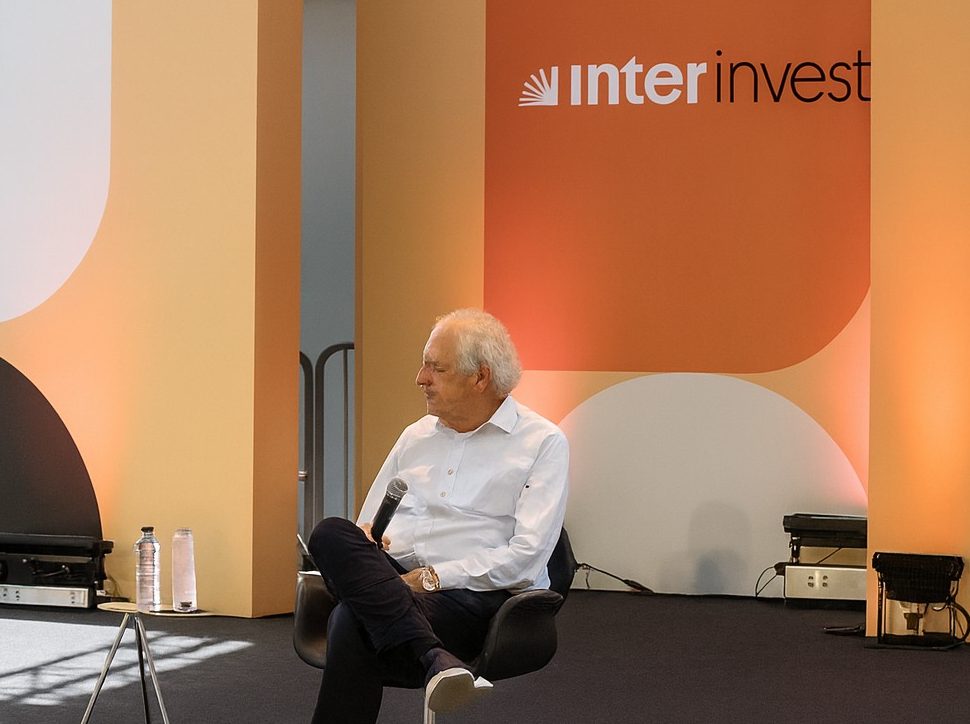
By Brazil Stock Guide – Businessman Rubens Menin, founder of MRV Engenharia (B3: MRVE3) and chairman of Inter (B3: INBR32), said on Saturday that Brazil’s real interest rate of 10% threatens industrial competitiveness and could trigger a crisis in the coming years. Menin, who also runs businesses in construction, finance and media (CNN Brasil), argued that the country urgently needs to reduce the cost of capital to accelerate growth.
“Brazil is lagging behind the world. Everyone else cut rates after the pandemic, and we haven’t yet,” Menin said. He warned that keeping rates elevated for so long already “orders a future crisis”, as it blocks investment and erodes the country’s industrial base. Still, he stressed that the solution will not come from arbitrary “rate cuts by decree” but from structural reforms. “Fiscal discipline and balanced public accounts are essential for interest rates to fall sustainably,” he added.
The remarks came during the Inter Invest Summit, held at Arena MRV, the Atlético-MG stadium in Belo Horizonte built with Menin’s backing. A lifelong fan of the club, he addressed an audience of about 6,000 people on innovation, investments and entrepreneurship.
Menin recalled that the digital bank launched in 2015 was born in the cloud with AWS support, unlike giants such as Itaú Unibanco (B3: ITUB4), which only migrated in 2025. Today, Inter has more than 40 million clients and releases “over one product per day,” he said, thanks to the scalability of its platform.
The bank is now pushing to strengthen its integrated digital ecosystem, spanning investments, insurance and a consumer marketplace. Menin highlighted that Inter is accelerating its use of artificial intelligence to personalize offers and boost efficiency, while exploring opportunities in open finance, large-scale data analytics and even quantum computing, in collaboration with Silicon Valley tech hubs.
“While traditional banks are satisfied with rolling out one product a month, we launch more than one a day,” he said. “That pace is what ensures competitiveness.”
Teams, scale and culture
Menin pointed out that the key to growth at both Inter and MRV has been building strong teams and a meritocratic culture. He coined the expression “good people, good team” to describe the strategy of valuing committed employees with a shared purpose. Inter grew from 300 to 4,000 employees in less than a decade, while maintaining a “hard core” of cultural multipliers.
He also noted that Brazil’s continental scale gives it unique competitive advantages in sectors such as agribusiness and financial services. This same logic guided MRV’s decision to expand into the United States rather than smaller Latin American markets with limited scale.
Menin’s criticism of high rates reflects a broader long-term concern: Brazil’s loss of global competitiveness. Without a structural reduction in the cost of capital, he argued, the country will struggle to keep pace with international rivals—even in sectors where it already stands out.
Still, Inter itself faces a paradox. As a digital bank with a large deposit base, it benefits in the short term from elevated rates, since returns on government bonds increase. But it loses in the medium and long run: credit origination slows, delinquency rises and the expansion of its digital platform is constrained.
For Menin, the way out of this dilemma lies in technology and innovation. Only companies that maintain speed in launching products and adapting to technological shifts, he said, will be able to thrive in a hostile macroeconomic environment.
“There’s no such thing as a war already won,” he said, warning that the biggest risk is complacency. “If a company settles into comfort, it will soon face the worst year in its history.”