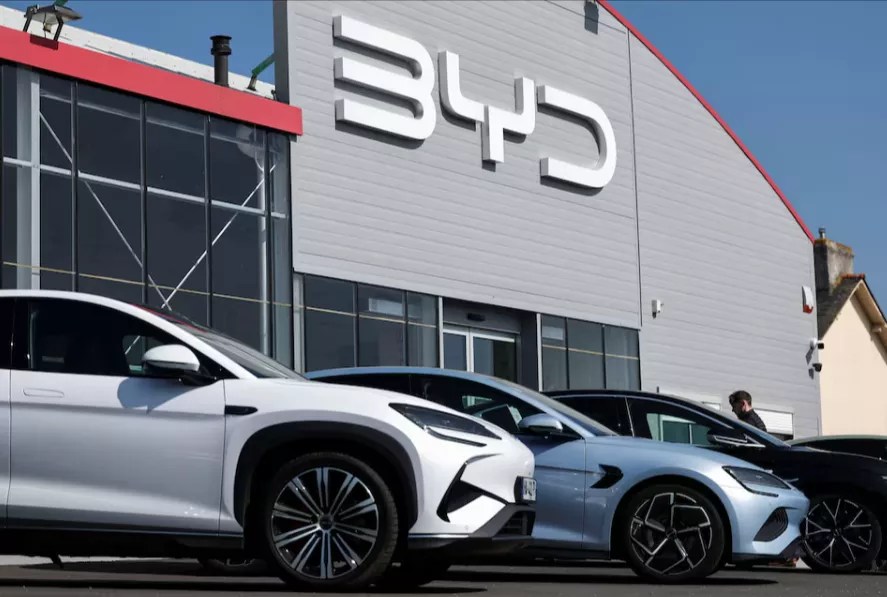
By Brazil Stock Guide – Chinese automakers are gaining ground in Brazil just as the country prepares for the return of its biggest auto industry showcase. According to Estadão, Chinese brands captured 11% of passenger car sales between January and August, less than four years after BYD (1211:HK) and Great Wall Motor (2333:HK) entered the market.
Chinese expansion and ambitions
Neocom, a consultancy focused on the auto market, reports that BYD, GWM, Omoda & Jaecoo and GAC now operate 347 dealerships across Brazil, surpassing the networks of Toyota, Renault (RNO:FP), Hyundai (005380:KS) and Honda (7267:JP). Only Stellantis, GM and Volkswagen maintain larger footprints. BYD, currently seventh in Brazil’s ranking, aims to enter the top five, while GWM projects eventual sales of 250,000 to 300,000 vehicles per year. Its new plant in Iracemápolis starts with annual capacity of 50,000 units.
Auto show as stage for competition
At the same time, Vice President and Industry Minister Geraldo Alckmin confirmed that the São Paulo International Auto Show will return in 2025, its first edition since 2018. Organized by automakers’ association Anfavea — which represents General Motors (GM), Volkswagen, Stellantis (STLA) and Toyota (TM) — the event is considered Latin America’s largest auto fair. “President Lula, there will be an Auto Show! Today a good piece of news from Anfavea: the auto show is back! It will be the first edition since 2018 of this celebration of technology, innovation and the achievements of the automotive industry, which generates jobs and income,” Alckmin wrote on X.
Alckmin emphasized that the Auto Show will highlight both innovation and confidence in Brazil’s car industry, noting that sales have been setting records in 2024. Analysts expect the fair to showcase sustainable mobility solutions, with a strong focus on hybrids and EVs — a field where Chinese brands currently lead.
But the dominance of newcomers will be tested. Stellantis, GM and Volkswagen are preparing their own hybrid launches to compete directly. A Webmotors survey indicates that infrastructure gaps, such as insufficient charging stations, and concerns over resale values remain barriers for wider adoption of electrified cars in Brazil.
Tariff headwinds and outlook
Government policy is also reshaping the market. Import duties on hybrids and EVs are being gradually reinstated and will return to 35% by July 2026. Automakers with local operations, including BYD in Camaçari and GWM in São Paulo state, still benefit from $463 million in quotas for semi-knockdown kits at reduced rates. Starting in 2027, however, all companies — including those assembling locally — will face the full tariff.
Bright Consulting projects that Chinese brands’ share will stabilize around 13% beyond 2027. Signs of growing competition are already evident in São Paulo, Brazil’s largest market, where Fiat’s Fastback hybrid accounted for nearly half of electrified sales growth in the first seven months of the year. “Fiat was the brand that grew the most in this segment, which shows the challenge Chinese automakers will face as established high-volume manufacturers launch their own electric and hybrid products,” said Alexandre Ayres, CEO of Neocom.