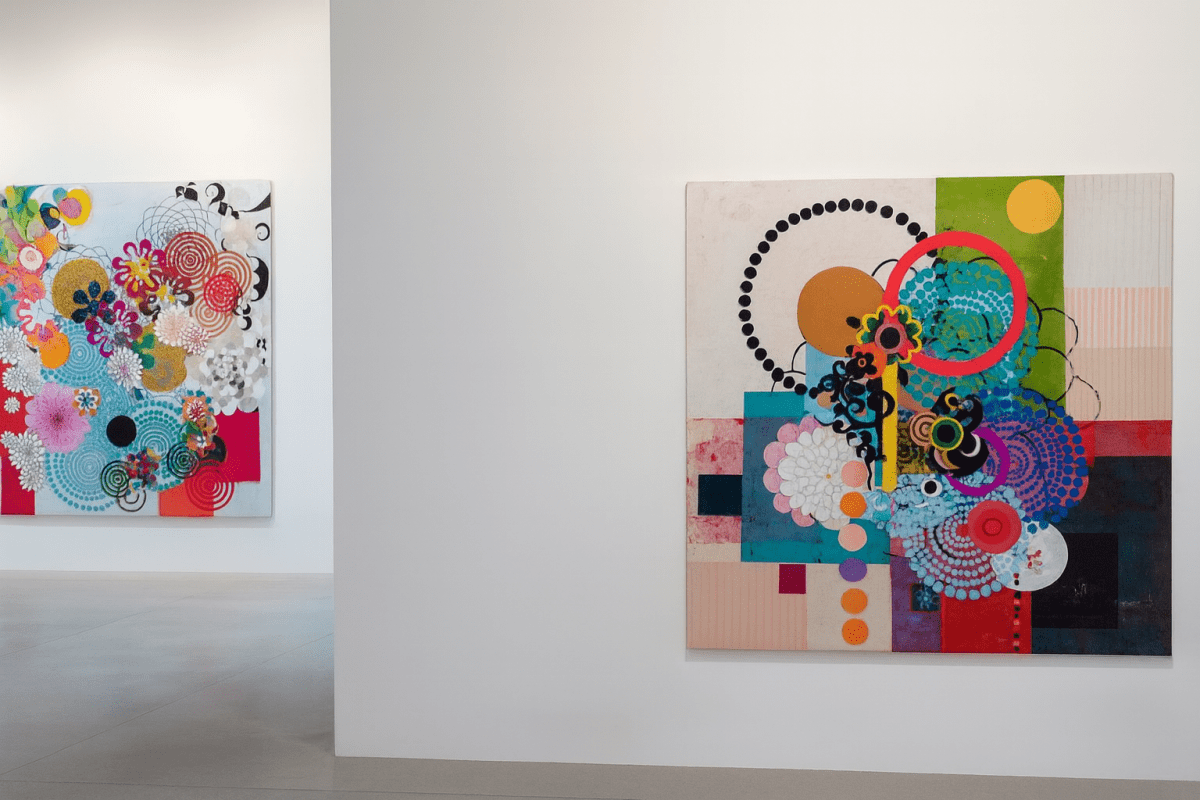
Retrospective exhibition that traces four decades of Beatriz Milhazes´s work at Tate St Ives.
By Rodrigo Uchoa, special for Brazil Stock Guide
Walk around London, New York or Paris and the queues for contemporary art can feel endless. Tate Modern remains among Britain’s busiest free attractions. In Paris, the Centre Pompidou closed in 2025 for a five-year renovation after drawing millions annually. Meanwhile, Paris’s privately backed Fondation Louis Vuitton (FLV) counted well over a million visitors in 2023, and the Bourse de Commerce — Pinault Collection has been a magnet since opening in 2021. Add Spain’s Guggenheim Museum Bilbao, which logged 1.3m visitors in 2024—just shy of its all-time record—showing how contemporary programming now pulls mass audiences across Europe. In New York, MoMA tallied nearly 2.7m in its 2023–24 fiscal year.
Enthusiasm at the turnstiles coexists with jitters at the cash desk. The Art Basel & UBS Art Market Report 2025 estimates global art sales fell 12% in 2024 to $57.5bn, even as transaction volumes rose 3%—evidence that activity migrated to lower price points while the trophy tier thinned. China adds nerves: reports of high post-auction non-payment on big-ticket lots hint at fragile market plumbing. Even the fairs are changing tone: Art Basel has dropped the term “VIP”, rebranding the unit as “collector and institutional relations”.
None of this is unprecedented. In 1990, at the crest of Japan’s asset mania, Ryoei Saito spent $82.5m on Van Gogh’s Portrait of Dr. Gachet and $78.1m on Renoir’s Bal du moulin de la Galette within two days—peak exuberance that became a cautionary tale when prices cooled. Bubble narratives recur because art mixes scarcity, status and storytelling in heady proportions.

‘Choreographies of the Everyday’, an exhibition celebrating the 30th anniversary of the Museum of Contemporary Art Tokyo
Brazil sits within this melodrama with particular quirks. Interest is climbing: Inhotim, the sprawling contemporary-art park near Belo Horizonte, recorded more than 335,000 visitors in 2024—its best result in seven years. São Paulo’s SP-Arte has matured into Latin America’s bellwether; organisers and media trailed attendance of about 30,000 for the 2024 edition, broadly in line with 2023. In Rio, the Museu de Arte do Rio (MAR)—inaugurated on March 1, 2013, with the Escola do Olhar (School of Looking) linking exhibitions to public-education initiatives—has become an emblem of Porto Maravilha’s cultural renewal and a steady platform for Brazilian and international shows.
At the macro level, sector studies peg Brazil’s 2023 art market at roughly R$2.9bn (≈$580m), up 21% year-on-year; that is about 0.9–1% of the global market, roughly double a decade ago—small, but no longer negligible.
Yet specialists and academics warn of distortions that rhyme with bubble mechanics. Brazil’s market remains illiquid by rich-country standards; when a handful of names dominate supply and headlines, price discovery can look suspiciously like momentum. Debates often swirl around Beatriz Milhazes, whose auction record stands at about $2.1m (Meu Limão, Sotheby’s, 2012). During SP-Arte 2016, a giant canvas (Summer Love – Gamboa Seasons) was reported sold for around R$16m, though contemporaneous coverage flagged controversy over whether the deal closed—useful context in a thin market.
Private Fortunes, Public Museums
A key through-line in today’s ecosystem is the role of private collectors building public-facing institutions—a model perfected in Europe and emulated elsewhere. In Paris, François Pinault’s Bourse de Commerce rotates parts of his collection (and influence). Bernard Arnault’s Fondation Louis Vuitton—a Frank Gehry vessel with blockbuster programming—helps keep Paris buzzing. In London, the Saatchi Gallery has long served as a platform for market-making contemporary shows and education programs, shaping taste well beyond the auction saleroom. In Brazil, Edemar Cid Ferreira (Banco Santos) and Bernardo Paz (Inhotim) sought versions of the same effect: private capital and curatorial ambition to seed public prestige and cultural soft power.
Brazil has also lived the laundering-risk script in dramatic form. Edemar Cid Ferreira, founder of Banco Santos, built a high-value art collection entangled with the bank’s collapse, which authorities characterised as a fraudulent bankruptcy tied to financial-system crimes and money-laundering. In October 2017, the U.S. Department of Justice announced the return of 95 artworks—recovered across multiple jurisdictions—to the Banco Santos bankruptcy estate. The episode remains a touchstone for prosecutors and dealers when discussing provenance, transparency and court-supervised disposal of assets.
Compliance anxieties add another layer. In 2017, Bernardo Paz—founder of Inhotim—was convicted in a lower court on money-laundering charges, specifically the allegation that funds raised overseas for Inhotim were funnelled to cover expenses in his mining and steel businesses. In February 2020, however, a federal appeals court quashed the conviction and acquitted Paz (and his sister), ending the case. The legal saga nonetheless sharpened debate at home about governance and financing models for private cultural flagships—and left what one might call a reputational hangover, even after acquittal.

Adriana Varejão, Carnívoras (Instagram)
Viewed from 30,000 feet, today’s wobble looks less like imminent collapse than rebalancing. The high end has cooled; mid-market segments ($10,000–$100,000) and local collectors have proved more resilient—precisely the profile visible in Brazil, where most gallery revenue comes from works well below $25,000. Meanwhile, museums continue to mint demand: Pompidou’s temporary closure is offset by global partnerships; FLV and Pinault keep Paris lively; Bilbao remains a magnet—and a macro case study.
As for the art itself, the Brazilian canon is sturdy. The modernists—Tarsila do Amaral, Lygia Clark, Hélio Oiticica—wrote the grammar; contemporary heirs— Adriana Varejão (art Carnívoras/Instagram), Ernesto Neto, Vik Muniz, Milhazes, Rosângela Rennó, Jonathas de Andrade—extend it with political bite, materials ingenuity and unabashed sensuality. Inhotim’s landscape pavilions, MAR’s civic-education footprint, and the fair floors of São Paulo make that diversity legible to newcomers. If the market sometimes behaves like a speculative instrument, the art rarely does. It returns, again and again, to the Brazilian preoccupations—race and class, nature and extraction, carnival and control—that give the work its tensile strength.
Bubbles come and go; culture persists. Even as prices wobble and compliance stiffens, the quality and intelligence of Brazilian contemporary art look anything but inflated. That, finally, is not a bubble—it’s ballast.