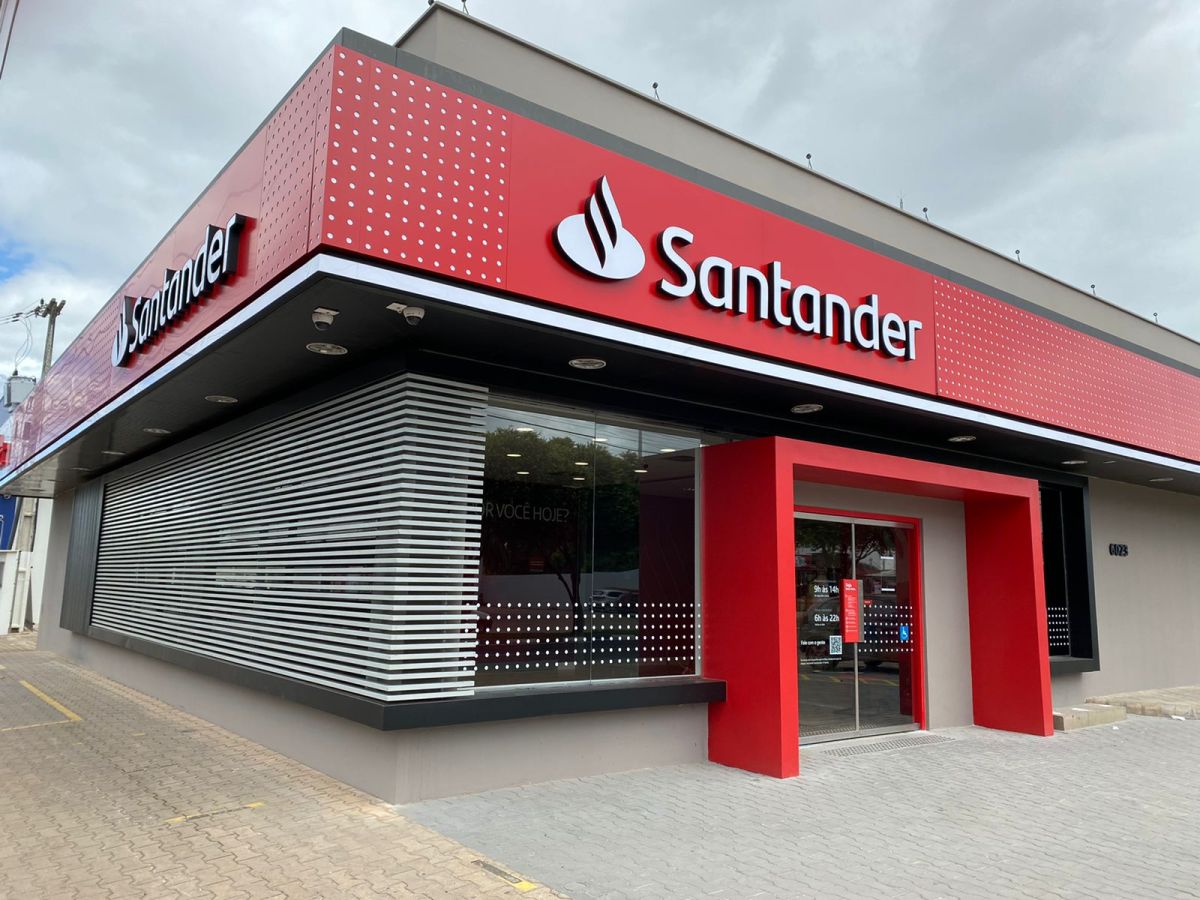

By Brazil Stock Guide – The Santander Brasil S.A. (B3: SANB11) management used its third-quarter earnings Q&A to outline a clear roadmap for the next two years: disciplined growth, zero nominal cost increase, and efficiency approaching 30%.
Chief Executive Officer Mário Leão framed the plan under a concept he calls “positive jaws” — revenues growing faster than expenses and provisions.
“We want to grow profit sustainably. Every quarter we’re getting closer to a 20% return — and we’re not stopping there,” Leão told analysts.
Cost discipline and efficiency: “Growth without inflation”
The call’s dominant theme was cost control. Leão reiterated that the focus is on outpacing inflation in real terms, using structural savings to fund the bank’s digital and AI transformation.
“Our mindset is zero nominal cost growth. The traditional bank must finance the new, digital bank,” he said.
Santander closed the quarter with an efficiency ratio of 37.5%, and management sees a path toward around 30% within the next few years.
CFO Gustavo Alejo added that recurring expenses rose only 1.2% in the quarter — below inflation — even as the bank continued investing in technology.
“We’ll anticipate everything we can without compromising expansion,” Leão said, responding to Eduardo Nishio of Genial Investimentos. “The goal is to self-fund investment, scale up results and keep the operation lean.”
Digital transformation: OneApp as backbone
Leão highlighted the launch of OneApp, Santander’s new unified mobile platform, as a key milestone in the bank’s digital transformation. Developed jointly with the group’s global tech teams, it already counts 2.3 million active users in Brazil and will serve as the global template for Santander’s retail app.
“OneApp is no longer the Santander app — it’s the client’s app,” said Leão. “It delivers hyper-personalized journeys and continuous conversations with customers.”
The app integrates Open Finance and AI-driven personalization, enabling users to view multiple bank accounts in one interface. Early adoption exceeded expectations: 80% of users rated it “excellent,” and three-quarters already prefer it to the legacy version.
3Q25 backdrop: profitability and balance sheet discipline
While strategy dominated the call, the numbers provided a solid backdrop. Santander Brasil reported a net income of R$4 billion in 3Q25, up 10% from the previous quarter, returning to its highest level in over three years.
The bank’s ROE rose to 17.5%, with customer margin up 2.7% and fee income increasing 6.7%, driven by stronger card, insurance and brokerage revenues.
Credit quality remained stable: NPLs over 90 days stood at 3.4%, slightly higher than in 2Q25 but within expectations.
“We don’t renegotiate without a cash component,” Leão stressed. “We prefer to write off and clean the book faster, focusing on high-return portfolios.”
Alejo noted that new loan vintages are performing better than legacy ones, reflecting stricter underwriting and a sharper focus on profitability.
Selective credit and lower rate sensitivity
Answering Mário Pierry of Bank of America, Leão said Santander will continue prioritizing loan growth in segments delivering returns above 20% on capital, while shrinking exposure where net margins are thinner.
Loan growth was strongest in cards (+14.5%), consumer finance (+12.6%), and SMEs (+12.4%), offset by a 6% contraction in low-income retail. “Our approach remains disciplined and technical — focused on marginal profitability, not volume,” Leão said.
The CFO also detailed the group’s ongoing effort to stabilize its net interest income (NII). Santander has completed two-thirds of an 18-month hedging program designed to reduce exposure to Brazil’s policy rate, the Selic.
“We’re hedging between 50% and 100% of new fixed-rate production,” Alejo said. “By 2026, our market margin should be far more stable and predictable.”
Capital and outlook: self-funded growth
With a CET1 ratio of 11.7%, Santander said it is positioned to sustain organic growth and potentially increase shareholder distributions without weakening its balance sheet.
Leão reaffirmed that Brazil will serve as one of the Santander Group’s global innovation hubs, exporting technology and AI solutions.
“We’re becoming a more predictable, diversified, and global bank,” he said.
Looking to 2026, Leão summed up the strategy succinctly: “Positive jaws — rising revenues, stable costs and provisions.” The bank expects to combine operating leverage with disciplined credit growth to achieve a ROE above 20%.