Where coffee once grew, Syrah now shines. Guaspari’s highland vineyards give Brazil a taste of Tuscany.
By Rodrigo Uchoa, special for Brazil Stock Guide

Not so long ago, Brazilian wine tourism meant busloads bound for the German-and-Italian-accented South. Lately, however, the map looks cheekily upside down: Bahia, Minas Gerais and São Paulo are luring corkscrews and camera phones with striking vineyards, polished cellars—and a clever agronomic hack. The trick is dupla poda, or “double pruning,” which flips the vine’s calendar so grapes ripen in the dry, cooler nights of winter rather than the stormy summer—an elegant way to trade mildew for freshness and poise.
Consider Uvva, set among the pink cliffs and blue skies of Bahia’s Chapada Diamantina. The region, once all garimpo and hikers, now adds galleries, refined architecture and tasting rooms to its tourist draw; Uvva’s own complex is a contemporary statement built to sit lightly in the landscape. Its Chardonnay is the calling card: pale straw, clean and bright, often showing floral aromas with orchard fruit, citrus lift and a neat, dry finish. On the winery’s shop it sits around R$143; a microlote Chardonnay appears at roughly R$188. Red ambitions are real too—Cabernet Franc and Cabernet Sauvignon clock in higher—but the white is what converts sceptics who thought Bahia was only for caipirinhas and waterfalls.

Vineyards at Uvva, framed by the pink cliffs of Chapada Diamantina. Bahia’s terroir finds freshness and elegance through double pruning.
If Bahia provides the surprise, Minas Gerais supplies the medals. The state is the cradle of the winter-harvest movement and, as of 2025, boasts Brazil’s first geographical indication dedicated to such wines (“IP Vinhos de Inverno Sul de Minas”). The logic is altitude, dry air and those prized day–night swings—conditions that double pruning is designed to exploit. This year, Maria Maria’s Isabela Syrah 2023 from Boa Esperança took gold and 96 points at the Decanter World Wine Awards—the lone Brazilian gold and the country’s highest DWWA score to date—cementing Minas on serious drinkers’ itineraries. No wonder some commentators have started calling the rolling coffee-and-vine hills of the south “a Brazilian Tuscany”—a comparison born of topography and a growing mix of wine, olive oil and agritourism rather than mere romance.

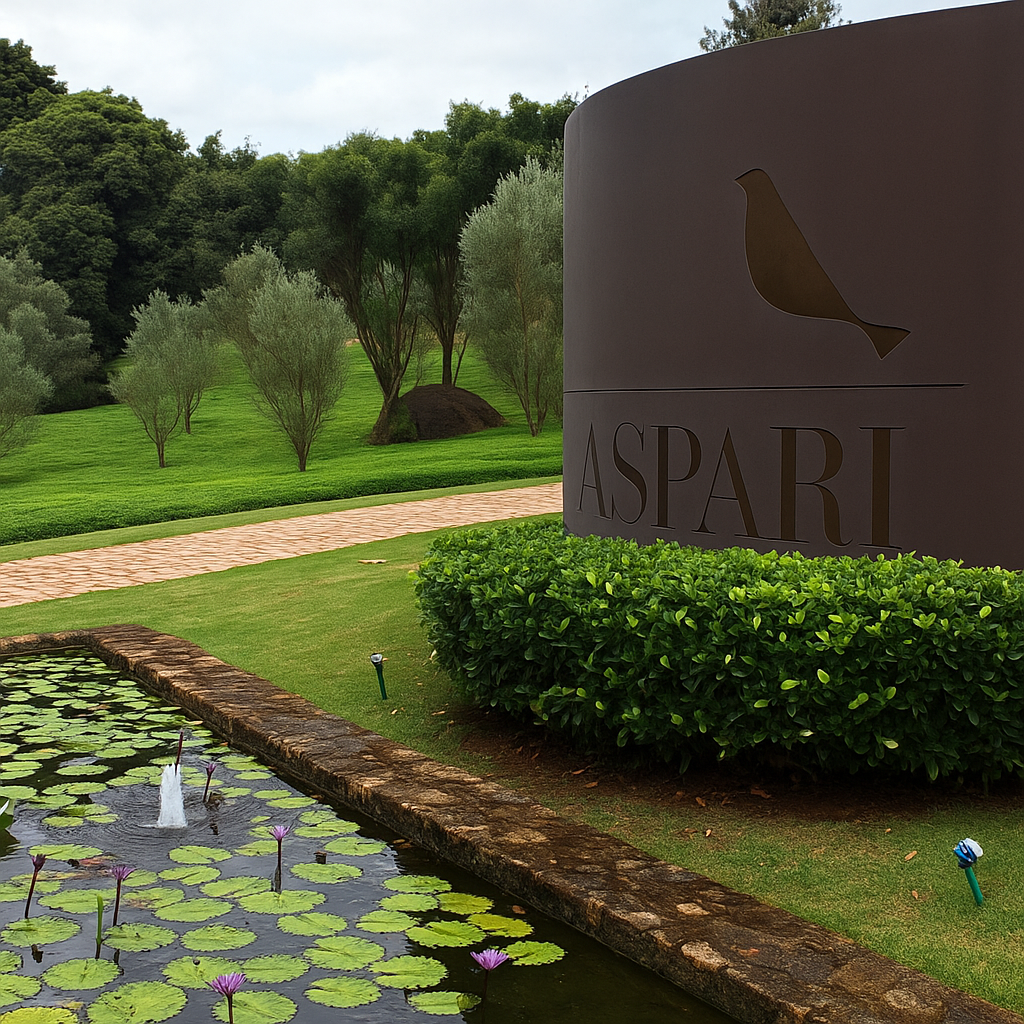
São Paulo, meanwhile, has learned to harvest after the rains and before the tourists. Guaspari, in Espírito Santo do Pinhal, helped blaze the winter-harvest trail on former coffee land and has the metal to show for it: its Syrah “Vista do Chá” took DWWA gold (2012; later again with 2014), while recent editions keep stacking up silver and bronze. Expect black fruit, pepper and savoury spice—Syrah with Brazilian altitude diction rather than a Rhône accent—while the more approachable Vale da Pedra line offers cellar-door prices from about R$178 for the red (the 2019 Vista do Chá currently sells for around R$400). The architecture and guest areas nod to Tuscan villas and gardens, underscoring just how far rural Pinhal has travelled from sacks of coffee to sabrage.
Awards now spill across the Mantiqueira ridge that Minas and São Paulo share. In 2024–25 the range accounted for a healthy slice of Brazil’s Decanter haul, with producers like Vinícola Ferreira also flashing medals—proof that winter wines are more than a clever idea. As visitors fan out from the southern strongholds into Bahia’s canyons, Minas’s rolling altitudes and São Paulo’s high farms, they’ll notice another delicious convergence: cheese. Routes like the Canastra trail turn winery weekends into dairy pilgrimages—an entire story in itself for another glass and another day.
Brazilian enotourism, then, is no longer a single destination but a season, a method and a mood. Follow the winter, follow the altitude, and follow the pruning shears. If you time it right, you’ll find Chardonnay chilling in Bahia, Syrah strutting in Minas and a Paulistano red with Decanter swagger—all tasted as the sun drops and the nights tip cool. Pack a light jacket, sturdy shoes and an extra suitcase. You’ll need room for bottles—and, inevitably, cheese.
🍷 Brazil’s New Wine Route
🏜️ UVVA Wine Estate
📍 BA-142, Mucugê, Chapada Diamantina, Bahia, Brazil
📫 ZIP 46750-000
🌐 vinicolauvva.com.br
⛰️ Maria Maria Winery
📍 BR-369 km 04, Boa Esperança – Campos Gerais, Minas Gerais, Brazil
📫 ZIP 37170-000
🌐 vinhosmariamaria.com.br
🍇 Guaspari Winery
📍 Rua Pedro Ferrari 300, Parque do Lago, Espírito Santo do Pinhal, São Paulo, Brazil
📫 ZIP 13990-000
🌐 vinicolaguaspari.com.br