
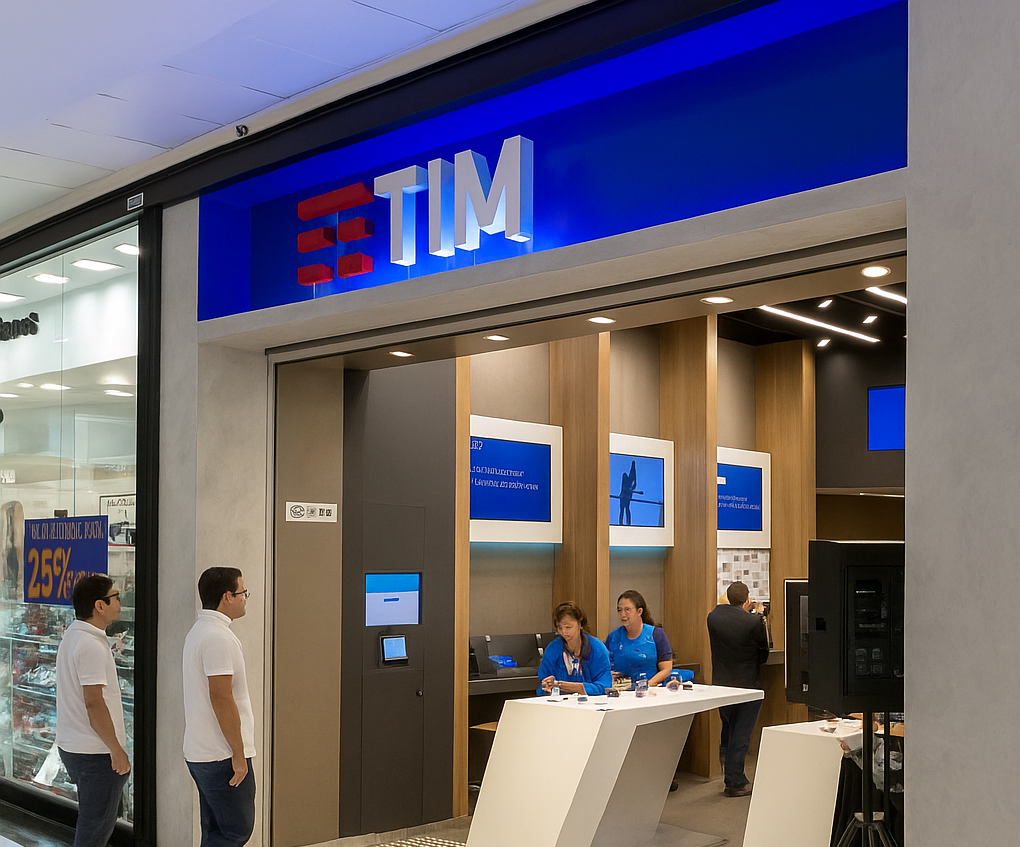
By Brazil Stock Guide – TIM S.A. (B3: TIMS3; NYSE: TIMB) reported its highest-ever quarterly profit, with normalized net income soaring 50% year-over-year to R$1.21 billion in the third quarter of 2025. The result was fueled by strong postpaid revenue growth, improved digital monetization, and tight expense control that lifted margins to record levels. Normalized EBITDA reached R$3.47 billion, a 7.2% increase from a year earlier, with margins expanding to 51.7%.
Postpaid leads as key profit driver
Mobile service revenue climbed 5.2% to R$6.2 billion, supported by continued gains in postpaid subscriptions. TIM’s ARPU (Average Revenue per User) — the industry metric that measures the average monthly revenue generated per customer — reached R$33.1, up 4.6% from last year. Within that, postpaid ARPU hit R$44.1, and postpaid ex-M2M (excluding machine-to-machine connections, such as IoT sensors and connected devices that generate minimal recurring revenue) rose to R$55.5, the highest in company history.
Prepaid revenues declined 8.9%, reflecting customer migration to more profitable plans, while fixed broadband unit TIM Ultrafibra maintained stability, ending the quarter with 823,000 clients and an ARPU of R$94.7.
Operating expenses rose only 1.8%, well below inflation, thanks to efficiency programs and digitalization of sales and billing. EBITDA after leases (EBITDA-AL) grew 8.3%, with a 40.4% margin, and free cash flow rose 4.5% to R$1.82 billion. Net debt remained low at 0.79x EBITDA, underscoring a conservative capital structure.
Investment, shareholder returns, and Vale partnership
TIM invested R$974 million in Capex (14.5% of revenue), focusing on network modernization and 5G densification — now covering 1,000 cities nationwide. It also distributed R$800 million in interest on equity (JCP) and repurchased R$369 million in shares so far in 2025, reaffirming its guidance for up to R$2.3 billion in total shareholder payouts this year.
A key highlight of the quarter was the new 5G and IoT partnership with Vale, through the TIM Smart Mining initiative. The agreement will deploy private industrial 5G networks across Vale’s mining operations in Brazil, supporting automation, worker safety, and environmental efficiency. The system integrates connected sensors, autonomous vehicles, and real-time data monitoring to reduce downtime, cut emissions, and optimize ore processing — positioning TIM as a strategic telecom provider for Brazil’s heavy industry.
Digital expansion and service excellence
TIM’s Meu TIM app reached 17.7 million monthly users, with 96.4% of customer requests resolved on first contact. Mobile advertising revenue grew 10.4%, with more than 1,000 campaigns and 270 advertisers. “Our results reflect the consistency of our strategy — combining connectivity, digital platforms, and sustainable growth,” said CEO Alberto Griselli during the results call.