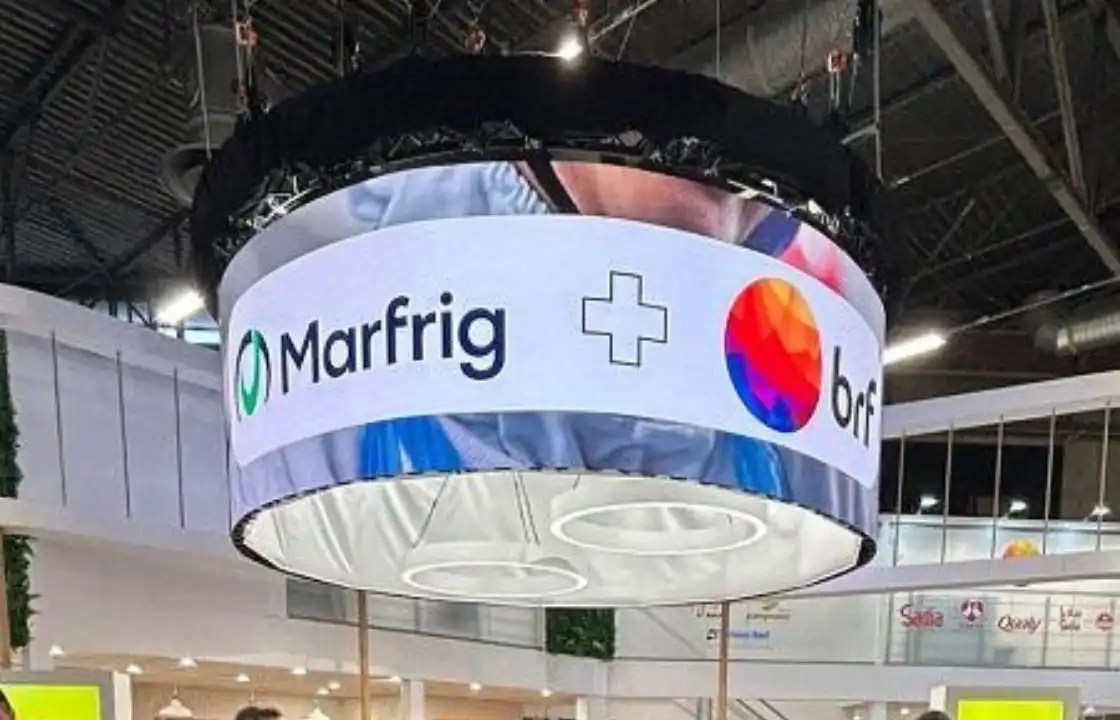

By Brazil Stock Guide – MBRF (MBRF3), one of Latin America’s largest food companies and the result of the 2025 merger between Marfrig Global Foods and BRF S.A., reported its first post-merger quarter proving the value of diversification. Despite the avian flu and a global shortage of beef, the company maintained margins and positive cash generation, supported by a multiprotein platform and a growing share of processed products — now 40% of its consolidated portfolio.
Multiprotein as a shield
CEO Miguel Gularte said the integration of BRF, Marfrig, and international operations was crucial to offset sector shocks. “While fresh poultry faced export restrictions, the strength of processed foods and beef operations in South America ensured stability,” he said. BRF delivered record-high volumes, while the group consolidated R$3.5 billion in EBITDA and R$94 million in net income for the quarter.
Halal expansion and synergies
The integration plan continues with R$1 billion in mapped synergies, of which R$600 million are expected to be captured by 2026. The biggest bet lies in the halal market, with the creation of Sadia Halal and plans for an IPO in 2027 on the Riyadh Stock Exchange. “We’re talking about a market exceeding US$1 trillion, where Sadia is already a leading brand,” Gularte said.
Resilience and discipline
CFO José Inácio Scoseria noted that diversification also strengthened the balance sheet. Even with higher inventories and share repurchases, leverage remained at 3.09x EBITDA and free cash flow positive at R$555 million. He highlighted that the global footprint and prudent capital management will reduce financial expenses — projected to fall by R$500 million in 2026 as interest rates stabilize.
Integrated markets and operational gains
The company also reported scale gains from South American exports, which grew 17.6% year-on-year. Uruguay, in particular, consolidated its role as a beef export hub to the U.S. and Asia. BRF’s domestic performance was driven by processed foods and logistics, with over 340,000 active sales points and strong growth in cold cuts and breaded products. “Integrated logistics and commercial execution were key to boosting efficiency and capillarity,” Scoseria said.
Global presence and long-term agenda
With 75% of revenue coming from outside Brazil, MBRF reinforced its global reach. Gularte emphasized that the company is one of the few in the sector with significant operations across South America, the Middle East, and Asia.
“Geographic diversification is a strategic asset. When one market faces restrictions, another offsets it — that’s what ensures predictability and sustainable growth,” he said. The company is also investing in energy efficiency and traceability, with 100% satellite monitoring of cattle suppliers and participation in low-carbon programs.
Expansion outlook and shareholder confidence
The strategic roadmap has the backing of controlling shareholder Marcos Molina, who reaffirmed his commitment to sustainable growth and value creation. Gularte said the merger between Marfrig and BRF “was not just a combination of assets but the creation of a new kind of food company.” The goal now is to turn MBRF into a global protein platform, able to grow with discipline and capture value across cycles. “We are multiprotein, multiregion, and multichannel — and that makes us stronger every quarter,” he concluded.