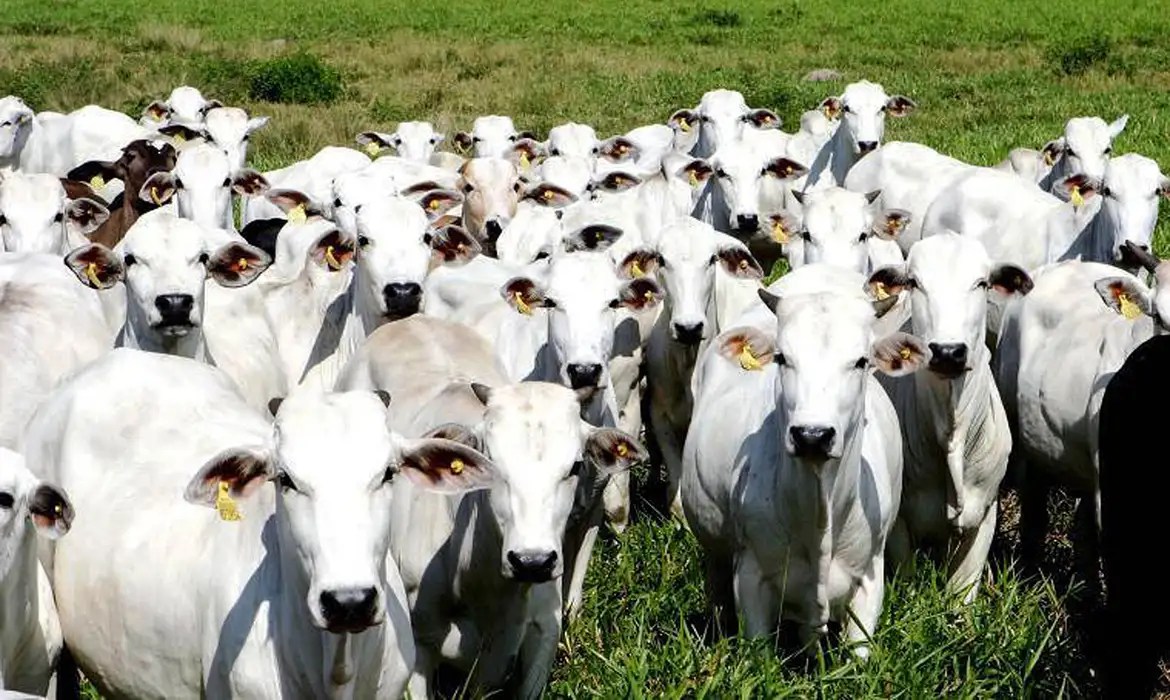
By Brazil Stock Guide — China’s decision to impose country-specific tariff-rate quotas on beef imports is set to disproportionately hit Brazil, the country’s largest supplier, as Beijing tightens access to its market under a safeguard regime starting in 2026. The move, anticipated by Brazil Stock Guide in November, will remove roughly 370,000 metric tons of demand from the global market next year, marking a clear inflection point in a trade relationship that has expanded rapidly over the past decade.
Under the new framework, total imports will be capped at 2.688 million tons in 2026, rising gradually to 2.742 million tons in 2027 and 2.797 million tons in 2028. Brazil, which has been the backbone of China’s beef imports, will be limited to 1.106 million tons in 2026, followed by Argentina at 0.511 million tons, Uruguay at 0.324 million, New Zealand at 0.206 million, Australia at 0.205 million, and the United States at 0.164 million.
While all suppliers are formally covered by the safeguard, Brazil and Australia emerge as the biggest losers in practical terms. Brazil faces a hard ceiling that curtails further volume growth just as Chinese demand had become central to its export strategy. Australia, constrained by herd rebuilding and higher production costs, also finds limited room to regain market share. By contrast, Uruguay and New Zealand stand out as relative winners, benefiting from incremental quota increases and a stronger positioning in premium and grass-fed segments.
The quotas will be annual and allocated on a first-come, first-served basis, triggering immediate distortions in buying behavior. Chinese importers are accelerating purchases to secure volumes within the quota, pushing local beef prices higher in the spot market. Traders expect this front-loading effect to dominate the early months of 2026, as exporters rush to clear shipments before the ceiling is reached.
In the short term, the policy is inflationary for beef prices in China. The more complex challenge, however, lies in the second half of 2026. Once quotas are exhausted, additional imports will face a 55% tariff surcharge, sharply lifting landed costs and potentially triggering an abrupt slowdown in imports. That dynamic could tighten supply, raise volatility and amplify pressure on exporters—particularly Brazil, whose exposure to China is both deep and structural.
Chinese authorities argue the move is a WTO-consistent safeguard designed to stabilize domestic cattle production rather than disrupt trade. For Brazil, however, the signal is unmistakable. Scale alone is no longer sufficient. Access to China’s beef market will increasingly depend on timing, quota execution and political risk, underscoring a structural shift in the world’s most important beef trade corridor.