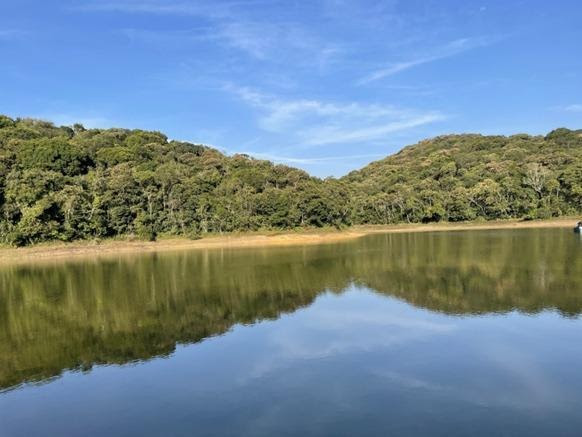
By Brazil Stock Guide – Sabesp (SBSP3), the water utility privatized by the São Paulo state government, has started construction of a permanent interconnection between the Billings reservoir and the Alto Tietê system, a R$ 1.4 billion project aimed at structurally reinforcing water supply across São Paulo’s capital and the broader metropolitan region. The new infrastructure will allow the continuous transfer of up to 4,000 liters per second of raw water from the Rio Pequeno arm of the Billings reservoir to the Taiaçupeba reservoir, expanding the operational flexibility of the Integrated Metropolitan System that serves nearly 22 million people.
The investment is being announced amid the most severe water-stress scenario in the region in the past decade. Sabesp’s reservoirs supplying the metropolitan area are currently operating at around 31% capacity, recovering only recently due to rainfall. Levels had fallen below 25% just weeks ago. The Cantareira system — the region’s largest and most critical — is operating at roughly 21% of total storage, underscoring the fragility of supply under prolonged drought conditions.
The planned transfer capacity is equivalent to the continuous consumption of approximately 1.9 million residents and mirrors the flow temporarily mobilized during the 2014–2015 water crisis. According to Sabesp, the key distinction this time is permanence. The system will allow Billings water to supply two production systems — Alto Tietê and Rio Grande — depending on operational needs and reservoir levels, rather than being constrained to a single route. All transferred volumes will undergo full treatment before distribution.
Technically, the project relies on a fully buried steel pipeline network extending roughly 38 kilometers, with diameters ranging from 1.5 to 1.8 meters. A new raw-water pumping station on the banks of the Rio Pequeno and a dedicated energy substation will power the transfer. The route was designed to run exclusively through public roads, limiting environmental and urban disruption while crossing six municipalities in Greater São Paulo.
Executives frame the project as a structural response to worsening hydrological stress. “We operate in one of the most water-scarce, densely populated metropolitan areas in the world, under increasingly irregular rainfall patterns,” said Marcel Costa Sanches, Sabesp’s director of planning and engineering projects. Per-capita water availability in the region is estimated at just 149 cubic meters per year — comparable to semi-arid regions and far below international benchmarks — a vulnerability laid bare again during the severe drought of 2025.
The new interconnection replaces an emergency setup used between 2015 and 2020, which relied on exposed pipelines, limited operational flexibility and costly gas-fired power generation. The definitive version shifts pumping to the electric grid, fully buries the infrastructure and allows dynamic allocation of flows between systems, reducing operational risk and energy intensity.
The Billings–Alto Tietê project is part of a broader post-privatization water-security plan extending to 2060. Sabesp plans to invest more than R$ 5 billion in resilience and supply-reinforcement projects in the São Paulo metropolitan region through 2027, adding a combined 8,000 liters per second of production capacity — a scale the company argues is necessary as climate volatility shifts from exception to baseline.