
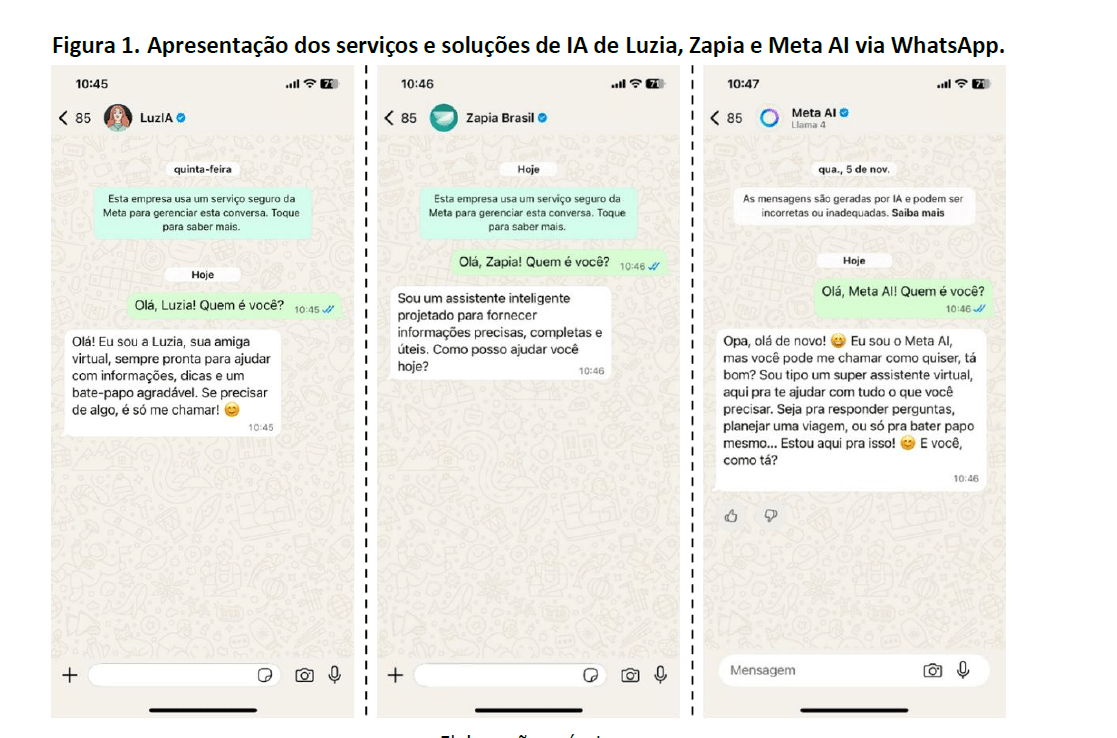
By Brazil Stock Guide – Brazil’s antitrust authority, the Administrative Council for Economic Defense (Cade), will rule on March 4 on a voluntary appeal filed by Facebook Brasil Ltda. and WhatsApp LLC. The case challenges a precautionary measure imposed by Cade’s General Superintendence that suspended changes to the WhatsApp Business Solution Terms.
At the center of the dispute is Meta’s decision to restrict general-purpose AI providers from operating through the WhatsApp Business API. The complaint was filed by Spain-based Factoría Elcano (Luzia) and Uruguay-based Brainlogic AI (Zapia), two developers of consumer-facing AI assistants. They argue that the rule changes effectively exclude competing AI providers and leave Meta AI as the only general-purpose assistant embedded in WhatsApp in Brazil.
One of the arguments raised by Luzia and Zapia is that WhatsApp functions as an essential digital infrastructure in Brazil. With near-universal penetration across smartphones and deep integration into daily communication, the app is not merely another distribution channel but a dominant gateway to consumers.
The companies argue that removing rival AI assistants from WhatsApp is not a routine contractual adjustment, but a structural foreclosure of access to a critical platform. Given WhatsApp’s scale in Brazil, they claim exclusion from the app materially impairs competition in the market for general-purpose AI assistants.
The second key argument centers on what the complainants describe as a classic “embrace, extend, and extinguish” strategy. According to their filings, Meta had encouraged third-party AI providers to integrate into WhatsApp as recently as 2023, prompting investment and user growth. After strengthening its own Meta AI offering, the company allegedly revised the terms to exclude rivals.
Luzia and Zapia further argue that recent reports of Meta testing paid “premium” AI features across Facebook, Instagram, and WhatsApp reinforce the competitive concern. In their view, once rivals are excluded and Meta AI becomes the sole embedded assistant, the platform gains the power to monetize AI services without competitive pressure—either through higher prices or reduced quality constraints.
Beyond Two Companies
The case goes beyond the commercial interests of two startups. Luzia and Zapia argue that the conduct risks reducing innovation, consumer choice, and long-term competitive dynamics in Brazil’s emerging AI market. From an antitrust perspective, the tribunal will examine whether WhatsApp’s rule changes constitute lawful platform governance or unlawful exclusionary conduct under Brazil’s Competition Law (Law 12,529/2011).
For Meta, the defense rests on the argument that the WhatsApp Business API was designed for structured business-to-consumer communication—not as an open infrastructure for general-purpose AI assistants—and that it retains the right to define how its platform is used.
A Regulatory Test Case
Cade’s decision could become a landmark in defining the limits of vertical integration and self-preferencing in dominant digital ecosystems in Latin America. At stake is a fundamental question now facing regulators worldwide: when does private control over digital infrastructure cross the line into anticompetitive exclusion?