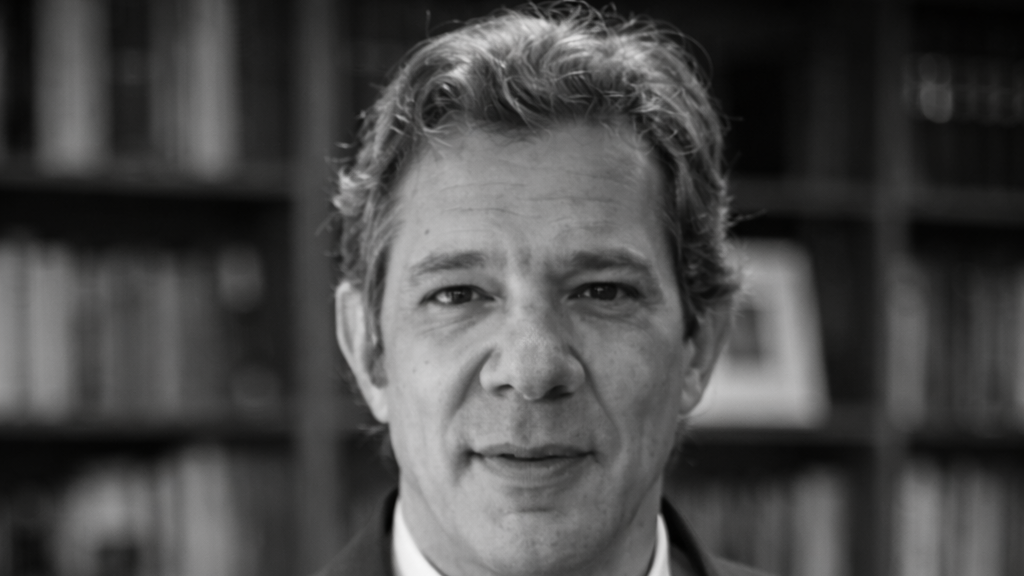
By Brazil Stock Guide – As he prepares to leave Brazil’s Finance Ministry, Fernando Haddad returns to the intellectual terrain that first defined his career: analyzing the economic system itself. In Superindustrial Capitalism, recently released by publisher Zahar, the economist and University of São Paulo professor argues that capitalism has entered a new historical phase — one in which economic power shifts from factories toward the control of knowledge, technology and information.
The book revisits research Haddad began in the 1990s and advances the argument that capitalism is moving into what he calls “superindustrial capitalism.” In this stage, the traditional drivers of wealth — land, labor and capital, emphasized by classical economists — are increasingly complemented by knowledge, science and information. These intangible assets, the author argues, have become central to contemporary economic accumulation.
According to Haddad, this transformation helps explain defining features of today’s global economy, including the growing power of Big Tech, the international race for innovation, and the strategic importance of areas such as artificial intelligence, data and intellectual property.
A thesis developed over decades
During the book’s launch event in early February, Haddad explained that the work emerges from an intellectual trajectory that began during his university years. At the time, he began exploring classic debates in political economy and historical materialism to understand how different societies transitioned into capitalism.

Trained in law, with a master’s degree in economics and a doctorate in philosophy from the University of São Paulo, Haddad is a professor in the Department of Political Science at the university’s Faculty of Philosophy, Letters and Human Sciences (FFLCH-USP). Throughout his public career, he has also held major positions in Brazilian politics, including serving as Minister of Education, Minister of Finance and mayor of São Paulo.
At the launch debate — moderated by historian Lilia Schwarcz and featuring economist and writer Celso Rocha de Barros — Haddad said the book reflects a revision of research developed over decades and updated in light of recent transformations in the global economy.
Marx, capital accumulation and historical paths
One of the analytical starting points of the book is the concept of primitive accumulation of capital, developed by Karl Marx to explain the historical processes that enabled the rise of modern capitalism.
Revisiting this debate, Haddad emphasizes that the transition to capitalism occurred through different historical paths around the world. In the Americas, for example, the process was deeply linked to slavery. In Eastern Europe, the formation of capitalist systems often emerged from forms of serfdom.
To build this comparative perspective, the author engages with historians and social scientists who have studied distinct development trajectories. Among them is British historian Perry Anderson, known for his work on pre-capitalist social formations and the institutional paths that led to the emergence of capitalism.
This discussion also connects to recent shifts in the global economy, particularly the rise of China as an industrial and technological power, which has reopened debates about different models of development within the capitalist system.
New class configurations
One consequence of this economic transformation, according to Haddad, is a shift in the structure of social classes.
In classical industrial capitalism, society was often described as divided between owners of capital and wage laborers. In the current system, that division becomes more complex.
Alongside the traditional industrial proletariat, new social groups emerge. These include workers in unstable or informal jobs — often described as the precariat — as well as professionals in the knowledge economy who produce information, technology and innovation.
This fragmentation of the labor market makes the formation of broad political coalitions more difficult and helps explain rising tensions in contemporary democracies.
Capitalism or “technofeudalism”?
The debate over the nature of this new phase of capitalism has also produced competing interpretations.
One of the most prominent comes from Greek economist Yanis Varoufakis, a former finance minister of Greece, who argues that the current system may be evolving into something beyond capitalism — a structure he calls “technofeudalism.” In this view, large digital platforms operate as new centers of power capable of controlling markets and extracting rents from data and digital infrastructure.
The interpretation presented in Superindustrial Capitalism, however, follows a different path. For Haddad, despite profound technological transformations, the system remains fundamentally capitalist — albeit operating on new productive foundations.
An intellectual project in progress
Superindustrial Capitalism is also part of a broader intellectual project Haddad has developed over decades.
The book directly engages with his previous work, The Third Excluded, revisiting debates formulated since the late twentieth century and updating them in light of the crisis of the “end of history” narrative and the emergence of new global powers.
Together, the works form part of a planned trilogy aimed at understanding the transformations of capitalism and their political and social implications. The third volume of the project has not yet been announced and does not have a scheduled publication date.
Book details
Book: Superindustrial Capitalism (only in Portuguese)
Author: Fernando Haddad
Publisher: Zahar
Pages: 440
Format: limited print edition and e-book