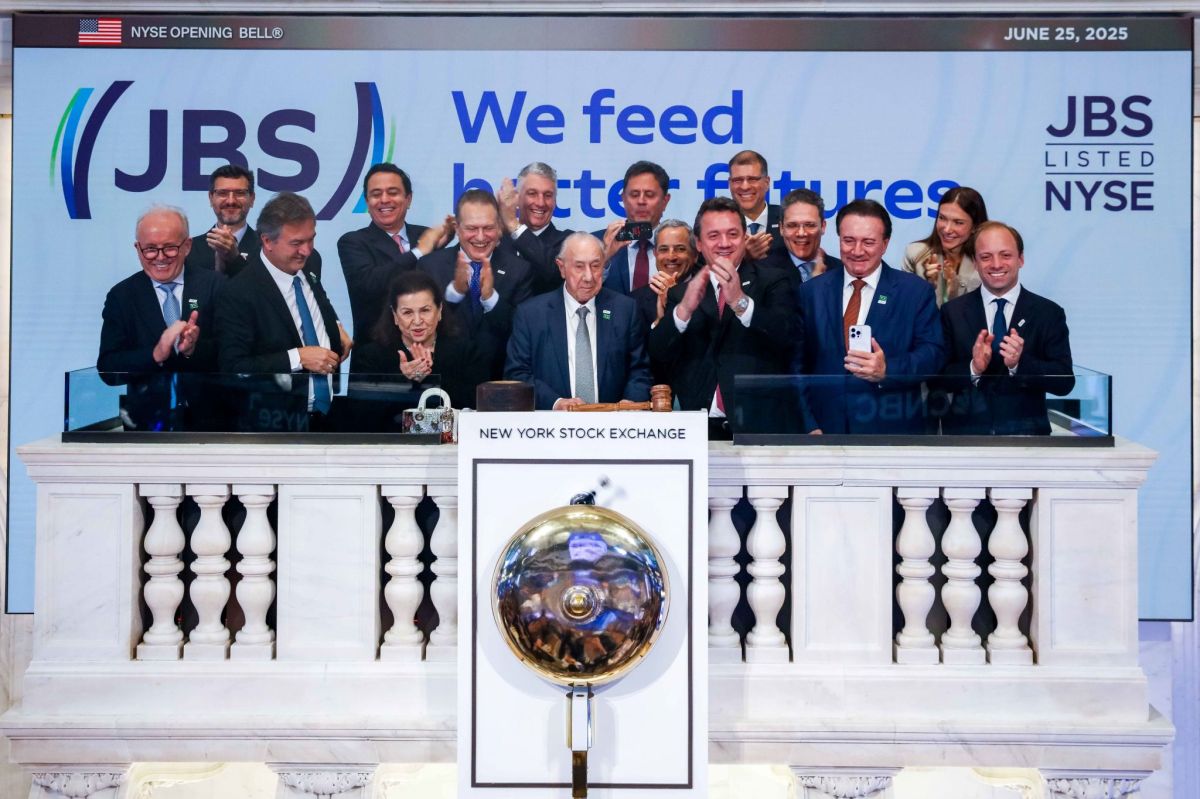
By Brazil Stock Guide – JBS (JBSS3; JBSAY) is entering a new phase in its capital markets story. After securing its U.S. listing and improving its balance sheet, the Brazilian meatpacker is now positioning itself for potential inclusion in the S&P 500 — a move that could unlock billions in passive investor flows.
The roadmap has become clearer following a meeting between BTG Pactual analysts and JBS CFO Guilherme Cavalcanti, which outlined both the milestones already achieved and the hurdles that remain.
The requirements are largely mechanical — but not trivial. To qualify for the S&P 500, JBS must build at least 12 months of trading history in the U.S., consistently file 10-K and 10-Q reports, and sustain a market capitalization above roughly $22.7 billion.
Today, JBS is not there yet. The company is currently valued at around $19 billion, equivalent to roughly R$100 billion, placing it below the minimum threshold required for index eligibility.
Russell comes first
Before reaching the S&P 500, JBS is expected to enter the Russell indexes, potentially as early as June. The Russell indexes — including the Russell 1000 and Russell 3000 — track a broad universe of U.S.-listed companies and are widely used by institutional investors as benchmarks for equity allocation.
In practice, inclusion typically triggers automatic buying from passive funds that replicate these benchmarks. BTG Pactual estimates that flows into JBS shares could reach three to four times the stock’s average daily trading volume — effectively serving as a liquidity and visibility test before a potential S&P 500 inclusion.
Free float constraint
Ownership remains one of the most delicate hurdles. The S&P requires a free float above 50%, a threshold that likely implies a reduction in the stake held by Brazil’s development bank, BNDES, currently around one-fifth of JBS’s capital.
The relationship is longstanding. Through its investment arm, BNDESPar, the bank became a shareholder in 2007, when JBS was still a largely domestic company generating roughly R$4 billion in annual revenue. BNDES — a state-owned lender created to finance long-term economic development in Brazil — played a central role in funding the company’s global expansion, helping transform it into one of the world’s largest protein producers.
But that legacy also comes with influence. BNDESPar is a signatory to JBS’s shareholder agreement and holds veto rights over certain corporate reorganizations — a level of control that goes beyond passive ownership and can complicate efforts to reshape the company’s structure for index eligibility.
In practical terms, reducing that stake is not just a matter of liquidity — it is a governance transition.
More than a checklist
Even if all formal criteria are met, inclusion is not automatic. The S&P index committee retains discretion, evaluating earnings consistency, governance standards, and the strength of the equity story.
Here lies a timing challenge. While JBS has strengthened its financial structure — reducing its cost of debt and expanding its global footprint — its operating cycle is softening. Beef margins in the U.S. remain under pressure, and the poultry cycle is turning, potentially weighing on near-term earnings visibility.
Becoming American enough
JBS would not be the first non-U.S. company to reach the S&P 500 — but those that did effectively became American in structure. Groups like Accenture and Linde only qualified after aligning their listings, governance frameworks and investor base with U.S. standards.
In practice, inclusion is less about where a company operates and more about how it is structured. For JBS, that means evolving from a Brazilian multinational into a stock that global investors treat as a U.S. consumer staple.
The prize is substantial. BTG Pactual estimates that S&P 500 inclusion alone could generate around $3 billion in passive inflows, a scale capable of materially reshaping the stock’s valuation dynamics.
Last week, JBS shares closed above $18, a record level, bringing year-to-date gains to approximately 26%.