By Brazil Stock Guide – Brazil is no longer a victim of rising oil prices — it is increasingly a beneficiary. A new report from BTG Pactual argues the country has undergone a structural shift in its external accounts, with higher Brent prices now improving, rather than deteriorating, its trade balance and current account. In 2026, a $10 per barrel increase in oil prices is estimated to lift Brazil’s trade balance and current account by about $5.9 billion, while a 10% rise in Brent generates a gain of roughly $3.7 billion and reduces the current account deficit by around 0.16 percentage points of GDP.
The turning point dates back to 2016, when Brazil effectively became a net oil exporter. Before that, the country’s external accounts were structurally exposed to higher oil prices, as imports of crude and refined products outweighed exports. In the early 2000s, a $10 increase in Brent would worsen the current account by roughly $1.2 billion. Today, the same shock produces a positive effect of nearly $5.9 billion — the strongest in the historical series.
The mechanics are straightforward but decisive. In the current 12-month rolling window through February 2026, the positive impact is overwhelmingly driven by crude oil exports, which alone contribute about $7.5 billion in a $10/bbl shock scenario. This is partially offset by higher import costs for refined products — especially diesel (-$1.5 billion) and crude oil (-$1.0 billion) — but the net balance remains strongly positive. Brazil’s exposure is now skewed toward exporting high-value crude rather than importing refined fuels.
From liability to hedge
BTG’s analysis shows the shift is not cyclical but structural. In the early 2000s, a 10% increase in Brent widened Brazil’s current account deficit by about 0.05 percentage points of GDP. By 2026, the same shock reduces the deficit by roughly 0.16 percentage points, reflecting the country’s transition into a commodity exporter with meaningful leverage to energy prices. Historical estimates confirm the trend: sensitivity moved from -$0.3 billion to +$3.7 billion under a 10% shock over the same period.
This helps explain why the recent oil rally is reinforcing Brazil’s external position at the margin, even as it raises domestic fuel costs. The trade balance has already been strengthening since 4Q25, driven primarily by higher export volumes — particularly crude oil — rather than price alone. Production gains are now amplifying the price effect.
Production and volumes matter
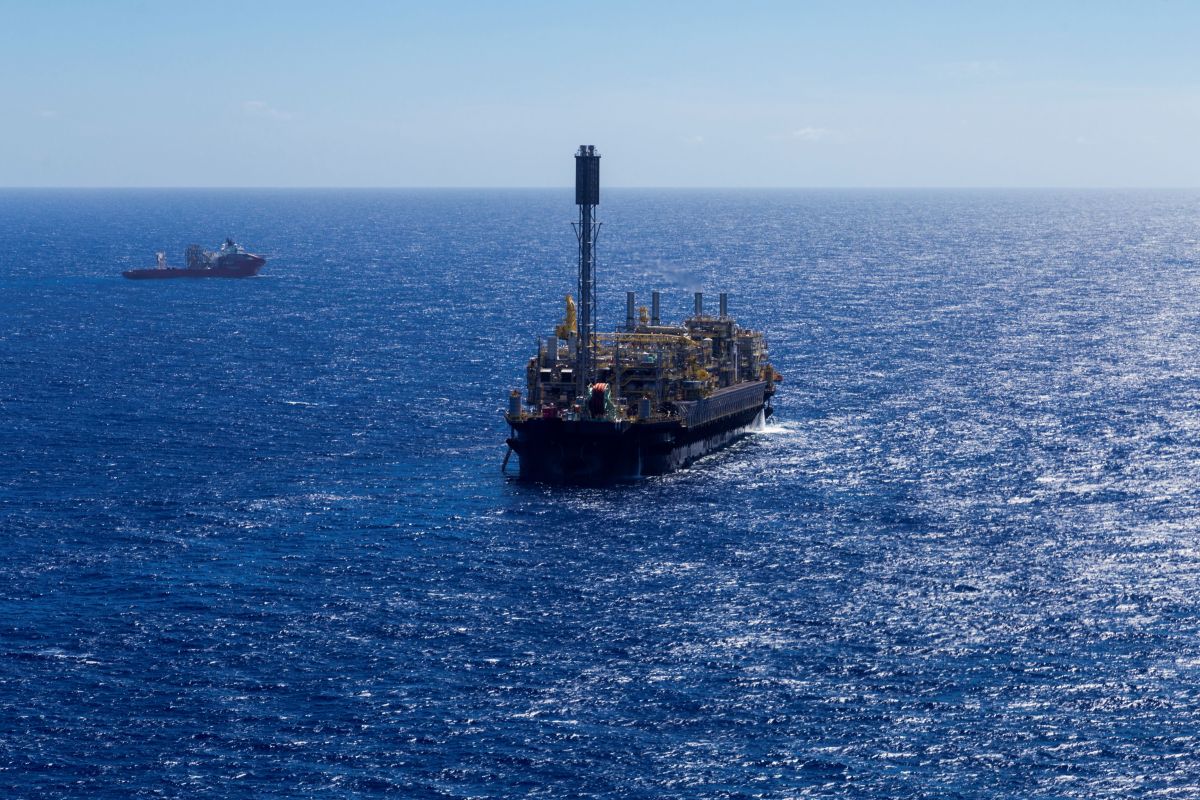
Brazil’s oil output reached around 4.1 million barrels per day in February 2026, a record level. This expansion is feeding directly into export volumes, reinforcing the trade surplus. At the same time, the recent increase in Brent prices has yet to be fully reflected in trade data, given typical lags in pricing and contract adjustments. BTG expects the positive effects to become more visible in the coming months.
The bank projects a $48 billion surplus in the oil and derivatives trade balance for 2026 — a new record — with exports near $78 billion and imports around $30 billion. For 2027, the surplus should remain elevated at roughly $45 billion. Scenario analysis shows how sensitive the outlook is to oil prices: with Brent at $100, Brazil’s total trade surplus could reach about $93 billion in 2026 and $104 billion in 2027. In a more extreme scenario, with Brent at $150, the surplus could rise to $114 billion and $138 billion, respectively. A drop to $70 would pull the surplus down to roughly $80 billion and $85 billion.
Not a pure windfall
Still, the gains are not one-for-one. Higher oil prices also increase Brazil’s import bill for key inputs such as fertilizers and raise global freight costs. BTG estimates that while the oil and derivatives surplus was revised up from $36 billion to $48 billion for 2026, part of that gain is offset by roughly $1.5 billion in higher fertilizer imports. On the other hand, stronger prices for other exported commodities add around $4.5 billion, keeping the overall balance positive.
As a result, BTG revised its forecast for Brazil’s total trade surplus to $90 billion in 2026 (from $75 billion) and $90 billion in 2027 (from $80 billion). The current account deficit is now expected to narrow to 2.3% of GDP in both years, down from 3.0% in 2025.