
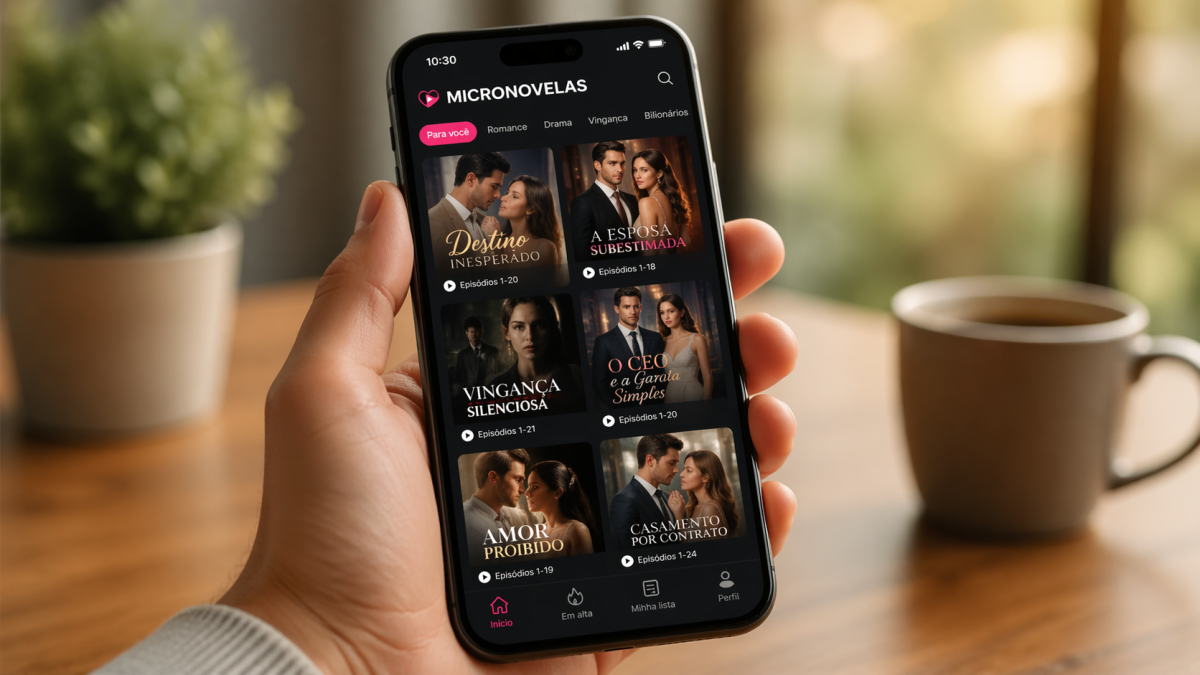
By Rodrigo Uchoa*, special for Brazil Stock Guide
In April 2020, Jeffrey Katzenberg had every ingredient for success. Money, and plenty of it: nearly $2 billion raised from investors including Disney, Comcast and AT&T. Recognisable talent: signed contracts with Hollywood stars, from Idris Elba to Chrissy Teigen. And a vision — that people would watch series and films on their phones, in episodes of up to ten minutes, during those pockets of dead time we all endure: the morning commute, the endless queue, even the elevator ride. The man who ran Disney during the animation renaissance of the 1990s and co-founded DreamWorks was absolutely convinced he had identified the next great leap in entertainment.
The service was called Quibi — short for quick bites. It lasted six months. Operations shut down in December 2020, with around 500,000 subscribers, a figure so far from projections it was almost too embarrassing to print. The content library was sold to Roku for less than $100 million, a tiny fraction of what had been poured in. For the annals of Silicon Valley, it was one of the most spectacular — and, let’s be honest, most instructive — collapses in recent memory.
In hindsight, the problem was never the idea. It was everything around it.

At CES in January 2020, Katzenberg had enthusiastically unveiled Turnstyle, a technology that allowed users to rotate their phone and switch seamlessly between horizontal and vertical formats — the service’s signature technical innovation. It was genuinely clever. But Quibi launched without support for Chromecast or AirPlay, meaning there was no way to watch it on a television. When those features were finally added, Turnstyle simply stopped working — and Turnstyle was, in reality, the only thing that set the service apart from any other video app. Support for Roku and Fire TV arrived too late to matter: one day before the shutdown announcement.
Users also couldn’t take screenshots or share clips on social media. At a time when Baby Yoda — the breakout character from Disney+’s The Mandalorian — was being turned into thousands of memes and, in the process, pulling thousands of new subscribers onto the platform, Quibi had built itself a walled courtyard with no windows to the outside world. For an entertainment service trying to establish itself in a saturated market, the absence of social sharing wasn’t merely a limitation. It was a self-inflicted wound.
Then there was the content itself. Quibi became known for offering mediocre productions that studios and networks had been trying to offload for years. It paid handsomely for names, but never found a hit — none of those series that take over conversations, the ones that make you look good for recommending them. Without its own Stranger Things, its own Mad Men or The Office, Quibi was charging between $5 and $8 a month to compete with TikTok and YouTube, which were free and already overflowing with short-form content shot on smartphones.

And then the pandemic arrived. Quibi had positioned itself as the service for watching on the go — on the subway, during a lunch break, waiting for the bus. By March 2020, nobody was going anywhere. With everyone at home, an app designed to fill “in-between moments” had lost its entire reason for existing before completing its first month on the market.
At the time, Katzenberg blamed the virus. He later walked it back. He eventually acknowledged that pinning it all on Covid wouldn’t be fair. An admirable concession — though it came at a cost of roughly $2 billion.
What makes the Quibi story particularly ironic is that its central premise — that the phone would become the next great entertainment platform — was not wrong. It was right, just attached to the wrong product.
While Quibi was flailing, TikTok surpassed one billion users, Instagram launched Reels, and YouTube responded with Shorts. The formula that worked was not expensive content chopped into ten-minute segments — it was the relentless algorithm, serving videos of fifteen seconds to two minutes, free, viral, and made mostly by ordinary people. The phone won. Just not the way Katzenberg had imagined.For years, the short-form video phenomenon was dismissed by streaming executives as second-tier entertainment — content for teenagers, not for paying subscribers. That contempt began to crack when platforms realised they were losing attention to TikTok at an alarming rate.

The shift is global, and Brazil is no exception. On April 13th, 2026, Globo officially launched GloboPop, an app for short vertical videos offering original content, short-run soap operas, behind-the-scenes footage, news, sports and sketch comedy — all tailored for the mobile screen. The app organises its material into sections called Palcos (stages), dedicated to programmes, artists and partner creators, and serves videos in an infinite personalised scroll. Globo is keen to distinguish GloboPop from a social network: in the words of the company’s head of digital entertainment products, it is “a curated editorial environment where audiences access topics of collective interest, responsibly organised.”
That framing will sound familiar — it is, curiously, not far from the pitch Quibi made to American audiences five years ago. This time, however, the bet is not an isolated gamble: it is the consolidation of a strategy Globo has been quietly building on multiple fronts. UOL is heading in the same direction, but from a journalism angle: UOL Flash brings short videos of the day’s top stories to the company’s app, with information updated in real time. Two different models, one shared conviction — Brazilian users also watch with their phones in hand. And in portrait mode.

On the global stage, Netflix announced in its April quarterly letter that it will launch a vertical video feed on its mobile app by the end of the month — a TikTok-style scroll through clips, designed to help users discover content. According to the company, video podcasts already “over-index” on mobile, meaning users naturally gravitate toward their phones for that type of content, a data point that reportedly drove months of internal debate about redesigning the mobile experience. Disney got there first, rolling out “Verts” on Disney+ in March: a line of short vertical videos produced natively for the format.
Netflix co-CEO Greg Peters has made clear that the ambition extends well beyond clips from existing shows. The company is developing original programming built from the ground up for the vertical format.
There is, of course, a fundamental difference between what Quibi attempted and what Netflix, Disney, Globo and UOL are doing now. Katzenberg wanted to build a new category of premium short-form entertainment from scratch, with no established audience, no existing goodwill, and a subscription fee attached. Those who followed are adapting already-dominant platforms — with vast user bases and deeply recognised brands — to a behaviour that audiences have already demonstrated, loudly and clearly, that they want. It is the difference between throwing yourself at a locked door and realising, five years later, that it opened inward all along.
The phone won. Short vertical video won. Katzenberg bet everything on that in 2020 and lost nearly $2 billion. Today, the biggest entertainment and media platforms on the planet are doing — with larger budgets and considerably more caution — exactly what he envisioned.
He could be forgiven for finding that mildly satisfying.