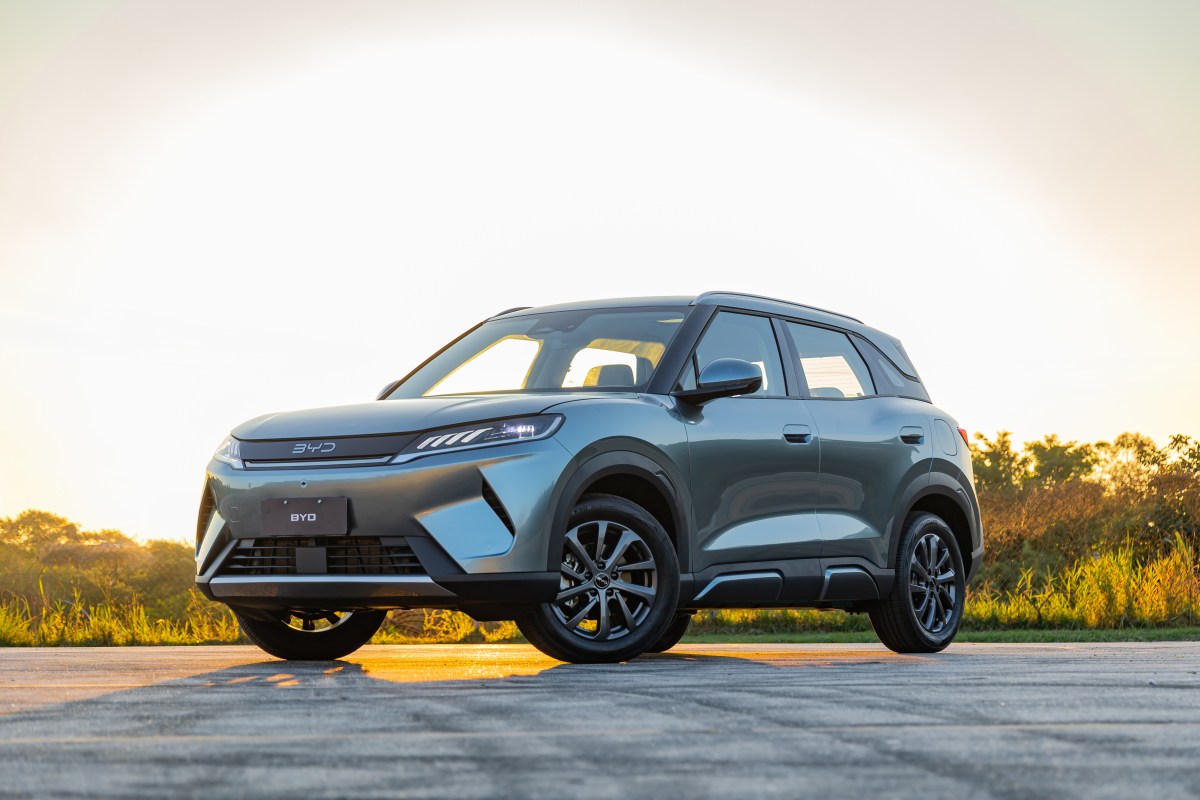
By Brazil Stock Guide — BYD is trying to do more in Brazil than launch another electrified compact SUV. With the Atto 2 DM-i Flex, the Chinese automaker is testing a formula that could reshape its local strategy: combining China’s scale and know-how in electrification with one of Brazil’s oldest competitive advantages — ethanol.
The new model arrives in two versions, GL and GS, with prices starting at R$149,990 for direct sales and R$169,990 at dealerships. The positioning is aggressive. BYD is not targeting only early adopters of electric vehicles or technology enthusiasts. It is moving into the heart of Brazil’s auto market, where compact SUVs, price, range and cost of ownership drive volume.
The core novelty is the flex-fuel DM-i system. BYD’s plug-in hybrid technology is already known in other markets, but adapting it to run on either gasoline or ethanol gives Brazil a different role in the company’s global operation. The car uses the electric motor as the main source of traction most of the time, while the 1.5-liter flex-fuel engine works primarily as a generator, taking over direct traction only under heavier driving conditions.
In practical terms, BYD is trying to sell a bridge between two worlds. For consumers who are still reluctant to depend exclusively on charging infrastructure, the Atto 2 offers a combined range of more than 1,000 kilometers on gasoline in the GS version, according to the NEDC cycle. For drivers with short urban commutes, the same version promises up to 110 kilometers in fully electric mode. Running on ethanol, combined range is expected to reach 770 kilometers.
Those figures should be read with caution. BYD’s range estimates are based on the NEDC standard, which is usually more optimistic than Brazilian testing criteria. Local PBEV/Inmetro numbers have not yet been released. BYD wants to reduce range anxiety without abandoning the appeal of electrification.


The launch also marks a new stage in BYD’s Brazilian business. In recent years, the company gained market share largely through imported electric vehicles, aggressive pricing and a strong technology pitch. Now, it is moving toward a more localized product strategy — not only through its industrial project in Camaçari, Bahia, but also by offering vehicles designed around Brazilian fuel habits, infrastructure constraints and consumer income levels.
That matters. Brazil’s charging network is expanding, but coverage remains uneven outside major urban centers. At the same time, the country has a mature nationwide ethanol infrastructure, and flex-fuel cars have long been part of everyday life for Brazilian drivers. By adapting DM-i technology to ethanol, BYD is not just responding to a local preference. It is trying to turn a Brazilian characteristic into a scalable business advantage.
The move also raises pressure on established automakers. Toyota, Stellantis, Volkswagen, Hyundai, GM and others are approaching the transition with different strategies, often based on conventional hybrids, more efficient flex-fuel engines or gradual electrification. BYD is moving at a different pace, using price, batteries, software and electric architecture to shorten the competitive cycle.
In that sense, the Atto 2 DM-i Flex is less a standalone product than a market-entry weapon. With 4.33 meters in length, a 455-liter trunk and a robust technology package, the model enters a price range where buyers compare not only powertrains, but also space, finish, connectivity and total cost of ownership. The GS version adds a 360-degree camera, panoramic sunroof, ADAS package, Google Automotive Services, a 50W wireless smartphone charger and an 18.03 kWh Blade battery.
There are challenges. The first is operational. BYD still needs to prove that it can turn Camaçari into an efficient manufacturing hub, with progressive localization, quality control, a supplier network and enough scale to sustain aggressive pricing. The second is commercial. The rapid advance of Chinese brands in Brazil has come with intense price competition, frequent discounts and concerns about residual values — a sensitive issue for consumers and dealers.
The third challenge is political and regulatory. Brazil’s auto industry is going through a complex transition, balancing decarbonization incentives, local manufacturing demands, rising import tariffs and pressure for domestic content. BYD wants to capture the green-mobility narrative, but it also needs to convince Brasília, unions and suppliers that its presence will be more than a sophisticated import platform.