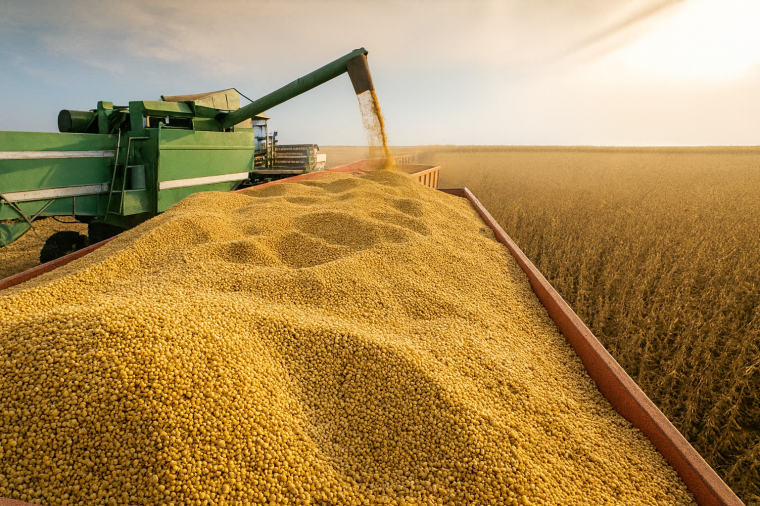

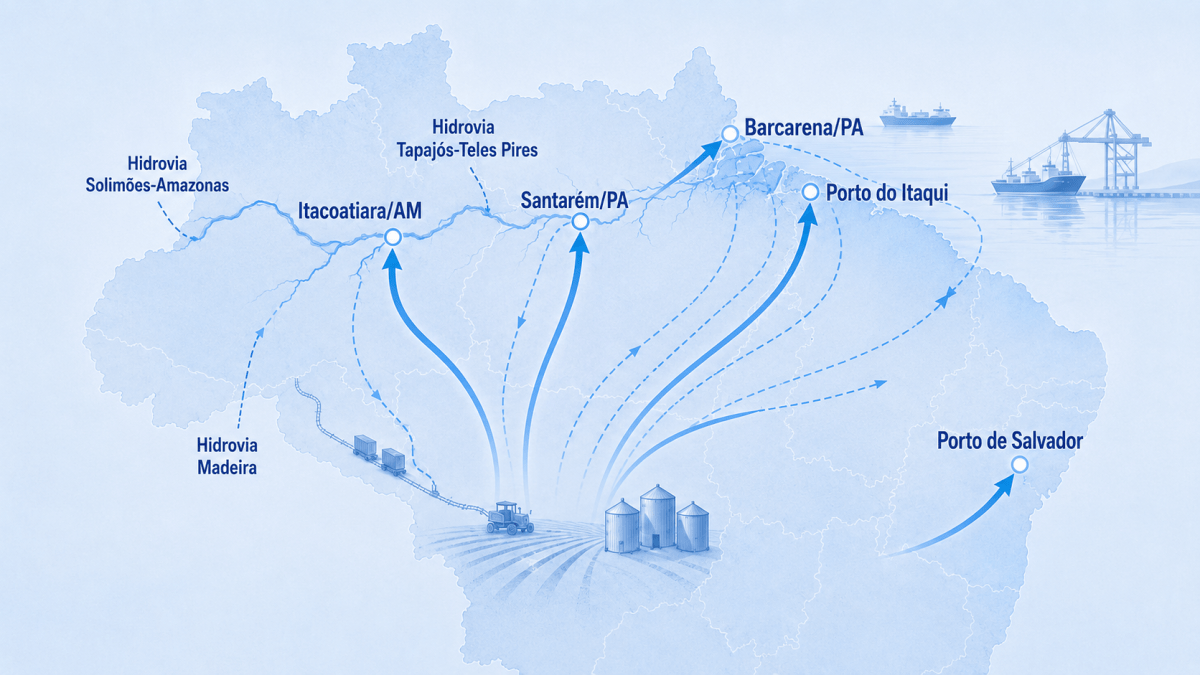
Brazil has found a shortcut to ship its bumper harvests to global markets. Like most shortcuts, it looks appealing on a map but proves more complicated on the ground. According to Conab’s 2026 Agrologistics Yearbook, presented on Tuesday, the Arco Norte corridor — which links Mato Grosso, Matopiba and parts of the Amazon to ports such as Itaqui in Maranhão, Barcarena and Santarém in Pará, and Itacoatiara in Amazonas — already handles almost 40% of Brazil’s soybean and corn exports. Its share reaches 48% in corn and 36.2% in soybeans. Brazil’s agribusiness logistics axis has moved north. So has the risk.
The economic logic behind the corridor is hard to dispute. Grain flows toward the ports while fertilizer returns inland along the same logistics route. This backhaul model improves the economics, shortens distances and boosts the competitiveness of Brazil’s Center-North farm belt. In 2025, Brazil imported 45.5 million tons of fertilizers, and Arco Norte stopped being merely an export corridor to become a gateway for agricultural inputs, surpassing Paranaguá in Paraná. Itaqui alone accounted for 34% of the fertilizer volume brought in through the corridor’s ports. In theory, this is logistics efficiency. In practice, it is the consolidation of a system that works well as long as everything around it cooperates.
The problem is that very little around it is stable. The Arco Norte corridor depends on waterways exposed to severe droughts in the Amazon, roads that remain fragile, heavy investment in ports and transshipment terminals, and a critical input that Brazil still buys abroad. China and Russia remain the main suppliers of fertilizers to the Brazilian market, according to Conab.
In other words, the new efficiency of Brazilian agribusiness is not built on self-sufficiency. It rests on a delicate equation involving climate, incomplete infrastructure and external dependence. Add the expansion of the agricultural frontier into environmentally sensitive areas, and the logistics gain starts to carry a political and territorial cost that is becoming harder to disguise.
Arco Norte is a real competitive advantage — but also an uncomfortable reminder. Brazil has reduced the distance needed to move its wealth; it has not reduced its vulnerabilities. Without more storage capacity, stronger climate resilience, better infrastructure and less dependence on imported fertilizers, the country is simply moving its bottleneck closer to the forest. The North has become more strategic. It has also become riskier.