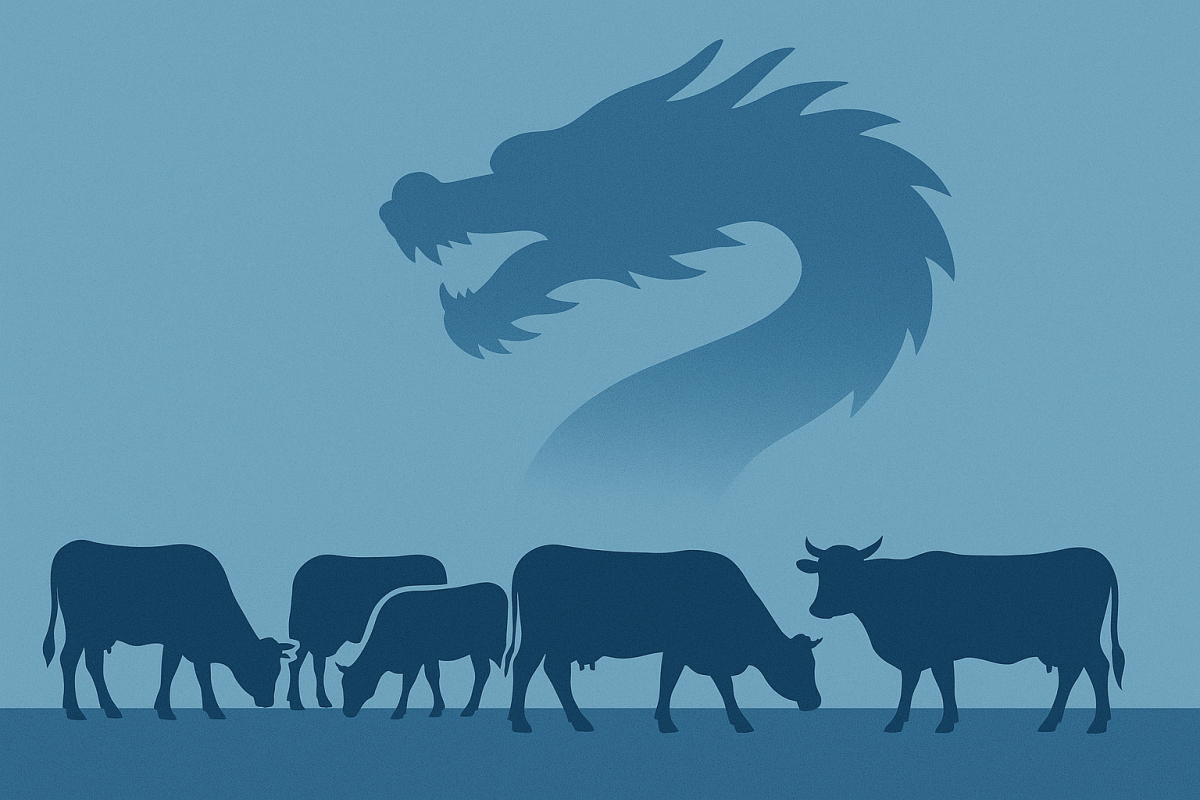
The good news didn’t last long for Brazil’s meatpackers. Barely five days after China publicly announced the end of its poultry ban — imposed following a single bird flu case in southern Brazil — Beijing is preparing a far heavier blow: quotas and anti-dumping measures on Brazilian beef. The official announcement is expected in the coming days, Brazil Stock Guide has learned — a diplomatic bomb disguised as a “technical adjustment.”
China is by far the main destination for Brazil’s protein exports. In beef, JBS, MBRF and Minerva each ship roughly a quarter of their output to the Chinese market — a trade worth an estimated US$ 6 billion to US$ 7 billion so far this year. The dependency is so structural that any tremor in Beijing reverberates through the earnings of Brazil’s largest listed companies. What looked like a gesture of détente on poultry now reveals a broader ambition: less about protein, more about power.
The coming move stems from a safeguard investigation launched by China’s Ministry of Commerce in late 2024, covering beef imports from all major suppliers — including Brazil. The probe follows complaints by Chinese industry groups claiming that surging foreign supply has caused “serious injury” to local producers. It gives Beijing the legal framework to impose quotas, tariffs or other “temporary measures” — the very tools now being prepared for Brazilian beef.
Beyond market protection, the move is designed to shift control from Brazilian exporters to Chinese importers — who will set prices, volumes and trade terms. Officially, the goal is to boost domestic production, stabilize prices and reduce external vulnerability. In practice, it’s a political message — and a sign that Brazil’s beef-export boom may be nearing an inflection point.
At the same time, the United States under Donald Trump is sharpening its knives, preparing new antitrust investigations into global giants such as JBS. On both sides of the Pacific, the rhetoric is the same: “reindustrialize,” “protect,” “bring it home.”
The result is a power play that threatens to splinter the global meat circuit. If confirmed, Beijing’s offensive will mark a new phase of commercial fragmentation — where selling beef also means managing geopolitical risk. For Brazil, the challenge is no longer to sell more, but to keep someone left to sell to.