
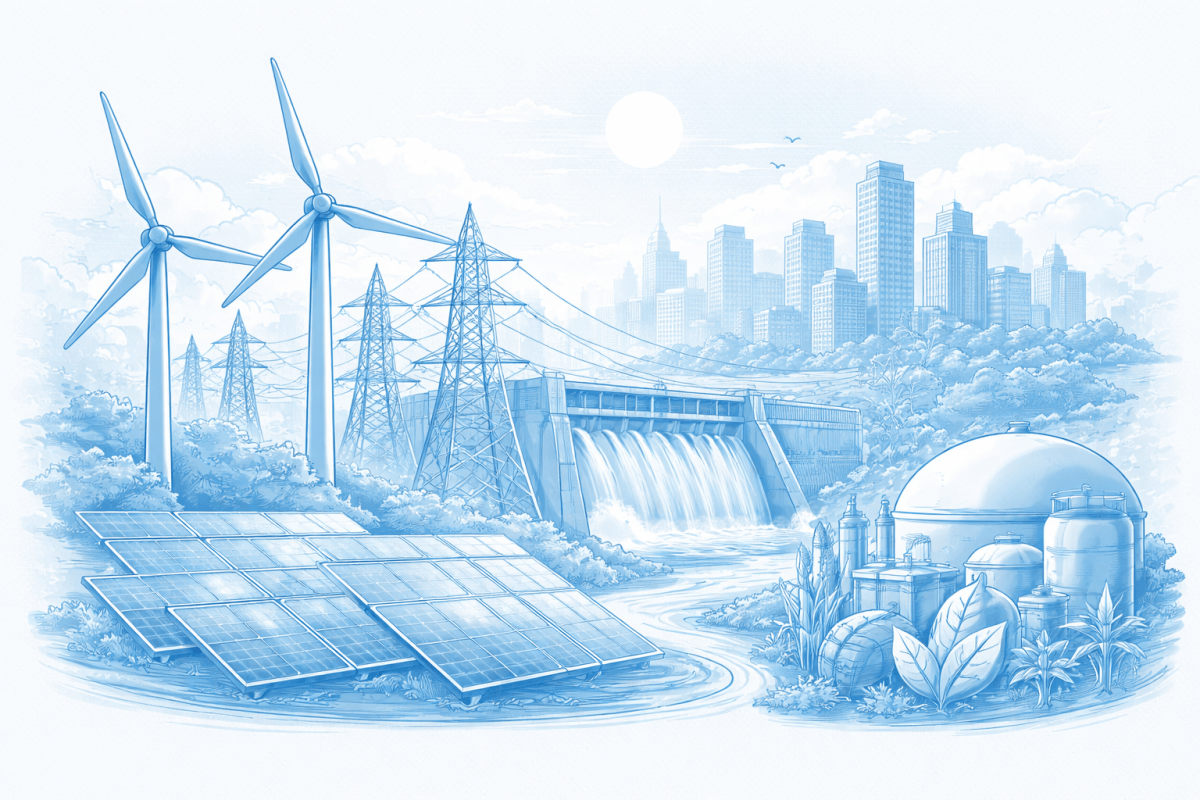
Energy planning has always required an exercise in disciplined foresight. This week, Brazil opened a public consultation for a new cycle of energy planning, reaffirming a principle that is as institutional as it is technical: medium-term expansion must be structured, and long-term choices must be deliberate. The framework rests on two complementary pillars. The Ten-Year Energy Expansion Plan to 2035 (PDE 2035) sets out the most probable trajectory under current policies, detailing projected generation additions, transmission reinforcement, supply security and investment needs. The National Energy Plan to 2055 (PNE 2055), updated every five years, adopts a 30-year horizon and explores multiple scenarios, from accelerated electrification and a declining role for oil derivatives to hydrogen, carbon capture and broader system resilience. Together, they seek to anchor energy planning as a state policy rather than a political cycle.
The organising idea is clear: the energy transition as an instrument of development. Compared with many large economies, Brazil begins with a structural advantage — an electricity mix that is already predominantly renewable. Yet the harder problems lie elsewhere: heavy transport, energy-intensive industry and the continued reliance on liquid fuels. The strategy, accordingly, is twofold — deeper electrification and bioenergy as a competitive edge.
Transitions, however, are not merely technological. They are institutional commitments sustained over decades. The past thirty years offer ample caution. The US shale boom, the precipitous fall in solar costs, financial crises, a global pandemic and renewed geopolitical fragmentation have repeatedly confounded forecasts. Long-term planning in energy must therefore be robust by design. The sector is capital-intensive, infrastructure-heavy and defined by assets whose economic lives span decades. Without a baseline of predictability, investment hesitates — and the system stalls.
Bioenergy illustrates both promise and tension. In theory, it offers a substitution of fossil carbon with carbon circulating within the biological cycle — ethanol, biodiesel, biogas, biomass — particularly compelling in a country with an established agricultural base. In practice, its scale depends on credible governance of land use, environmental integrity and regulatory stability.
Official estimates place Brazil’s renewable potential at roughly 1.6bn tonnes of oil equivalent per year — more than five times the country’s current energy consumption. On paper, abundance is not in question. Converting theoretical potential into real supply, however, demands transmission capacity, long-term financing, regulatory certainty and sustained political coordination.
Climate volatility further complicates the picture. Greater hydrological instability, heatwaves and extreme weather events reshape the calculus. Energy security is no longer solely about expanding capacity; it is about building systemic resilience. Mitigation and adaptation move in tandem. The decisive question is not whether Brazil will precisely forecast 2055. It is whether it can preserve institutional coherence for three decades. Under that lens, the energy transition becomes less a test of prediction than of governance.