
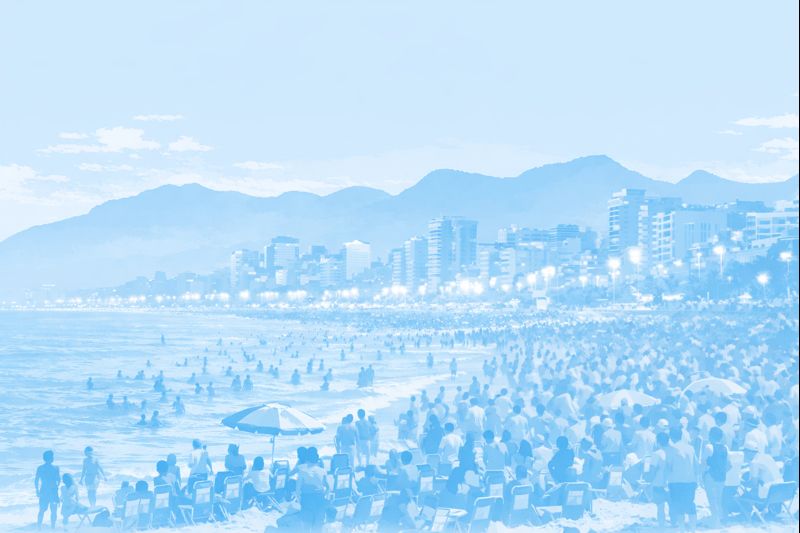
Brazil welcomed more than 9 million foreign tourists in 2025 — an impressive jump from the 6.7 million recorded a year earlier. A 40 per cent increase would be cause for celebration anywhere. But during the southern hemisphere summer, when international arrivals overlap with intense domestic travel, a more structural question emerges as the country edges towards the threshold of 10 million visitors a year.
Once that level is reached, tourism ceases to be merely an industry of promotion and demand generation. It becomes, inevitably, a test of planning capacity. The central debate shifts accordingly: not how to attract more visitors, but how to prevent success from turning into economic, environmental and social friction.
The first trap is to treat volume as a virtue in itself. High-density tourism markets learn early that infrastructure does not scale at the same pace as demand. Airports, urban transport systems, hotel capacity and environmental management are rigid systems, designed for peak stress rather than annual averages. When planning remains anchored in headline figures, bottlenecks appear quickly: overcrowded destinations, cities pushed beyond their limits and the gradual erosion of the very assets that sustain tourism revenues.
This is why effective tourism infrastructure begins where investment is least visible — in what visitors rarely notice. Sanitation, water supply, waste management, energy and digital connectivity must be sized for critical weeks, not typical days. Without that foundation, every new marketing campaign becomes a risk multiplier. Mature destinations understand that a pristine beach loses value without sewage treatment, just as a national park loses economic appeal once pollution enters its rivers and trails.
Concentration compounds the problem. Countries that absorb tens of millions of visitors without diversifying their tourism map end up subsidising their own scarcity. Distributing demand across seasons and regions is cheaper — and more efficient — than endlessly expanding already saturated cities. That requires new products, incentives for off-peak travel and regional integration. These are political choices, not merely commercial ones.
The most sensitive constraint, however, is governance. Physical infrastructure without institutional capacity produces disorder. Tourism municipalities must operate as economic hubs, with clear rules governing land use, pricing, licensing and service provision. When local authority falters, price becomes the default regulator — usually in its most destructive form, through conflict, exclusion or urban decay.
Unsurprisingly, experienced destinations deploy access fees, visitor caps and dynamic pricing not as punishment, but as tools of organisation. Venice and Machu Picchu illustrate the logic. The goal is not higher revenue, but flow management. Tourism at scale is a game of marginal quality: each additional visitor must generate more value than the cost imposed on the system.
For countries crossing the 10 million mark, the lesson is blunt. The relevant question is no longer how many tourists can be attracted, but how many can be absorbed without destroying what made the destination attractive in the first place. Those that grasp this early turn tourism into a durable asset. Those that do not eventually discover that too much tourism is simply another form of scarcity.