
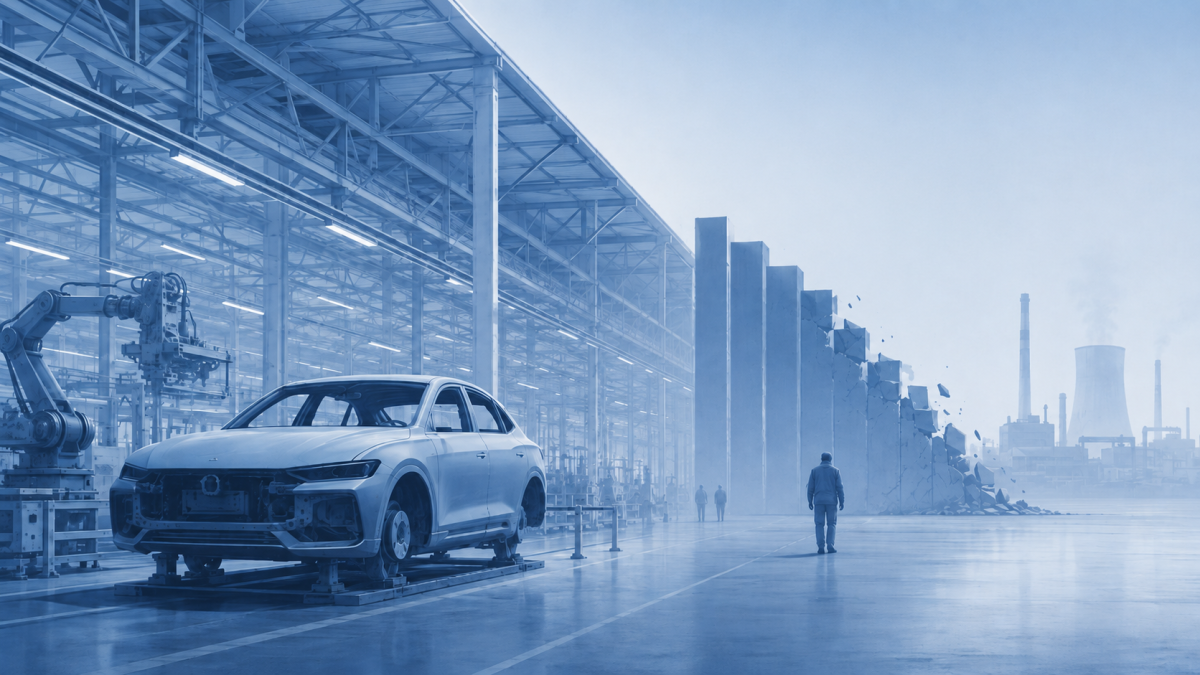
Volkswagen has never been just a carmaker. For decades, it stood as one of the clearest symbols of German industry: engineering, factories, unions, exports, high wages and the welfare state moving together. That is why the plan attributed to VW’s current leadership to cut up to 100,000 jobs — almost one in six workers globally — and end production at four German plants is bigger than a corporate restructuring. It is a sign of the times.
Volkswagen’s problem is not simply that it is selling fewer cars. It is that the world for which it was built is disappearing. The old model — designing, producing and exporting cars from an expensive, unionized and highly protected industrial base in Germany — worked while China was mainly a consumer market. European technical superiority was enough to justify higher prices. Now China is a tougher market, a global competitor and a benchmark in batteries, software, production speed and lower costs.
The shock is complete. Volkswagen is one of Germany’s largest private-sector employers and operates within a power structure shaped by strong unions, works councils, regional political influence and decades of social negotiation. Closing factories in Germany is not like shutting a peripheral unit in some distant market. It means touching the core of the pact that sustained Germany’s postwar prosperity.
That is why the union response matters as much as the number of job cuts. If the plan moves forward, it will not be only a dispute between management and workers. It will be a fight over who pays the bill for Europe’s loss of competitiveness. For shareholders, excess capacity and high costs have to come out of the balance sheet. For workers, each job cut means less income, less protection, less tax revenue and more pressure on Germany’s social state.
Even if the cuts only materialize by 2030, the effects start earlier. A threatened factory changes decisions on investment, consumption and careers. An industrial city at risk loses confidence before it loses jobs. Suppliers adjust, young people rethink technical careers and local governments start facing a weaker tax base. In that sense, Volkswagen’s crisis raises an uncomfortable question: can Germany’s welfare state survive if the industry that helped finance it shrinks?
The irony is that Volkswagen still knows how to build cars. The problem is that the market has learned to build them differently. China has shortened cycles, changed the scale of production and turned batteries, software and cost into industrial weapons. Volkswagen is trying to respond by selling assets, simplifying structures, seeking partners and reducing capacity. But the question is no longer whether VW can cut costs. The question is whether old industrial Germany can still fit into the new global car market.
What About VW in Brazil?
In Brazil, the picture is less bleak than in Germany, but the local operation is not immune to the same competitive shock. Volkswagen enters 2026 with strong volumes, leadership in Brazilian retail sales, a 13.3% market share from January to May, and products well aligned with local tastes, such as the Polo, T-Cross, Tera, Nivus and Saveiro. That performance helps push back against any immediate reading of a local crisis. But the Chinese offensive has already started to reshape the Brazilian market through its most sensitive point: price. BYD, GWM, Chery and other brands do not need to overtake VW in volume in the short term to pressure its margins and the perceived value of its cars.
Brazilian unions also know this script. In previous cycles of adjustment in the auto industry, pressure from global headquarters eventually reached local factories through labor negotiations, layoffs, temporary furloughs or threats of cuts. Brazil does not appear to be Volkswagen’s global problem. But it is no longer a safe harbor either.