
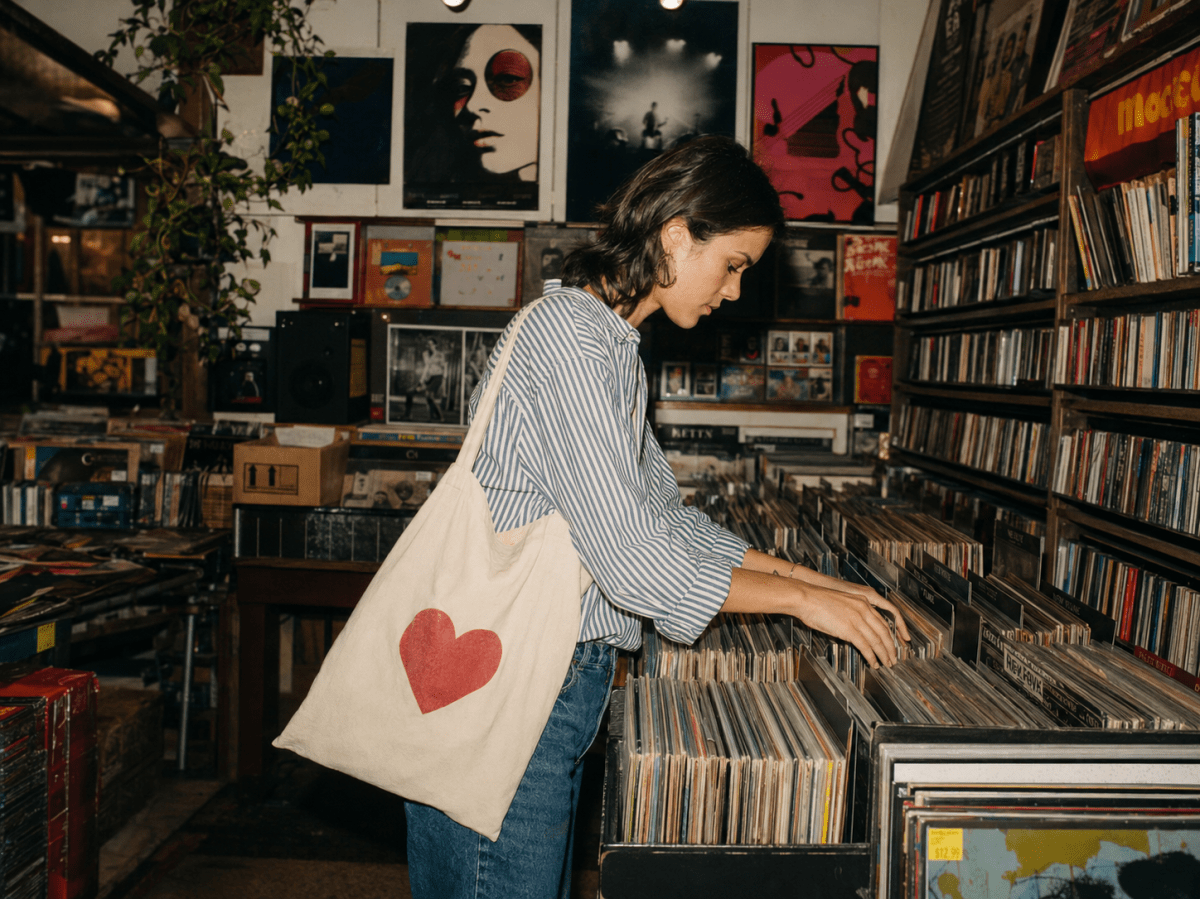
Olivia is 17, owns a smartphone with a cracked screen she has not bothered to fix, and maintains a collection of records — CDs and vinyl — that is growing at a pace that moderately concerns the household budget. On a Saturday afternoon, she can be found rummaging through the stalls of the Edifício Maleta gallery in central Belo Horizonte, a building in Brazil’s third-largest city where second-hand record shops and salgadeiros — the local equivalent of a snack bar — share floors with the occasional holdout tailor. She is looking for a specific LP, not necessarily to play it, but because the cover art is beautiful and would look well on the shelf beside the turntable she received for her birthday. The previous week she was in São Paulo’s Liberdade neighbourhood, the historic Japanese quarter, hunting through stationery shops for notebooks with good paper and pens that “actually write”. She came back with three physical manga volumes that already exist digitally, free, one click away.
The camera she carries in her pocket is an Olympus Stylus 35mm her mother had kept in a box since the 1990s. Olivia found it, bought a roll of film on the Brazilian equivalent of eBay, and now produces photographs that take days to develop, come out slightly out of focus and carry that grain that no Instagram filter can faithfully replicate. She posts the photographs on Instagram. The irony, she acknowledges with a sideways smile, is not lost on anyone.

What is lost on many adults, however, is that Olivia is not eccentric. She is, by all available evidence, perfectly representative of her generation.
Researchers have a name for the phenomenon that drives Olivia and millions of young people like her around the world: anemoia. The term was coined by writer John Koenig in his project “The Dictionary of Obscure Sorrows” and describes a nostalgia for an era one never lived through — a longing without memory, a grief for experiences that existed before you did. A 19-year-old in London, interviewed by researchers mapping the phenomenon, put it with disarming precision: “I’m nostalgic for a time when I was present, when my generation was between five and ten years old and still did things in the real world. I don’t remember what I watched yesterday on TikTok, but I remember what I did years ago, when I didn’t have a phone.” She paused. “That seemed like a better time.”
The feeling has acquired measurable scale. In 2025 alone, more than 11.7 million posts on Instagram carried the hashtag #nostalgia. Google searches for “90s movies” have doubled since 2015. Interest in Y2K aesthetics — low-rise jeans, tinted sunglasses, flip phones — surged 891 per cent since November 2024. A generation that barely lived through the twentieth century has developed a considerable longing for it.
It would be tempting to dismiss all this as passing aesthetic, another microtrend born and destined to die on TikTok. The numbers, however, insist on telling a different story.
Start with the most visible evidence. Vinyl sales in the UK climbed from 4.3 million units in 2019 to 6.7 million in 2023. Until recently, experts attributed this market to nostalgic forty-somethings and middle-aged men who never quite got over the 1980s. Not any more. Data now points clearly to the 16-to-24 age group as the primary driver. In the United States, more than 46 million vinyl records were sold in 2024. In 2025, American vinyl revenue exceeded $1 billion for the first time since 1983 — the nineteenth consecutive year of growth, and the first time annual revenue crossed that threshold since Ronald Reagan was in the White House.

There is a revealing detail buried in these figures. According to the 2023 Luminate entertainment report, Generation Z is 27 per cent more likely to buy vinyl than the average music consumer. And half of vinyl buyers in the United States do not own a turntable. They are purchasing the record as object — as an artefact of identity, a piece of décor, a token of fandom.
Beyond vinyl, there is a constellation of converging signals. Sales of instant cameras — Polaroid and its equivalents — rose 15 per cent in 2024. Physical book sales are growing, driven in no small part by the same generation that could read everything on a screen. British magazine i-D returned to newsstands with a relaunch explicitly shaped around Gen Z’s appetite for “tangible and collectible” media. Generation Z is 33 per cent more likely than the general population to buy an artist’s merchandise. The Ziggy Stardust T-shirt Olivia wants to buy appears to carry more emotional weight for her than it ever did for her father, who actually grew up listening to Bowie.
And then there are wired headphones. After five consecutive years of declining sales, driven by the dominance of wireless earbuds, purchases of corded headphones exploded in the second half of 2025, with revenue running 20 per cent above the previous year in early 2026. The audience pulling hardest at this reversal? Young people. The great irony is that Apple judged the wired headphone sufficiently obsolete to eliminate the headphone jack from the iPhone in 2016 — a decision that provoked outrage at the time and was swiftly normalised. The cable is now returning as a symbol of something not yet fully named, but which might be called a certain kind of unpretentious purism.
There is a structural irony in all of this that young people themselves readily acknowledge. The renaissance of analogue photography is, for instance, a social media phenomenon. The hashtags #filmisnotdead and #believeinfilm have tens of millions of posts on Instagram. Tutorials on developing film at home proliferate on YouTube. Shops selling vintage cameras have found much of their customer base through TikTok. The analogue has been popularised digitally — and the digital distribution of analogue results creates a feedback loop that draws in still more converts.
When this contradiction is pointed out to Olivia, she finds it less troubling than her interlocutor does. “I use Instagram to show the photos, not to create them,” she explains, with the impatience of someone accustomed to explaining obvious things to adults. “They are different things.”
Researchers studying the phenomenon reach the same conclusion. This is not a rejection of technology as such. It is, as one recent study put it, “a small act of protest to reclaim something the generation considers its own.” Generation Z is simultaneously using AI to prepare study flashcards for an organic chemistry exam and developing film at the local photography lab. For this generation, that is not incoherence — it is curation.
It is on the question of AI-generated content, however, that the aversion becomes most visceral, most nearly ethical. Ask Olivia what she thinks of AI-generated posts on social media. She visibly shudders. “You can tell,” she says, with a grimace. “And it’s horrible. It feels fake.”
This is not a rejection of AI as a tool — she uses ChatGPT to summarise biology texts and Claude to edit essays. What troubles her is something more specific: using AI to simulate human connection in a space where human connection is precisely the point.
The data suggests she is far from alone. A 2025 survey found that 63 per cent of Generation Z view AI as potentially inauthentic, and more than 70 per cent express specific concerns about AI-generated content on social media. A Goldman Sachs survey from August 2025 was more direct still: 54 per cent of young people prefer zero AI involvement in creative work. For comparison, only 13 per cent feel the same way about online shopping. The implication is tolerably clear: AI may recommend products, but it may not write poetry or impersonate a person.
Data from July 2025 shows that 32 per cent of American and British consumers say AI is negatively disrupting the creator economy — a figure that stood at 18 per cent in 2023. The pace of the shift is itself a data point.
A recent analysis captures the paradox well: “This is not a rejection of AI. Generation Z is the generation most likely to use AI for productivity, writing and research. It is a rejection of synthetic authenticity — the use of AI to simulate human connection in a context where genuine human creativity and vulnerability are the primary currency of trust.” The distinction Olivia makes intuitively — AI for chemistry, not for feelings — appears to be a distinction widely shared.
They are not Luddites. They are selective.

It is tempting, and wrong, to frame all of this as a movement against modernity. Those buying vinyl have not cancelled their Spotify subscriptions. Those shooting on film have not smashed their iPhones. Those who prefer paper notebooks still use Google Docs for schoolwork. The “Offline Club”, founded in Amsterdam as a phone-free social community, has expanded to 19 cities — but people find out about its events on Instagram.
What is happening is more subtle. This is a generation that grew up inside the digital system, understands its mechanisms of attention capture with the fluency of a native speaker, and is now finding ways to introduce deliberate friction. There is a demand for the mild inconvenience of having to turn a vinyl record over to hear side B, of waiting days for a photograph, of writing by hand, of untangling a cable.
A 2024 Pew Research survey found that nearly half of American 13-to-17-year-olds — 48 per cent — now view the effects of social media as mostly negative. Two years earlier, that figure was 32 per cent. And 44 per cent have already actively reduced their smartphone use. The analogue, in this context, is less nostalgia than reaction — a response to a life that feels excessively automated.
The market followed the signal faster than analysts expected. The global social-media-blocking app sector — yes, applications designed to block applications, a mise en abyme that Jorge Luis Borges would have found professionally interesting — is projected to grow from $1.47 billion in 2025 to $5 billion by 2035. Digital detox cabins are proliferating across the English countryside. Phone-free festivals sell out months in advance.
Back to Olivia. At the end of a Saturday afternoon in central Belo Horizonte, she leaves the Edifício Maleta gallery carrying a Talking Heads CD and a Caetano Veloso vinyl from the 1970s. At home, before putting either on, she opens her laptop and spends 40 minutes with Claude sorting out the final details of an organic chemistry assignment. The AI performs its role with efficiency, but without affection. Then she gets up, puts on the record and turns up the volume. No screen, no algorithm, no recommendation as to what she should listen to next. The vinyl here is not regression. It is, in its crooked and analogue way, an act of freedom.
This article drew on research from Luminate, the Pew Research Center, Goldman Sachs, the Vinyl Alliance, the RIAA, SoundGuys and Fortune, among other sources. It was adapted into English by the author, for whom it is not a first language, with assistance from Claude — which, in the circumstances, felt appropriate. And it had Olivia as its real, and sentimental, inspiration.