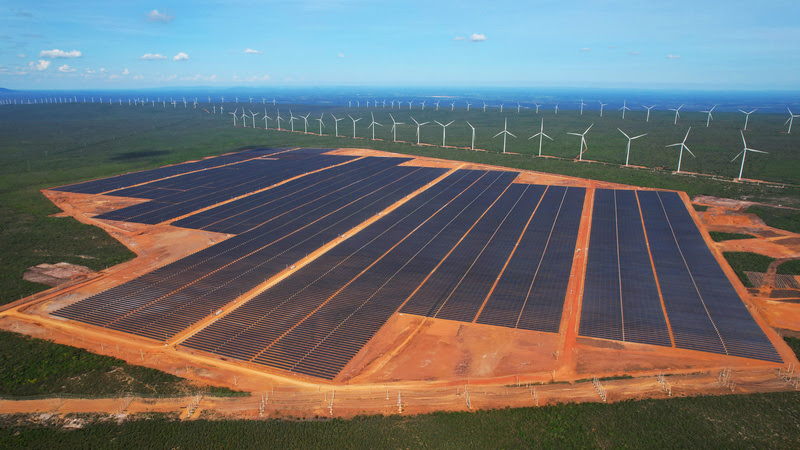
By Brazil Stock Guide – ArcelorMittal (NYSE: MT) has completed a R$5.8 billion renewable energy investment cycle in Brazil with the start-up of a new solar plant at the Babilônia Centro complex in Bahia. The facility, located in Várzea Nova and developed in partnership with Casa dos Ventos, has installed capacity of 200 MW and required approximately R$700 million in capital. The project marks the final step in a broader strategy that added roughly 1 GW of installed capacity to the company’s energy portfolio in the country, as it targets increasing renewable self-generation from 61% to 85% by 2030.
Industrial scale
The move goes beyond sustainability optics. As one of Brazil’s largest electricity consumers, ArcelorMittal is effectively reshaping its cost structure and reducing exposure to power price volatility. The Babilônia Centro complex now operates as a hybrid asset, combining wind and solar generation on shared infrastructure — a model that improves asset utilization and delivers a more stable and predictable energy output throughout the day.
Hybrid optimization
Before the solar addition, the wind farm at Babilônia Centro had already entered commercial operation in 2025. With the new solar unit, total investment in the complex reached R$4.8 billion and installed capacity rose to 753.5 MW. Around 90% of the energy generated will be directed to ArcelorMittal’s industrial operations, while the remainder will be sold into Brazil’s power market, creating an additional revenue stream.
Capital efficiency
The decision to integrate solar capacity within an existing wind complex was primarily financial. By leveraging pre-existing infrastructure — including substations, transmission lines and grid connection — the company minimized incremental capital expenditure while maximizing return on invested capital. The hybrid model also reduces idle capacity by balancing wind and solar output, enhancing efficiency for an energy-intensive business.
The R$5.8 billion package also includes the ArcelorMittal Energia Paracatu solar project in Minas Gerais, which received R$895 million in investments. Combined, the three assets position the company at a new level of energy self-sufficiency. For ArcelorMittal, the payoff is not just environmental. In a sector increasingly shaped by cost discipline, decarbonization pressures and global competition, access to cleaner, more predictable and internally generated energy is becoming a structural competitive advantage.