Special Issue
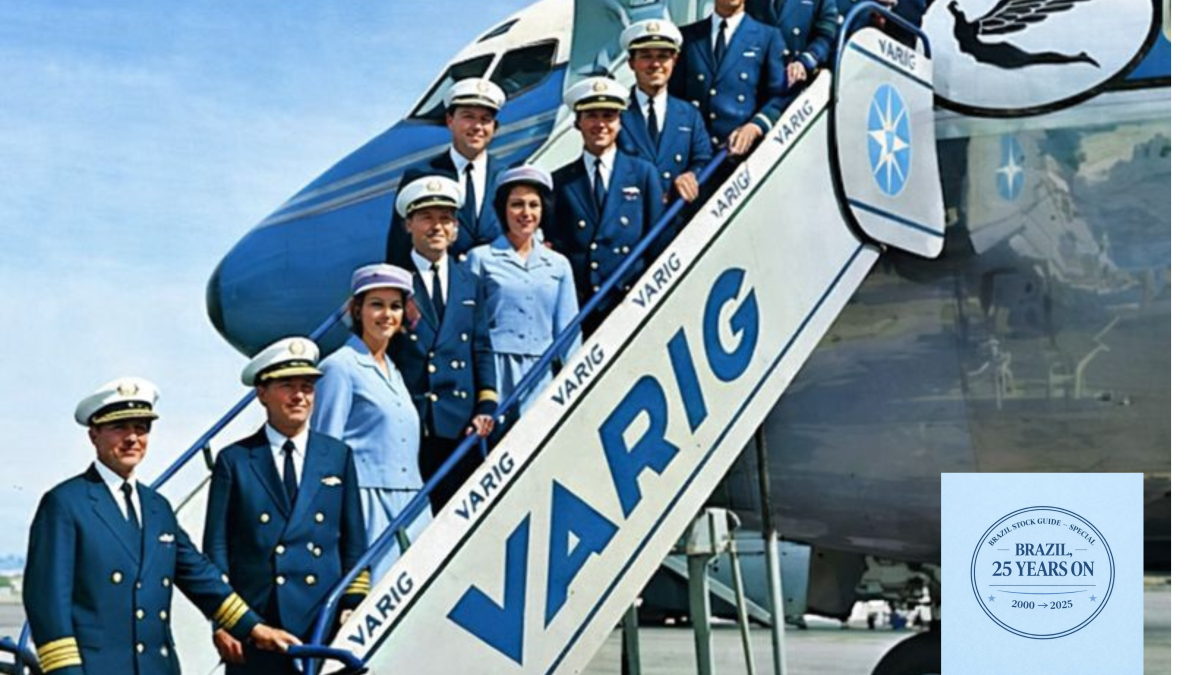
By Brazil Stock Guide – Varig was founded in the late 1920s as an airline and remained one of Brazil’s most emblematic aviation companies throughout much of the 20th century. It expanded aggressively from the 1960s onward, benefiting from government protection and a long-standing monopoly on international air routes.
For decades, the airline symbolized national ambition and a state-backed industrial policy. When Brazil began opening its markets in the 1990s and exposing protected sectors to competition, Varig proved unable to adapt. Burdened by high costs, a weak capital structure and delayed restructuring, the company collapsed. Today, Brazil still has three major airlines—but all of them operate with some degree of foreign capital exposure: Latam, Azul and Gol.
Varig’s disappearance is not an isolated case. For decades, names such as Embratel and Eletropaulo were embedded in the daily lives of Brazilians, present in phone bills, electricity accounts and essential infrastructure. In the ranking of Brazil’s largest companies in 2025, those names are gone—although many of their underlying assets remain active under different corporate umbrellas.
A comparison between the 2000 and 2025 rankings, compiled by Brazil Stock Guide using public data and corporate financial statements, reveals an intense process of consolidation that reshaped entire sectors and erased some of the most recognizable brands of Brazilian capitalism.
This transformation is closely linked to the liberalization agenda launched in the 1990s. Trade opening, privatizations and regulatory reform reduced protection for domestic industrial champions and exposed Brazilian companies to global competition. The shift was not abrupt. It was structural—and its effects became more visible over the following decades, as nationally controlled brands steadily lost ground in manufacturing-intensive sectors, while multinational groups and foreign capital expanded their presence.
At the start of the century, Brazil’s corporate landscape was still populated by independent companies with a domestic focus and strong public identities. Twenty-five years later, many of those brands did not fail outright—they were absorbed. Petrobras Distribuidora became Vibra; Texaco was incorporated into Ultrapar. Embratel and Brasil Telecom disappeared as standalone companies after telecom consolidation. Eletropaulo was folded into a foreign-controlled group. GPA split its operations, giving rise to Assaí as a separate business.
This wave of consolidation also reflected deeper changes in Brazil’s macroeconomic environment. Persistently high interest rates, currency volatility and recurring economic crises raised the cost of capital and penalized companies with fragile balance sheets. Groups with access to long-term financing, scale and financial discipline gradually took control of their industries.
The profile of capital shifted accordingly. The state reduced its dispersed presence and concentrated its role in strategic sectors such as oil and energy. Foreign capital expanded its footprint in areas backed by tangible assets, concessions and predictable cash flows. Survival became less about brand legacy and more about financial scale and balance-sheet strength.
The result is a more concentrated, less fragmented—and less sentimental—form of capitalism. The 2025 ranking shows that the companies that endured were those capable of adapting to liberalization, consolidation, financial discipline and global integration. The first quarter of the 21st century did more than reorganize Brazil’s corporate elite. It redefined what it takes to remain relevant in the Brazilian economy.

Brazil’s 25 Largest Companies
Comparison: 2000 vs 2025 – Net Revenue (R$ billions)
| Rank | 2000 – Company | Revenue 2000 | Sector (2000) | 2025 – Company | Revenue 2025 | Sector (2025) |
| 1 | Petrobras | 49.1 | Oil & Gas | Petrobras | 490.8 | Oil & Gas |
| 2 | Petrobras Distribuidoraᵃ | 16.1 | Oil Derivatives | JBS | 417.0 | Food & Protein |
| 3 | Volkswagen | 10.2 | Vehicles & Parts | Raízen | 255.2 | Oil & Gas |
| 4 | Furnas | 9.3 | Electric Power | Vale | 200.0 | Mining |
| 5 | Telefônica SP | 9.0 | Telecom | Vibraᵃ | 172.3 | Oil Derivatives |
| 6 | Ipirangaᵇ | 8.9 | Oil Derivatives | Cosan | 169.3 | Oil & Gas |
| 7 | Shell | 8.9 | Oil Derivatives | Marfrig | 148.9 | Food & Protein |
| 8 | Telemarᶜ | 8.5 | Telecom | Ultraparᵇᵍ | 133.5 | Oil Derivatives |
| 9 | Embratelᵈ | 7.3 | Telecom | Grupo Carrefour Brasil | 115.6 | Retail |
| 10 | Pão de Açúcarᵉ | 7.2 | Retail | Cargill | 109.2 | Agribusiness |
| 11 | Carrefour | 7.1 | Retail | Ambev | 89.5 | Food & Beverages |
| 12 | General Motors | 7.0 | Vehicles & Parts | Stellantisᶠ | 79.2 | Vehicles & Parts |
| 13 | Embraer | 6.7 | Vehicles & Parts | Braskem | 77.4 | Oil & Gas |
| 14 | Fiat Automóveisᶠ | 6.4 | Vehicles & Parts | Assaí Atacadistaᵉ | 73.8 | Retail |
| 15 | CVRD (Vale) | 6.4 | Mining | Bunge Alimentos | 69.8 | Agribusiness |
| 16 | Texacoᵍ | 6.2 | Oil Derivatives | Gerdau | 67.0 | Metals & Steel |
| 17 | Brasil Telecomʰ | 6.2 | Telecom | ArcelorMittal Brasil | 66.6 | Metals & Steel |
| 18 | Eletropaulo Metropolitanaᶦ | 5.9 | Electric Power | Copersucar | 62.3 | Bioenergy |
| 19 | Itaipu Binacional | 5.8 | Electric Power | Mercado Livre | 61.5 | Retail |
| 20 | Bunge Alimentos | 5.4 | Food | BRF | 61.4 | Food & Protein |
| 21 | Varigʲ | 5.3 | Air Transport | Telefônica Brasil | 55.8 | Telecom |
| 22 | Essoᵏ | 5.2 | Oil Derivatives | Shell Brasil | 55.0 | Oil & Gas |
| 23 | Correios | 4.5 | Services | COFCO International | 53.3 | Agribusiness |
| 24 | Cemig | 4.5 | Electric Power | Rede D’Or | 50.6 | Healthcare Services |
| 25 | Cargill | 4.2 | Food | Neoenergia | 49.0 | Electric Power |
Sources: Audited company financial statements and disclosures, CVM regulatory filings, historical nominal company-reported financial series.
Notes – consolidation and corporate transformations (2000–2025)
- Petrobras Distribuidora was privatized and rebranded as Vibra.
b) Ipiranga was acquired and incorporated by Ultrapar.
c) Telemar’s assets were consolidated into Oi.
d) Embratel was privatized and later acquired by Claro.
e) GPA (Grupo Pão de Açúcar) completed a spin-off, creating Assaí Atacadista as a standalone company.
f) Fiat Automobiles became part of Stellantis following the FCA–PSA merger.
g) Texaco’s assets were incorporated by Ultrapar.
h) Brasil Telecom’s assets were incorporated into Oi.
i) Eletropaulo’s assets were acquired by Enel São Paulo (Enel-SP).
j) Varig filed for bankruptcy and ceased operations.
k) Esso sold its Brazilian assets to Raízen.