
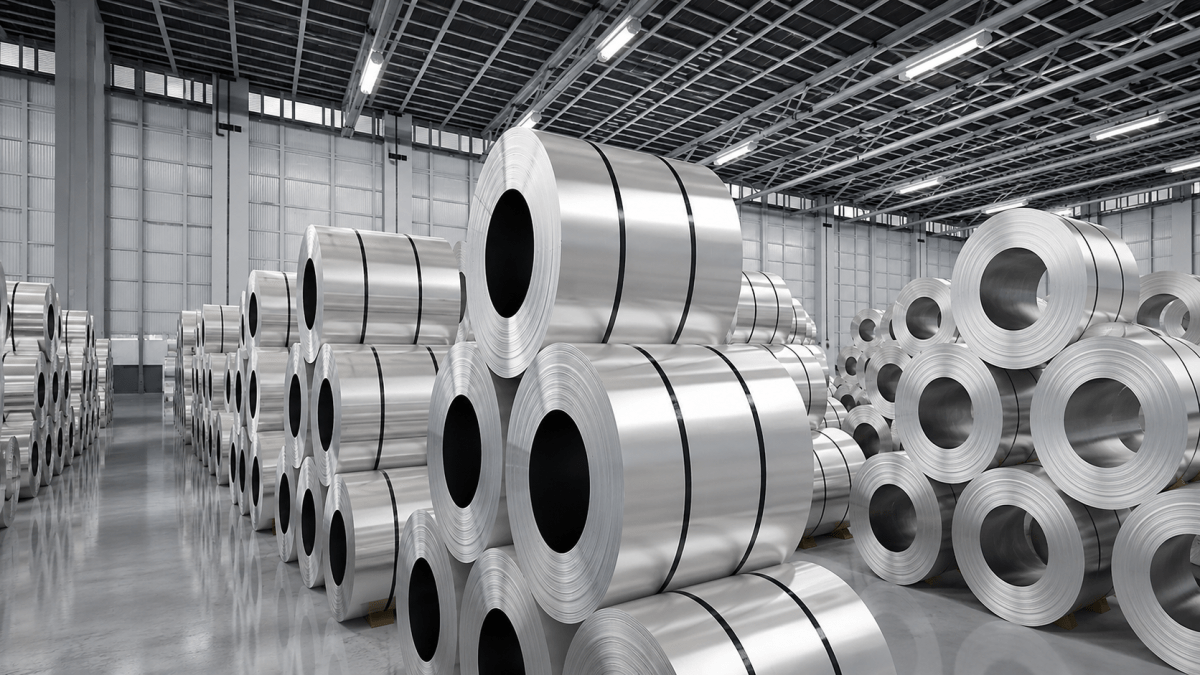
By Brazil Stock Guide – Brazil’s government has rejected a request for reconsideration filed by the Brazilian Steel Packaging Association, known as ABEAÇO, and upheld definitive anti-dumping duties on imports of metallic steel sheets from China. The decision effectively preserves an important layer of trade protection for Companhia Siderúrgica Nacional (CSNA3), or CSN, Brazil’s main domestic producer of the input used in metal packaging.
Gecex Resolution No. 905, published in Brazil’s Official Gazette, fully dismissed ABEAÇO’s appeal against a 2025 decision that imposed anti-dumping duties for up to five years. The measure applies to carbon steel sheets less than 0.5 millimeter thick, a product used in the production of metal cans and other industrial packaging.
Method dispute
The dispute was technical, but the economic implications are clear. ABEAÇO argued that Brazil’s trade-remedies department, DECOM, had used an inadequate methodology to calculate the anti-dumping duty, especially by choosing the period known as P1 as the benchmark for a “no-injury” scenario when estimating price undercutting by Chinese imports.
In the association’s view, other periods in the investigation could also have been treated as periods without dumping and, therefore, might have led to a lower duty. Baosteel, one of the Chinese companies involved in the case, supported that interpretation and argued that the choice of P1 artificially inflated the adjusted domestic price, increasing the duty applied.
DECOM rejected the argument. The authority said the period used to analyze dumping is different from the period used to assess injury. It also said the choice of P1 was based on the fact that it came before the first significant increase in Chinese imports, which rose 106.9% from P1 to P2 and affected the financial and operating indicators of the domestic industry.
Causality question
ABEAÇO’s second line of argument focused on causality. The association said the opening of another anti-dumping investigation involving imports from Germany, Japan and the Netherlands raised doubts about the conclusion that CSN’s injury had been caused by Chinese imports.
The government also rejected that claim. According to DECOM, imports from other countries may have contributed to the deterioration of CSN’s indicators, but that does not eliminate the causal link between Chinese imports and the injury suffered by the domestic industry. In practical terms, the authority said China does not have to be the only source of injury to justify the measure. It is enough for Chinese imports to be one relevant cause.
Costs downstream
The decision highlights a clear divide across the supply chain. On one side, CSN argues that anti-dumping duties are necessary to restore fair conditions of competition and neutralize the impact of imports sold at prices considered unfair. On the other, companies that use the input argue that the measure raises production costs and increases their dependence on a concentrated domestic market.
Spaal, one of the companies heard in the proceeding, made that point directly. The company said domestic production of metallic steel sheets is concentrated in a single supplier, with high prices, rigid commercial terms and minimum order volumes that are incompatible with its needs. For Spaal, imports are a necessary alternative to keep its operations competitive.
CSN’s regulatory win
For CSN, the decision is a regulatory victory. It keeps a barrier in place against Chinese products in a segment where foreign competition had been identified as a source of pressure on domestic prices and margins.
For metal-packaging manufacturers, however, the ruling keeps alive concerns over costs and supply. The decision suggests that, at least for now, Brazil’s trade-defense policy has prevailed over arguments about the impact of the measure on downstream users of the input.
The case also shows how anti-dumping decisions can work as a form of industrial policy. While they protect local production against practices deemed unfair, they can also shift costs to sectors that rely on the protected product as a raw material. In the case of metallic steel sheets, that tension remains unresolved — with one clear short-term conclusion: CSN’s trade protection remains firmly in place.