By Brazil Stock Guide – The investigative arm of Brazil’s antitrust watchdog has recommended that a group of construction companies and individuals be found liable for an alleged cartel in railway infrastructure contracts, reviving a long-running case tied to some of the country’s most important logistics projects.
The General Superintendence of CADE, Brazil’s competition authority, said the alleged cartel operated in public tenders run by Valec, the former state-owned rail engineering company, for works on the North-South Railway and the East-West Integration Railway, known by its Portuguese acronym FIOL.
The contracts under investigation involved civil works, bridges, viaducts, rail infrastructure and engineering services. According to CADE, the affected tenders were worth R$ 9.7 billion.
The recommendation is not a final conviction. The case now goes to CADE’s administrative tribunal, where a commissioner will be appointed to report on the matter before the panel makes a final decision. Companies found liable could face fines and other penalties under Brazil’s competition law.
The case matters beyond the potential fines. It offers a rare look at how Brazil’s old model of large public infrastructure contracts allegedly worked, according to the antitrust authority: through market-sharing agreements, bid suppression, cover bids, coordinated consortia and exchanges of competitively sensitive information.
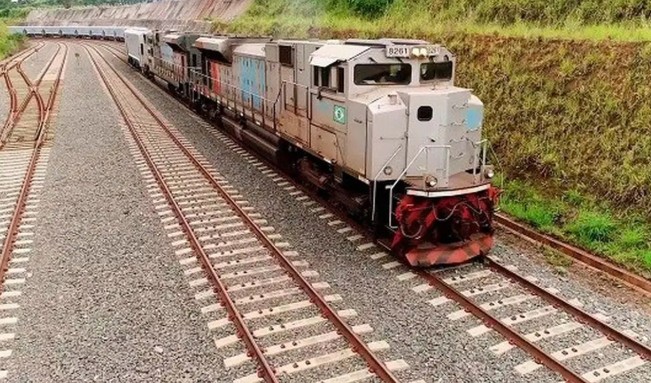
The railways involved are central to Brazil’s effort to reduce its dependence on roads and lower the cost of moving grain, minerals and industrial cargo.
The North-South Railway is one of Brazil’s main inland rail spines. It was designed to cut through the country’s interior, linking producing regions in the North, Center-West and Southeast to ports and other rail corridors. Its route includes states such as Maranhão, Tocantins, Goiás and São Paulo, making it a strategic axis for cargo flows from agricultural and mining regions.
FIOL has a different geography. It is an east-west corridor intended to connect inland Bahia to the Atlantic coast, especially the Ilhéus and Porto Sul region. It is also designed to link with the country’s central rail network, helping move cargo from western Bahia and neighboring regions to export terminals.
In other words, the case involves two of Brazil’s most politically and economically important rail ideas: one railway built to stitch the country together from north to south, and another created to carry inland cargo eastward to the Atlantic.
Old process
According to CADE’s technical note, the alleged cartel was implemented between 2000 and 2014, with roots dating back to the 1980s. The agency said the arrangement evolved over time, becoming more complex as new companies joined and public works were divided into lots.
CADE said that, before 2000, Valec favored one company through restrictive clauses in tender notices, creating conditions for anti-competitive practices. Between 2000 and 2002, seven companies allegedly began market-sharing agreements in North-South Railway tenders, with support from Valec, according to the technical note.
The next phase, from 2003 to 2008, is described by CADE as the consolidation of the cartel. During that period, as railway works expanded, the participants allegedly created what became known as a “periodic table” to allocate lots among companies and reduce real competition in public tenders.
That phrase is the most striking element in the case. In CADE’s account, the “periodic table” was not a metaphor for confusion. It was a tool used to organize the division of public works among rivals that were supposed to be competing against one another.
From 2009 to 2014, CADE said the cartel expanded to involve 39 companies. The agency said the expansion benefited from tender rules that allowed consortia and subcontracting, especially in works related to the North-South Railway and FIOL. In CADE’s view, the different phases formed a single anti-competitive arrangement marked by the systematic allocation of projects and the restriction of competition in public procurement.
The conduct described by the watchdog includes price-fixing, coordination of commercial conditions, agreements not to participate in certain tenders, market division, formation of consortia among competitors, suppression of bids, submission of cover bids and exchanges of sensitive information.
CADE’s General Superintendence recommended convictions for dozens of companies, including Acciona Construccion, Agis/Ferreira Guedes, Andrade Gutierrez Engenharia, CR Almeida, Constran, Barbosa Mello, Cowan, Sanches Tripoloni, Convap, Egesa, Fidens/FDS, Galvão Engenharia, Iesa, Mendes Júnior, Ourivio, Pelicano, Pedrasul, Salgueiro/Delta, Serveng, Servix, Techint, Tecnimont/Maire, TIISA, Tonioli Busnello and Trier, among others.
The authority also recommended liability for 17 individuals, though it did not amount to a final ruling. Their responsibility will still be assessed by CADE’s tribunal.
The technical note also separates defendants for which CADE’s investigative arm said the evidence was insufficient. It recommended closing the case against companies including Embratec, Paviservice, S.A. Paulista de Construções e Comércio, Somague Engenharia and Top Engenharia, as well as several individuals, citing a lack of enough evidence to establish participation in the alleged conduct.
Settlements also shaped the outcome. CADE said four cease-and-desist agreements were signed during the investigation, based on separate collaborations negotiated in parallel and approved by the tribunal in the same session. A fifth agreement was later signed.
For Coesa, the current name of the former OAS construction company, the General Superintendence recommended closing the case because the company fulfilled its settlement obligations and contributed to the investigation.
For Álya, the current name of the former Queiroz Galvão, and Carioca Christiani Nielsen, the investigative arm recommended keeping the case suspended until all obligations under their settlements are fully met.
One sensitive point involves CNO, the current name of the former Construtora Norberto Odebrecht. CADE’s investigative arm recommended a review of whether the company may have breached its cease-and-desist agreement, leaving a separate front open in the case.
The process also includes Pedrasul Construtora, which is under judicial reorganization, in a separate but related proceeding. CADE said the case was split off because of a procedural error involving the identification and notification of another company.
CADE’s General Superintendence also ordered the public version of its report to be sent to the Federal Public Prosecutor’s Office attached to CADE and to Brazil’s Federal Engineering and Agronomy Council. That could open the door to consequences beyond the antitrust case, although any further steps would depend on other authorities.
The case reaches CADE’s tribunal as Brazil is trying to present railways as a central part of its next infrastructure cycle. Successive governments have promoted rail projects as a way to reduce freight costs, improve export logistics and make the country less dependent on trucking.
But the recommendation by CADE’s investigative arm puts an uncomfortable legacy back in view. According to the watchdog, some of the same rail projects now seen as essential to Brazil’s logistics future were shaped, in part, by an alleged long-running system to divide public works and limit competition.