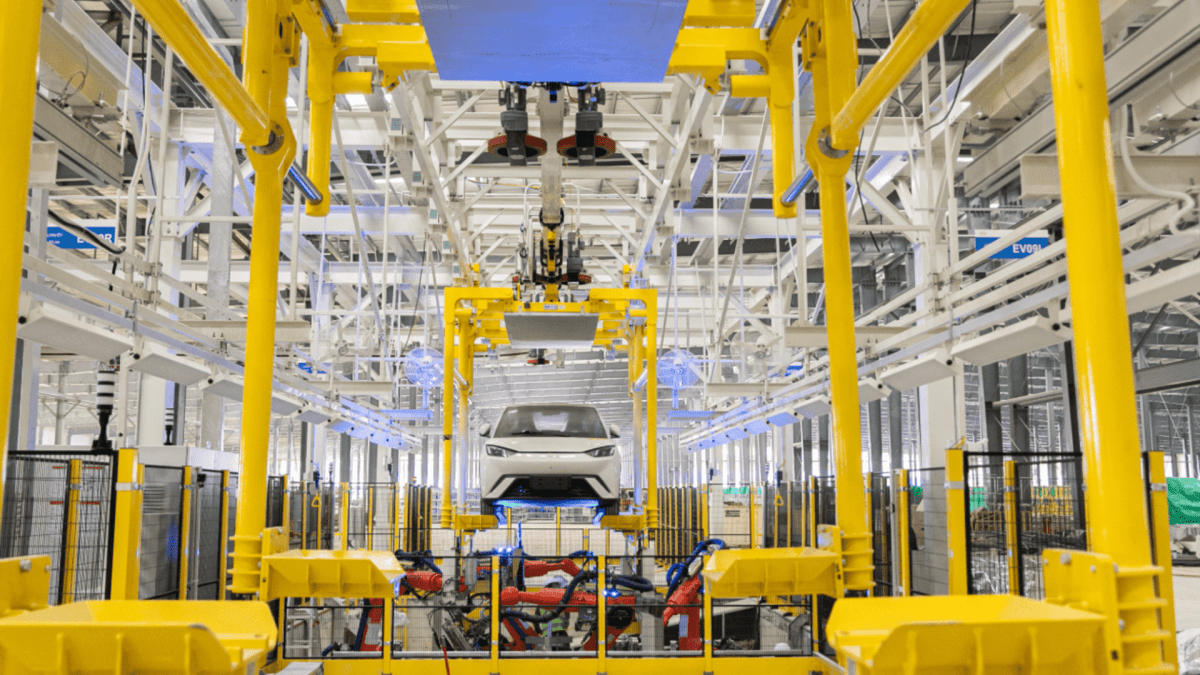
By Brazil Stock Guide – Chinese automaker BYD Co. is inaugurating its new manufacturing complex in Camaçari, Bahia, on Thursday (Oct. 9), marking the largest industrial investment in Brazil since the pandemic — R$5.5 billion (US$950 million). Built from scratch on the site once occupied by Ford, the facility signals the return of large-scale car manufacturing to northeastern Brazil and the rise of BYD as a dominant force in Latin America’s fast-growing EV market.
President Luiz Inácio Lula da Silva, Vice President Geraldo Alckmin, BYD Chairman Wang Chuanfu, and top cabinet officials are attending the ceremony at 11:30 a.m. The plant will start producing 150,000 electric and hybrid vehicles per year, with capacity to expand to 300,000 in a second phase — making it the company’s largest industrial complex outside Asia.
The 4.6 million-square-meter site integrates three major operations: production of electric and plug-in hybrid cars, trucks and bus chassis, and battery-materials processing involving lithium and iron phosphate. The facility will initially assemble vehicles under the SKD (Semi Knocked-Down) system and gradually move toward full local production — including stamping, welding, and painting — starting in 2026.
BYD has already hired 350 employees and expects to reach 2,000 in the coming weeks. Once fully operational, the complex could generate up to 20,000 direct and indirect jobs, according to government estimates. “It’s an extraordinary boost for the economy, trade, jobs and income — and it strengthens Brazil’s role in global technological development,” said Rui Costa, Minister of the Civil House.
Production begins with the BYD Dolphin Mini, currently Brazil’s best-selling EV with over 34,000 units sold, alongside the Song Pro and King plug-in hybrids. During the ceremony, the company will unveil the world’s first plug-in hybrid flex vehicle, designed jointly by Brazilian and Chinese engineers to run on any mix of ethanol and gasoline — a technological adaptation aimed at BYD’s regional expansion.
Construction began in March 2024, with the first of 26 planned facilities already operational. The site has obtained I-REC certification, guaranteeing that 100% of its electricity comes from renewable sources, in line with Brazil’s low-carbon transition goals.
The Bahia project cements BYD’s position as the largest EV and hybrid manufacturer in the world and deepens its decade-long presence in Brazil, where it already operates plants in Campinas (SP) and Manaus (AM). Since 2022, the company has sold over 170,000 vehicles in the country and expanded its dealership network to more than 200 stores nationwide, targeting 250 outlets in the coming months.
BYD’s expansion underscores a shifting industrial balance: while legacy automakers like Volkswagen, Stellantis, and Toyota race to catch up, BYD is betting on local production and ethanol-compatible technology to anchor Brazil as its strategic hub for Latin America.