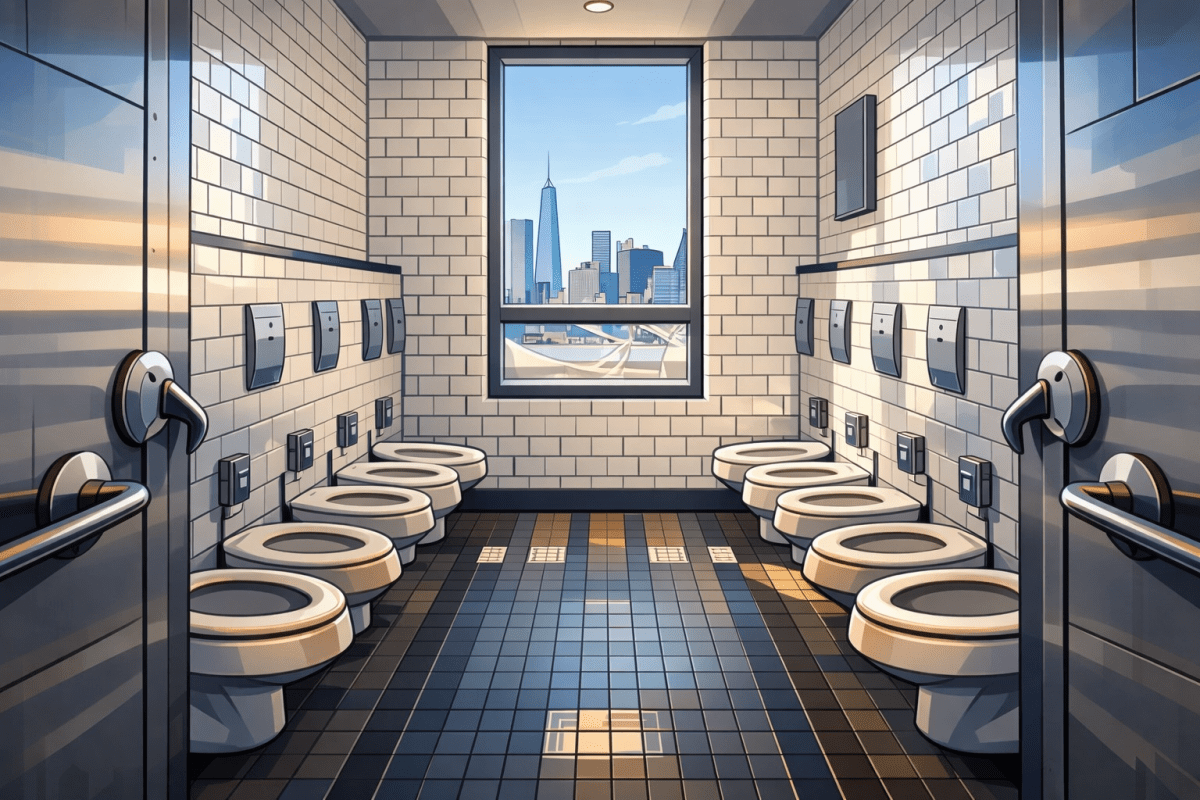
It might have remained nothing more than a footnote in the couple’s travel memories — one of those stories that begins with “remember that hotel in London?” — if thousands of other guests around the world weren’t quietly accumulating the same story. Until someone decided enough was enough.
Sadie Lowell is an American marketer based in Europe, well-acquainted with the peculiarities of international hospitality. In 2024, she travelled to London with her father to see a show. She booked a twin room and walked in to find no bathroom door whatsoever — not even a panel of optimistic glass. For someone who had spent years absorbing the hotel industry’s more creative approaches to the concept of privacy, this was the moment the tolerance ran out. Years of mild inconvenience curdled, quite suddenly, into productive fury.

By October 2025, bringbackdoors.com was live. The premise was straightforward: a crowdsourced database of hotels catalogued by the degree of bathroom privacy they actually provide. The site currently lists over 300 hotels offering what Lowell classifies as “50% privacy” — glass doors with walls — and more than 400 properties offering no privacy at all: no door, no wall, or a wall with a window, which is arguably worse. The worst offenders, in her taxonomy, are those where guests must leave the room entirely whenever nature calls.
The site became a media phenomenon. “This is beyond my wildest imagination,” Lowell told CNN. “Part of me wondered: will people actually care about this? And the traction we’re getting tells me yes — a lot of people care.”
A caveat is warranted here. Lowell is a marketer, and a good one: the site is well-built, the messaging is sharp, and the “name and shame” mechanic for offending hotels has an instinctive feel for virality. None of that invalidates the cause, but it does help explain how the absence of a door — an object whose primary purpose was settled some time around the Bronze Age — became an international news story. A sign of the times, certainly. But one that arrived in exceptionally good packaging.
The global fallout has been, in places, unintentionally hilarious. Britain’s Guardian dubbed it the “bathroom door scandal,” deploying that particular register of British irony that implies both genuine horror and theatrical detachment. The Wall Street Journal ran a feature on the trend in early 2026. CNN covered it. Fox News covered it. Publications in Israel, Germany and Japan covered it. Stand-up comedians found rich material in what amounts to the ultimate stress test of any relationship — using the bathroom in full view of a partner. Or, worse, in full view of a work colleague on a business trip. “My husband went to Vegas for a convention,” one Reddit user posted in a travel forum. “He was sharing a room with some guy he barely knew. No bathroom door.” The post required no further elaboration.

Humanity, it turns out, has its limits.
To understand how we arrived here, it helps to take a few steps back.

The shift came in the early 2000s, with the rise of the boutique and lifestyle hotel, which positioned design as its primary competitive advantage. Architects and interior designers discovered that glass and open-plan layouts created the illusion of space — a particularly valuable illusion in London, New York or Tokyo, where every square metre carries a price that would make a Victorian land baron faint. According to Sarah Stacey, founder of her namesake interior design firm, sliding barn doors and glass panels are simply easier to standardise: when you’re building hundreds of identical rooms, a sliding door that covers any doorway eliminates the need for precise measurements. Less precision, less labour, less cost. Multiplied across three hundred rooms, the arithmetic begins to make sense on a developer’s spreadsheet.
The industry’s official case rests on environmental logic: sealing off a windowless room means guests run up the energy bill and leave maintenance crews changing bulbs. Concrete and timber are expensive. Glass opens the space to natural light. This argument lands rather better in a slide deck for investors than it does at eleven o’clock at night, when your travelling companion is scrolling through their phone on the other side of what turns out to be a very optimistic piece of tinted glass.
The problem, of course, is that this cost calculation is being made in a market that bears no resemblance to the one that existed twenty years ago.
The global hotel sector is projected to generate around $455 billion in revenue in 2025 — an impressive headline figure that conceals a reality of compressed margins and competition of a kind the industry has never faced before. Airbnb now operates across more than 220 countries, with 8.1 million listings and a user base exceeding 275 million. PwC projects RevPAR — revenue per available room, the industry’s standard health metric — to grow by a mere 0.8% for traditional hotels in 2025. In an industry grappling with rising operational costs, that is, for practical purposes, stagnation.

For the traveller, the result is an embarrassment of choice. A full apartment in Paris with a kitchen, unpredictable neighbours and the sensation of actually inhabiting a city? Airbnb. A bed-and-breakfast in Edinburgh where the proprietor serves scrambled eggs and asks after your family in an accent that alone is worth the trip? Booking.com handles it. A chain hotel with loyalty points, a concierge and a gym operational at six in the morning for reasons that remain unclear? Marriott Bonvoy. Each option comes with its own trade-offs, of course: Airbnb has no room service; the B&B has no pool; and the boutique hotel has a glass panel where the bathroom door used to be, along with an architectural rationale for its absence.
The question that Lowell’s movement poses — with its elegant combination of genuine grievance and well-executed public relations — is precisely how much of that trade-off travellers are prepared to accept. In other accommodation formats, the absence of certain comforts is tacit and essentially contractual: nobody expects a uniformed porter at an Airbnb. But hotels carry a different historical promise. The transaction involves infrastructure, standardisation, predictability. And, historically, a door.

Perhaps, twenty years from now, the doorless bathroom will simply be another thing that people have quietly incorporated into their definition of acceptable. An evolutionary adaptation. A new normal.
For now, the growing volume of submissions on bringbackdoors.com suggests we are still in the early stages of that adjustment. And that there is something stubbornly, perhaps wisely, human about the refusal to surrender a door. After all, what separates us from the animals, the philosophers remind us, is reason, language, and self-awareness.
And a bathroom door that actually closes.