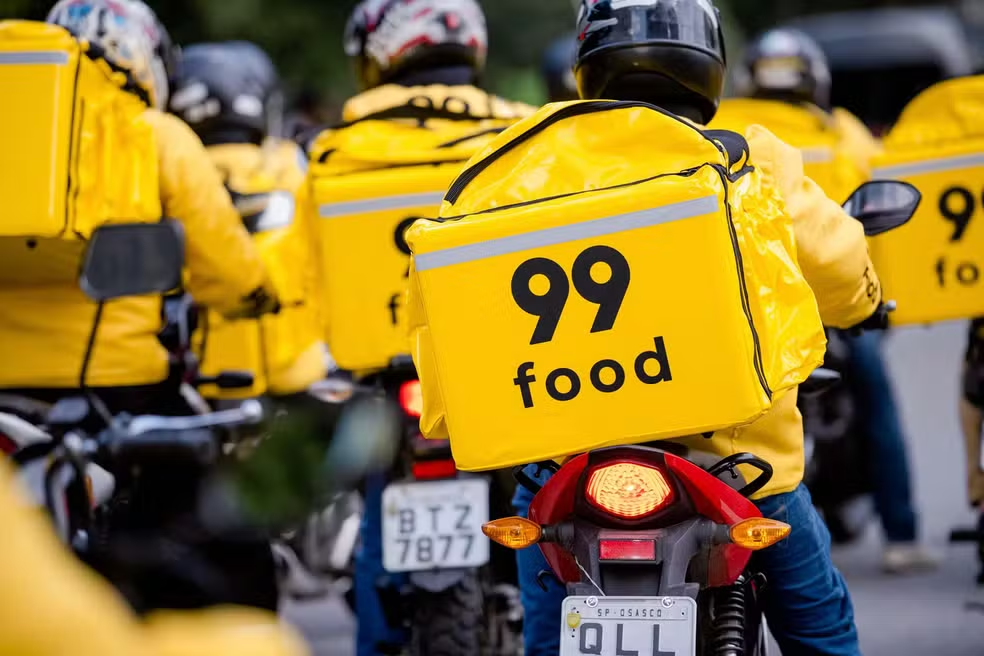
By Brazil Stock Guide – The rivalry in Brazil’s food delivery sector intensified as Keeta filed a new complaint with Brazil’s antitrust regulator, the Administrative Council for Economic Defense (Cade), against 99Food, a unit of China’s DiDi Global Inc. (DIDIY). The filing, reported by O Globo, asks Cade to prohibit 99Food from signing exclusive contracts with restaurants, arguing that a company executive “confessed” to anti-competitive conduct during an interview.
Keeta, backed by Chinese tech giant Meituan (3690.HK), claims 99Food’s exclusivity deals amount to a “ban clause” preventing restaurants from joining rival platforms. The dispute adds to the legal battles between the two companies, after a São Paulo court recently struck down the exclusivity terms that restricted restaurants from partnering with Keeta in exchange for lower fees.
Executive remarks spark legal escalation
In an interview with O Globo following the court decision, 99Food’s communications director Bruno Rossini defended the company’s stance, saying its practices are “legal and fully compliant with regulatory norms.” He added that exclusivity contracts—partial or total—are necessary to “break market inertia” in a sector where iFood controls about 80% of the delivery market.
“We’re protecting the space we’ve built,” Rossini said. “If we don’t do that, there will be a flood of companies entering the 20% that isn’t iFood’s.”
Keeta’s lawyers cited this statement as “a clear confession” of anti-competitive intent. In their submission to Cade, they wrote that “99Food admits, in plain terms, that the purpose of these clauses is to prevent new entrants from disputing the 20% not controlled by iFood.” The company argues that 99Food seeks to position itself as the only viable competitor to iFood, effectively eliminating room for a third player.
“Semi-exclusive” contracts questioned
99Food, which re-entered the Brazilian food delivery market earlier this year after pausing operations in 2023, launched in Goiânia and São Paulo before expanding to Rio de Janeiro this month. During the Rio launch event, 99’s Brazil CEO, Simeng Wang, said restaurants could choose between exclusive or non-exclusive contracts lasting up to two years, with varying commission rates.
He also described a “semi-exclusive” model in which restaurants access lower fees but “choose not to work with potential new entrants,” a clause now central to Keeta’s Cade complaint.
Keeta’s legal team has requested that Cade compel 99Food to disclose the list of restaurants offered exclusivity clauses and those that accepted. Rossini declined to release figures, telling O Globo that only “hundreds” of restaurants are under semi-exclusive deals, representing “a very small percentage” of 99Food’s total partner base.