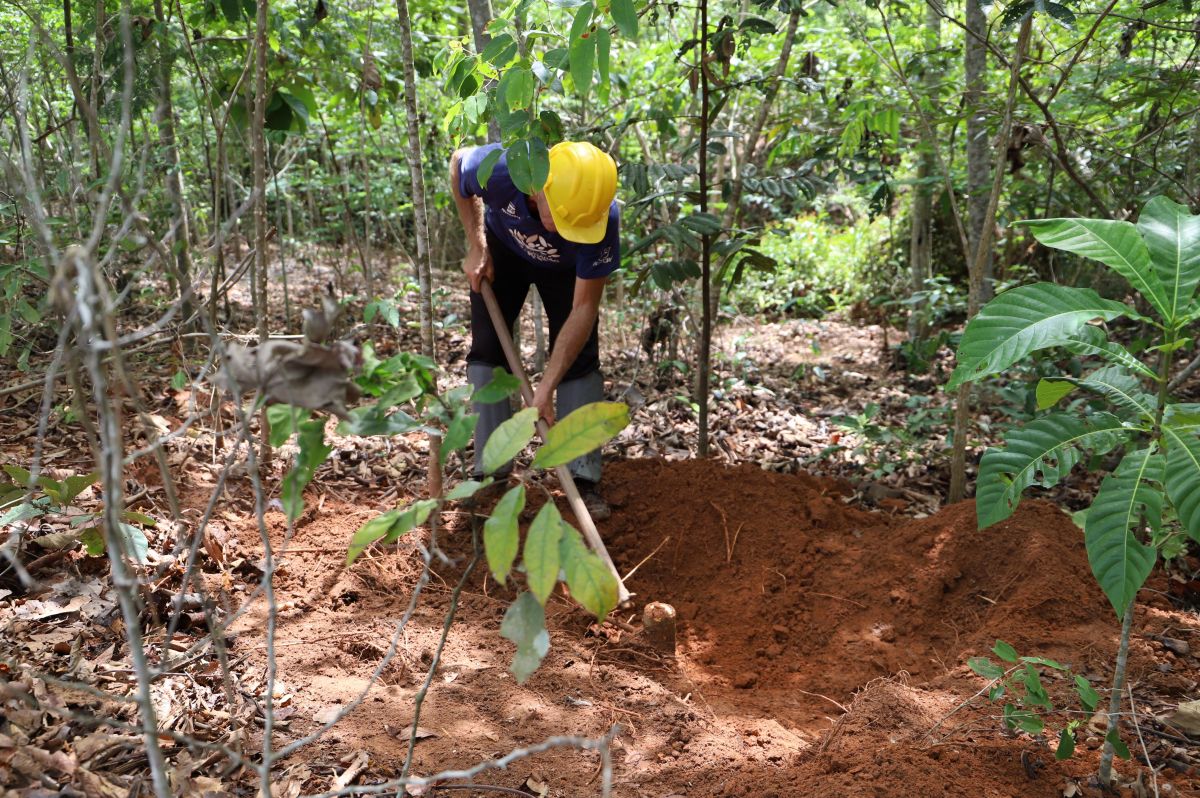
By Brazil Stock Guide — Petrobras and Shell Brasil, alongside CCARBON/USP, have launched Carbon Countdown, the largest project ever undertaken in Brazil to measure, in a standardized and nationwide manner, carbon stocks above and below the soil. The five-year initiative will cover all Brazilian terrestrial biomes and explicitly includes both agricultural areas and native ecosystems, expanding its relevance to debates around low-carbon farming, land use and nature-based solutions.
The project will receive around R$ 100 million in funding, sourced from the mandatory Research, Development and Innovation (R&D) clause in oil and gas exploration and production contracts, with use regulated and supervised by Brazil’s oil regulator ANP. Execution is led by CCARBON, based at Esalq/USP, with participation from universities and research centers across every region of the country.
Scientific baseline
Carbon Countdown aims to establish an unprecedented national scientific baseline for carbon stocks, using methodologies recognized by the Intergovernmental Panel on Climate Change (IPCC). All data generated will be open-access, enabling applications ranging from conservation and climate modeling to land-use planning and verification of carbon credit projects.
According to Olivier Wambersie, Technology Director at Shell Brasil, the project “provides the tools to build a solid and reliable database on natural carbon stocks, essential to strengthen carbon credit projects, restoration initiatives and sustainable land-use strategies, while consolidating the role of Brazilian science in this emerging market.”
Scale and coverage
The survey will span 6,500 demarcated sites, with more than 250,000 soil samples, an even larger number of vegetation samples and roughly 400,000 complementary environmental measurements, making it the largest inventory of its kind ever conducted in the country. Research hubs will operate across Brazil’s six biomes — Amazon, Cerrado, Caatinga, Atlantic Forest, Pantanal and Pampa — supported by local field teams and laboratory infrastructure, unified methodologies, health and safety protocols, ethical standards and strict data consistency rules.
From global methods to local reality
For Lílian Melo, Executive Manager at Petrobras’ R&D center CENPES, the project’s core deliveries include “a public geospatial database based on representative environmental sampling, the deployment of research infrastructure, and the reliable tropicalization of international methodologies to the reality of Brazil’s biomes, agricultural systems and soil types.”
That adaptation is central to reducing uncertainty in measurement, reporting and verification — a key bottleneck for scaling high-quality carbon projects in tropical countries.
Benchmark potential
The scientific leadership of CCARBON/USP adds further weight. Maurício Roberto Cherubin, the project’s scientific coordinator and a professor at Esalq/USP, said the initiative places Brazil “in a position of prominence by generating, for the first time, national reference values for carbon stocks in soil and vegetation.” According to him, the rigor applied will help refine quantification methodologies, reduce uncertainty and increase the competitiveness of restoration and sustainable production projects, with potential to serve as a global reference.
Market and policy implications
By delivering a realistic and scientifically validated dataset, Carbon Countdown aims to provide greater certainty for investors and policymakers, support Brazil’s transition to a low-carbon economy and strengthen the country’s standing in the global carbon credits market, particularly for nature-based solutions such as agroforestry, conservation and reforestation.
Capacity building
Beyond data generation, the project will invest in training research teams, strengthening laboratories across Brazil and building an integrated platform for data storage, analysis and sharing, under the scientific leadership of CCARBON/USP. The partners say the effort leaves a permanent legacy for Brazilian environmental science while underpinning the next phase of the country’s carbon market development.