
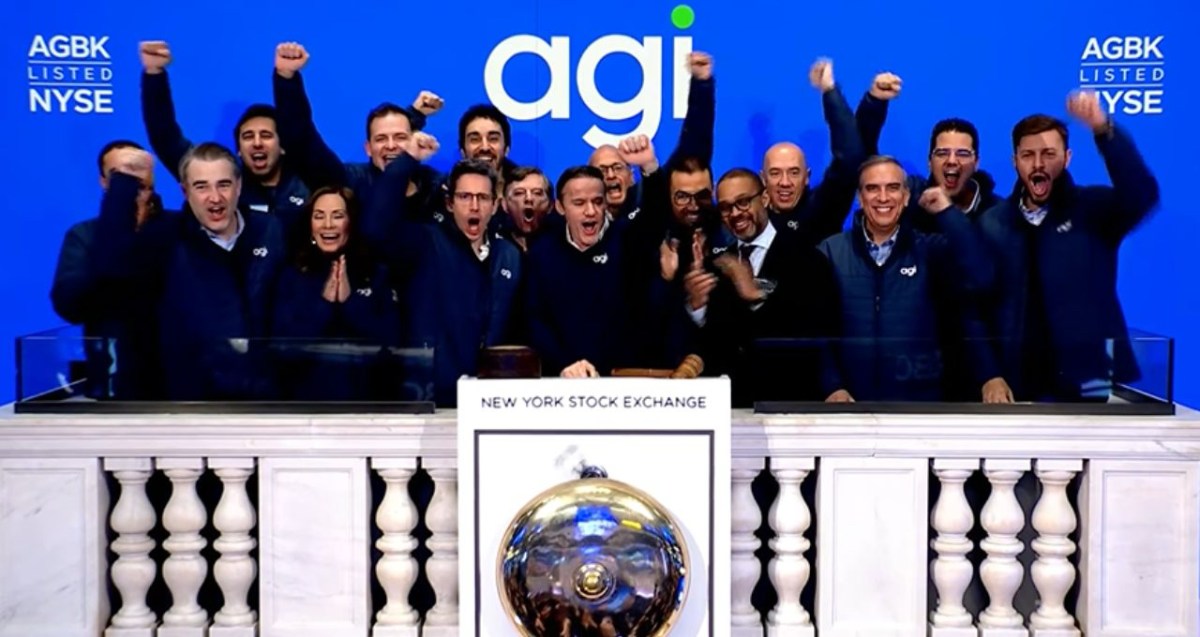
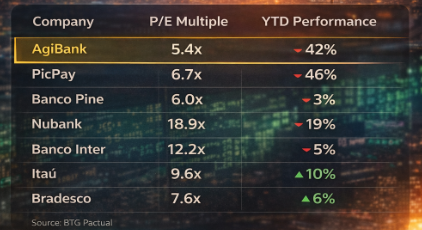
By Brazil Stock Guide – Shares of PicPay (PICS) and AgiBank (AGBK) have plunged as much as ~46% and ~42% since their IPOs, erasing their “unicorn” status and dragging both fintechs below a US$1 billion pre-money valuation — a sharp reversal just weeks after listing, according to a report by BTG Pactual.
The magnitude of the decline stands in contrast to fundamentals, according to BTG Pactual. PicPay, for instance, now trades at roughly 6.5x earnings based on annualized 4Q25 results, while AgiBank sits closer to 5.5x — both at a steep discount to peers like Nubank (~19x) and Inter (~12x), and even below traditional banks such as Itaú (~9.5x) and Bradesco (~7.5x).
The sell-off, however, appears less about earnings and more about positioning. In the bank’s assessment, the primary driver has been a post-IPO rotation in the shareholder base — particularly the exit of hedge funds and short-term investors who anchored the book. With still limited liquidity, even a handful of large sellers has been enough to pressure prices disproportionately.
At the same time, results failed to provide a catalyst. PicPay reported an increase in Stage 3 loans in the fourth quarter, while AgiBank faced weaker credit origination amid disruptions in INSS-linked payroll lending. Still, BTG Pactual notes that these factors alone do not fully explain the scale of the drawdown.
The broader macro backdrop has compounded the move. As highlighted in the report, what was initially a momentum trade tied to expectations of rate cuts has reversed as interest rates remain higher for longer, triggering a shift to risk-off positioning and exposing the lack of long-term, high-conviction holders in these names.
Orphan risk builds
The deeper concern for investors is structural. According to BTG Pactual, with offshore listings and no natural domestic investor base, PicPay and AgiBank risk becoming “orphan stocks” — securities that trade at persistent discounts due to low liquidity and limited coverage.
There is precedent. BTG highlights cases such as Vinci Partners and Patria, where strong operational performance failed to translate into sustained investor interest after offshore listings, ultimately leading to discounted valuations and reduced liquidity.
Unlike those firms, however, PicPay and AgiBank lack a clear strategic rationale for listing overseas. While Vinci and Patria used U.S. listings to support cross-border M&A and capture higher valuation multiples, BTG argues that digital banking already has established domestic comparables in Brazil, weakening the case for offshore exposure.
The result is a paradox. Valuations now look undeniably cheap — but, in BTG Pactual’s view, without a stable investor base, the discount may persist.