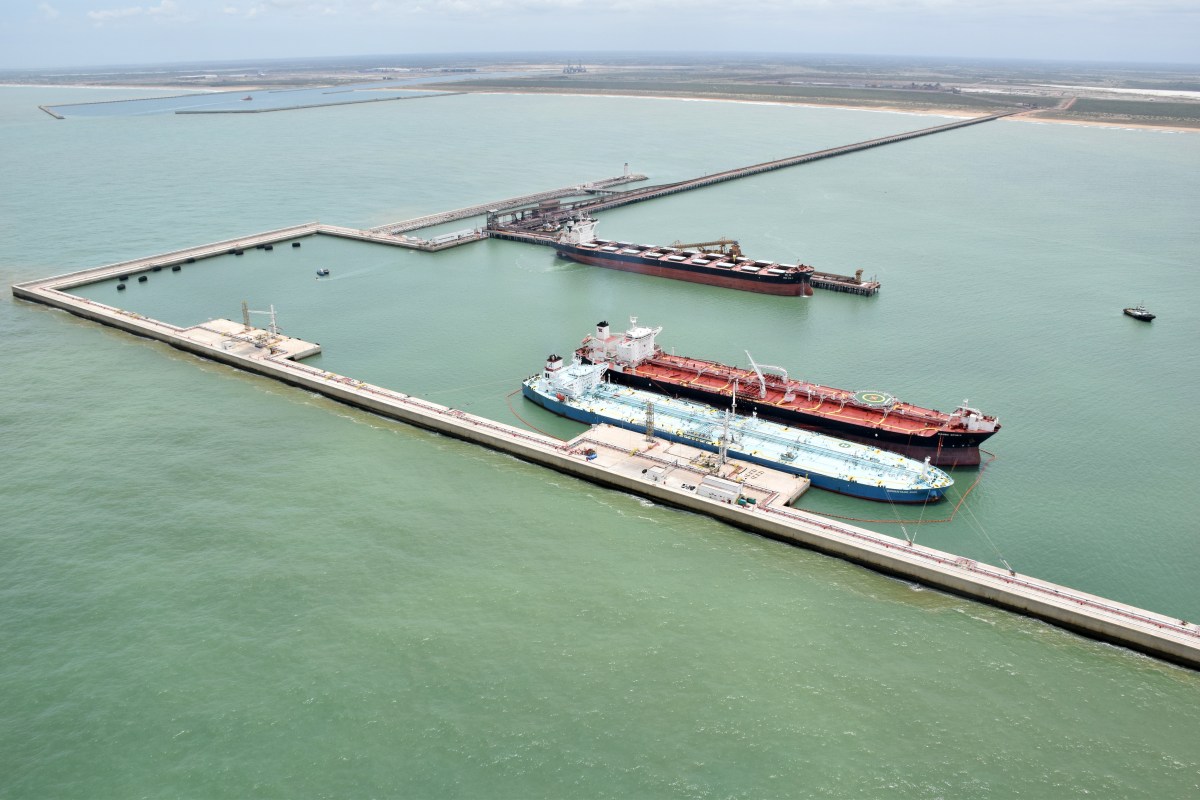
By Brazil Stock Guide – Porto do Açu and Port of Antwerp-Bruges signed a memorandum of understanding on Monday (3) to develop a green maritime corridor between Brazil and Europe. The project aims to become the world’s first large-scale e-fuels export route and start operations before 2030, the ports said at the Oceans of Opportunity Summit in Rio de Janeiro.
The initiative stems from a pre-feasibility study by the Rocky Mountain Institute (RMI) and the Global Maritime Forum (GMF), according to Broadcast. The analysis highlighted Brazil’s potential to supply low-carbon fuels to Europe, leveraging its renewable energy matrix and growing green hydrogen sector.
Strategic Partnership
Rogério Zampronha, CEO of Prumo, the holding company controlling Porto do Açu, said the deal reinforces Brazil’s position in the global energy transition.
“We are working to make Porto do Açu a global hub for zero-emission maritime fuels, strategically positioned to connect Brazil’s production with Europe’s growing demand for low-carbon solutions,” Zampronha said.
Porto do Açu plans to anchor its hydrogen and derivatives hub to meet part of Europe’s future demand. Antwerp-Bruges, one of Europe’s largest industrial clusters, is targeting imports of 6 to 10 million tons of green ammonia annually by 2030, equivalent to 1.2 to 1.5 million tons of green hydrogen.
Competitive Advantage and Global Regulation
The pre-feasibility study concluded that the Açu–Antwerp route could achieve cost parity with fossil fuels under new incentives from the International Maritime Organization (IMO). It also mapped required infrastructure, safety protocols, and regulatory frameworks to ensure commercial feasibility with low compliance risk.
Eugenio Figueiredo, CEO of Porto do Açu, emphasized the international relevance of the partnership.
“This cooperation demonstrates the power of global collaboration and how we can contribute to a sustainable and circular maritime economy,” Figueiredo said. “Açu is an ecosystem that delivers real results, offering energy availability and operational agility under the highest ESG standards.”
European Cooperation and Market Outlook
Kristof Waterschoot, CEO of Port of Antwerp-Bruges International, said the project represents a milestone for sustainable trade routes.
“The partnership with Porto do Açu marks a significant step in building a transatlantic green energy corridor. Together, we are preparing the first imports of green ammonia from Açu to Antwerp-Bruges, advancing a truly sustainable maritime economy,” he said.
The study also notes that the upcoming IMO Net Zero Framework, together with European policies such as FuelEU Maritime and the Emissions Trading System (ETS), will strengthen market incentives for zero-emission fuels.
Brazil’s Role in the Green Fuel Race
Currently, maritime transport accounts for about 80% of global trade volume and roughly 3% of global carbon emissions. Brazil’s renewable energy base and low capital costs make it one of the most competitive countries for e-fuel production.
Jon Creyts, CEO of RMI, said Brazil has the potential to lead the next wave of global clean energy exports.
“Brazil has the resources to lead the world in sustainable, cost-competitive maritime fuels,” Creyts said. “Its renewable power, natural carbon assets, and robust industrial base position it as a global powerhouse in the coming energy economy.”