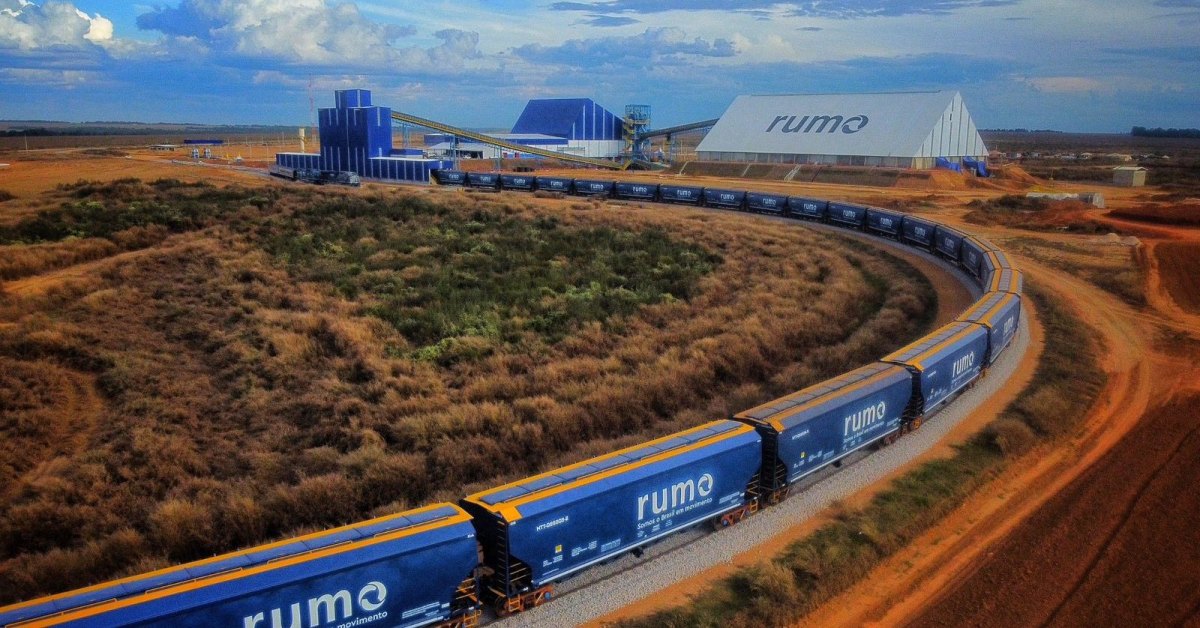
By Brazil Stock Guide – Rumo (RAIL3), Brazil’s largest rail logistics operator, opened the first phase of its Mato Grosso State Railway on Saturday, delivering 162 kilometers of new track and a grain terminal on the BR-070 federal highway in a project aimed at easing logistics bottlenecks in the country’s largest grain-producing state.
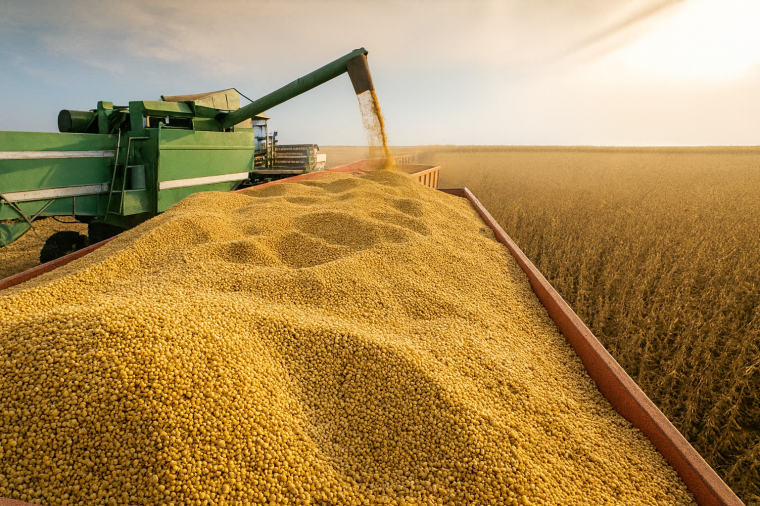
Mato Grosso, located in Brazil’s Center-West region, is the heart of the country’s soybean and corn expansion, but still relies heavily on trucks to move crops to export corridors.
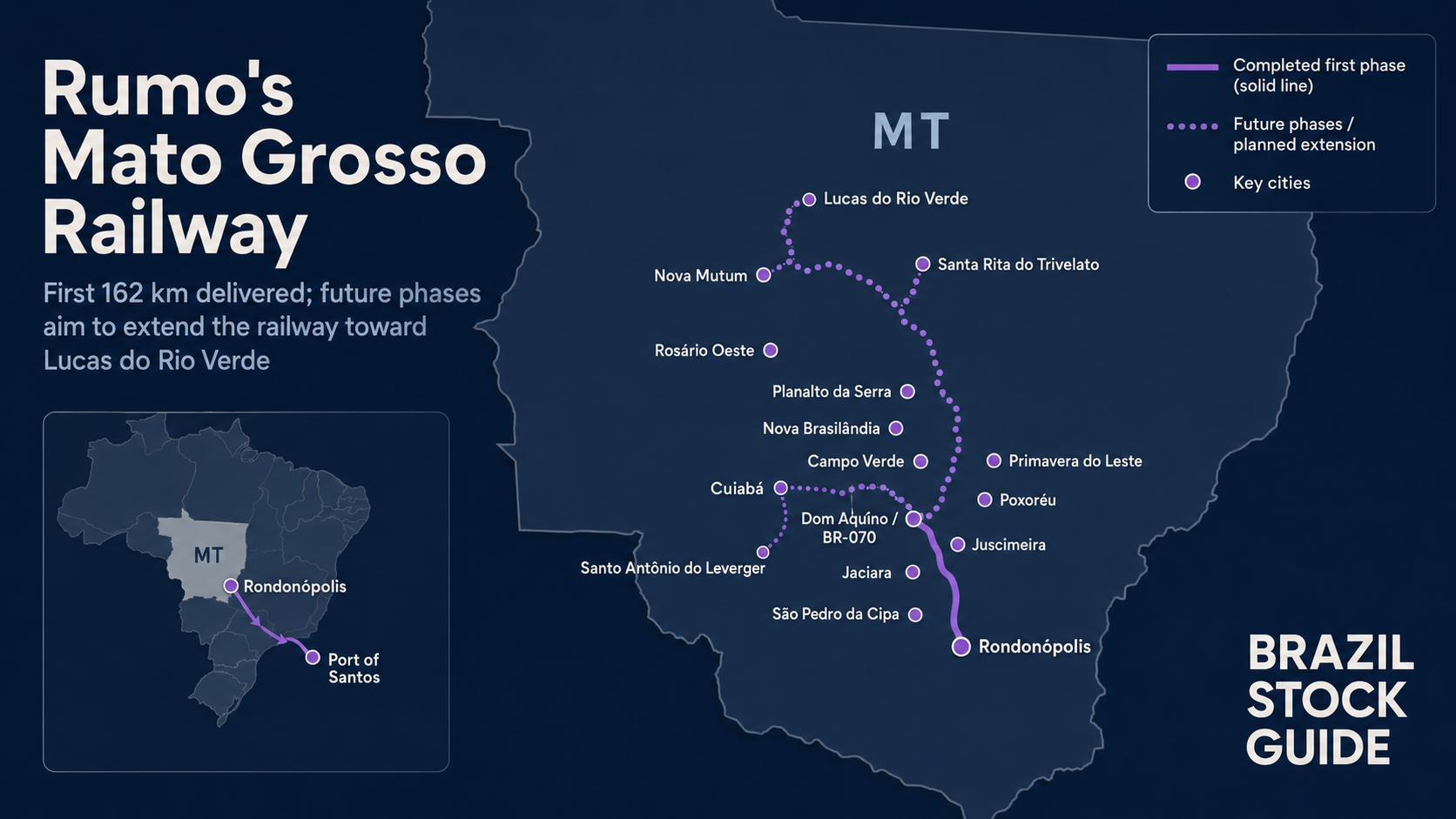
The new stretch connects Rondonópolis, already an important rail hub, to the Dom Aquino region. It is part of a broader plan to extend the railway north toward Lucas do Rio Verde, one of Mato Grosso’s main agricultural centers. The full project is expected to reach more than 700 kilometers and includes a planned branch to Cuiabá, the state capital.
The project matters because Mato Grosso sits at the center of Brazil’s grain boom but remains constrained by long road distances, expensive trucking and limited rail coverage. By pushing rail deeper into the state, Rumo is trying to shorten truck routes, improve logistics efficiency and strengthen the corridor that links the farm belt to the Port of Santos, Latin America’s largest port.
The first phase required more than R$ 5 billion in investment over a little more than three years, according to Rumo executives. The new BR-070 terminal can handle up to 10 million tons of grain per year. It is expected to start with test operations in June and gain traction in the second half of 2026, with a more meaningful contribution from 2027.
For the market, the opening is a sign that Rumo is beginning to turn a long investment cycle into operating capacity.
Pedro Palma, Rumo’s chief executive officer, said the company has already more than doubled rail volumes from Mato Grosso to Santos since taking over the former concession in 2015.
In 2014, about 12 million tons were transported by rail from Mato Grosso to Santos, Palma said at the ceremony. Last year, before the newly opened stretch was operating, that number had already exceeded 25 million tons.
“We believed it could be more,” Palma said. “In this ten-year journey, we delivered more than 100% growth in volumes within this structure.”
Palma said the new railway stretch and terminal add another 10 million tons of capacity to Rumo’s system. He said large infrastructure projects require more than capital, citing long-term vision, technical knowledge, partnerships, courage and execution.
The project is also a test case for Brazil’s infrastructure model. It is the first railway in the country developed under a state authorization framework, rather than a traditional federal concession. Under this model, a private company receives authorization to build and operate new infrastructure, instead of taking over an existing public asset through a concession auction.
Palma credited Mato Grosso’s state government and legislature for creating the regulatory structure that allowed the project to move forward.
Federal support also played a role. The Brazilian Development Bank (BNDES), state-owned development bank and one of the main sources of long-term financing for infrastructure projects in the country, supported the first phase with R$2 billion.
Eduardo Tavares, secretary for funds and financial instruments at the Ministry of Integration and Regional Development, said another R$500 million came through the Constitutional Fund for the Center-West, a regional development fund, in partnership with Sudeco, the federal agency responsible for economic development in Brazil’s Center-West region.
The project is also included in the New PAC, Brazil’s federal infrastructure investment program. PAC stands for Growth Acceleration Program, a government initiative used to prioritize and coordinate public and private infrastructure projects.
Vice President Geraldo Alckmin, Transport Minister George Santoro, Mato Grosso Governor Otaviano Pivetta, former governor Mauro Mendes, senators and state officials attended the ceremony.
Rubens Ometto, chairman of Cosan and Rumo, used the event to frame the railway as a response to one of Brazil’s most persistent problems: world-class agriculture combined with expensive logistics.
Mato Grosso accounts for 33% of Brazil’s grain production and nearly 15% of global grain trade, Ometto said. Yet until now, the state had only about 300 kilometers of railways.
“Mato Grosso is not a state that merely has potential,” Ometto said. “It is a reality, a power in Brazil’s Center-West.”
Ometto called the project the “true grain railway,” but said it should not be seen only as a soybean and corn route. The corridor can also move fertilizers into Mato Grosso, cotton in containers, ethanol, fuel products and industrial goods in both directions.
That matters for Rumo because two-way cargo flows can improve asset utilization and reduce the seasonality of a business still heavily tied to crop cycles. In rail logistics, higher utilization usually matters as much as pricing, because fixed assets such as tracks, terminals, locomotives and wagons need steady volumes to generate attractive returns.
The inauguration comes as analysts are paying closer attention to road freight costs, a key variable for Rumo’s pricing power. BTG Pactual, one of Brazil’s largest investment banks, said in a June 15 report that Rumo’s rail tariffs are priced against the best trucking alternative. In other words, when trucking becomes more expensive, rail becomes more competitive.
In long-haul grain routes, diesel can represent 40% to 50% of total road freight costs, BTG said. Fuel exposure on Rumo’s main lines is typically lower, at about 15% to 25%.
That gap can become important if road transport costs rise. BTG cited diesel, maintenance, driver wages, tolls, truck fleet supply, freight-floor enforcement and Brazil’s tax reform as factors that could support a higher structural cost base for trucking.
The freight floor is a minimum road freight tariff set by Brazil’s transport regulator after the 2018 truckers’ strike. It is designed to protect truck drivers’ income, but it can also prevent road freight prices from falling too much when trucking capacity is abundant. That may indirectly support Rumo’s pricing umbrella.
The bank also said logistics capacity in Mato Grosso tends to grow in large steps, while agricultural production expands more steadily. That mismatch can create bottlenecks and periods of scarcity. BTG said Rumo has been the only player continuously adding logistics infrastructure in the state.
The main question is how quickly the new BR-070 terminal will be filled. BTG noted that slow grain logistics contracting has so far delayed the pass-through of cost pressures into freight prices. For Rumo, that means the earnings impact will depend on contracted volumes, corridor competitiveness and the company’s ability to capture attractive yields.
The next phase of the project will be closely watched. The full Mato Grosso railway is expected to connect Rondonópolis to Lucas do Rio Verde, but the stretch beyond Dom Aquino has not yet been built. The contract provides for completion by 2034, and the next stages still depend on environmental licensing, financing conditions and execution.
That is the main caveat for investors. The first phase reduces execution risk and proves that a large railway can be built under the state authorization model.
George Santoro said Brazil needs a broader rail investment cycle to reduce logistics costs, which he said represent about 15% of gross domestic product. He cited a federal target of R$160 billion in rail investments and said BNDES has launched a credit line for railway construction and rolling stock, with long-term financing and grace periods during the capital expenditure phase.
Otaviano Pivetta was more direct about the challenge. He said Rumo began the project in 2022, when interest rates were much lower, and later faced a sharp increase in borrowing costs. Entrepreneurs willing to invest in infrastructure, he said, should not “break along the way” because of the business environment.