By Brazil Stock Guide — Brazil’s rural credit crisis is moving from bank balance sheets to the country’s most important agricultural asset: land.
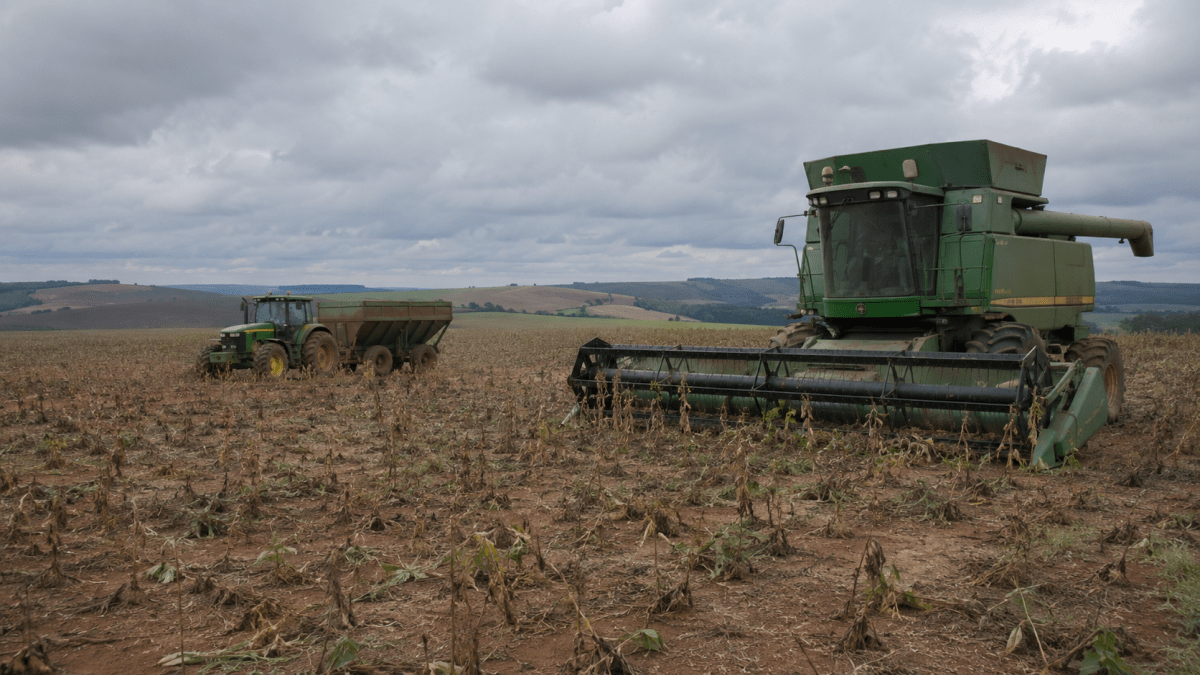
Farm auctions are rising sharply as more producers struggle with high debt, weaker margins and tighter credit. According to data compiled by Reuters, the number of rural properties taken to auction in Brazil reached 14,219 in 2025, up 30% from the previous year. Out-of-court auctions, used by creditors to accelerate collateral enforcement, nearly doubled to 2,398 properties.
The increase marks a new phase in the downturn. After years of abundant credit, low interest rates, strong margins and rapid expansion, Brazilian agriculture is now facing a more difficult mix: lower grain prices, higher input costs, double-digit interest rates, extreme weather and more selective lenders.
Problematic rural loans — including delinquencies, defaults, rescheduled payments and renegotiations — more than quadrupled in two years to R$ 171.2 billion at the start of this year, according to central bank data. That represented 19.6% of outstanding rural credit, up from 5.5% two years earlier.
The figures help explain why the sector is no longer treating the problem as a temporary credit squeeze. Defaults may be close to a peak, according to market participants, but that does not mean the pain will fade quickly.
In rural credit, the peak in default rates often comes before the end of the economic stress. First, late payments stop rising. Then come renegotiations, provisions, bankruptcy filings, collateral enforcement and auctions. That second stage can last several quarters, even after default indicators begin to stabilize.
The base case in the market is that the upward cycle in rural defaults may start to lose momentum between the second half of 2026 and early 2027. A broader normalization, however, will depend on lower interest rates, better margins and the absence of major new climate shocks.
Lack of margin
The problem is not only a lack of credit. It is a lack of margin. Farmers have been squeezed from several sides. Financing costs rose sharply. Soybean prices fell from the peak of the cycle. Inputs became more expensive. Official rural credit became relatively less important as market-rate funding grew. In some regions, weather destroyed crops, assets and predictability.
Rio Grande do Sul is the clearest example. The state, one of the hardest hit by rural defaults, is still recovering from the 2024 floods. Reuters noted that the disaster was influenced by climate change and El Niño, according to a study published in NPJ Natural Hazards, a Nature journal.
Farmers are now preparing for the risk of another strong El Niño. Climate, once treated mainly as an operational variable, has become a credit variable. It affects yields, cash flow, collateral values and the ability to roll over debt.
That is the central point of the current crisis: rural credit depends on confidence, and confidence has become scarcer.
Banks, asset managers, Fiagro funds, suppliers and traders are demanding stronger collateral and more predictable cash flows. Bankruptcy protection has become one of the biggest sources of friction. Creditors say the tool is increasingly being used by some producers to postpone payments and preserve cash, rather than only as a legitimate restructuring mechanism.
The result is simple: even good borrowers pay the price, because systemic risk raises the cost of funding across the chain. Land has become central to this process.
For creditors, fiduciary liens over rural land have become one of the preferred structures to secure new loans. For producers, pledging land, selling with a repurchase option or entering sale-and-leaseback structures can provide time to get through the cycle.
But it can also be the start of a loss of wealth. When renegotiations fail, land goes to auction. The rise in auctions shows that part of the crisis has already moved into the enforcement phase.
The stress, however, is not uniform. There are very different producers inside the same crisis.
The most vulnerable are highly leveraged farmers, those with lower productivity, greater reliance on leased land and less ability to absorb high interest rates. Producers with owned land, scale, strong yields, hedging, better governance and access to credit remain in a stronger position.
Champions
That gap may accelerate a more selective consolidation of Brazilian agriculture. Not every indebted producer will be acquired. Many may simply lose area, return leased land, sell assets or stop competing for new farms. At the same time, better-capitalized producers and companies may gain room to expand, taking over areas, buying assets on more defensive terms and attracting a larger share of available credit.
This is consolidation by quality, not only by distress.
SLC Agrícola offered a clear example of the other side of the cycle. Against a backdrop of rising rural auctions and problematic debt, SLC disclosed a strong hedge position and an irrigation plan that underscore the gap between exposed producers and operators with tools to manage risk.
For the 2025/26 crop year, SLC said it had FX hedges covering 77.8% of soybeans, 78.9% of cotton and 73.5% of corn. On commodities, the company had hedged 76.3% of soybeans and 89.8% of cotton. In a year of uncertainty over the dollar, agricultural prices and production costs, that protection reduces volatility and improves cash-flow visibility.
The company also updated its irrigation project. Its current irrigated physical area is 19,061 hectares. With projects planned for the 2026/27 crop year and the following years, that area could reach 58,461 hectares, an increase of 206.7%. SLC said irrigation should help mitigate climate risk, raise productivity, stabilize output and increase land use through second-crop production.
In the new phase of Brazilian agriculture, scale, hedging, irrigation and owned land are defensive tools.
SLC’s land portfolio update reinforces that point. The company’s owned land, together with areas linked to FIPs managed by BTG Pactual, was valued by Deloitte at R$ 13.53 billion. The average value per arable hectare reached R$ 59,534, up 1.0%. The company’s net asset value was estimated at R$ 13.82 billion, or R$ 27.7 per share.
The contrast is powerful. While indebted farmers risk seeing land move to auction, capitalized operators continue to treat land as a store of value, a production platform and a strategic asset. That does not eliminate the crisis. But it changes the reading of who may come out stronger.
The debate over a broad rural debt renegotiation in Brasília sits exactly in this gray area. Some producers need a bridge, especially those hit by extreme weather or temporary shocks. But there is also moral hazard: a broad program could reward opportunistic behavior and encourage borrowers to stop paying in anticipation of better terms.
For the financial market, the answer must separate viable producers from non-viable ones. Renegotiating the debt of a farmer hit by a one-off crop failure is one thing. Rolling over the liabilities of a producer who cannot generate enough cash to survive is another. The first may preserve value. The second only delays the loss.
The Plano Safra remains important, especially for smaller farmers and those less served by the private market. But Brazilian agriculture has become too large to depend only on subsidized credit. Private banks, capital markets, Fiagros, CRAs and more sophisticated financing structures are likely to play a larger role.
The problem is that private capital demands predictability. And predictability is exactly what has become scarcer.
The long-term thesis for Brazilian agriculture remains intact. The country is still one of the world’s most competitive food producers, with scale, land, productivity and a central role in global supply chains.
But the path has narrowed. The sector must get through a period of compressed margins, high interest rates, elevated costs, more volatile weather and greater scrutiny from creditors. When the cycle turns, Brazilian agriculture is likely to be more concentrated, more professional and more dependent on capital.
In the short term, debt is turning into land. In the medium term, that land may help define the next stage of consolidation.