
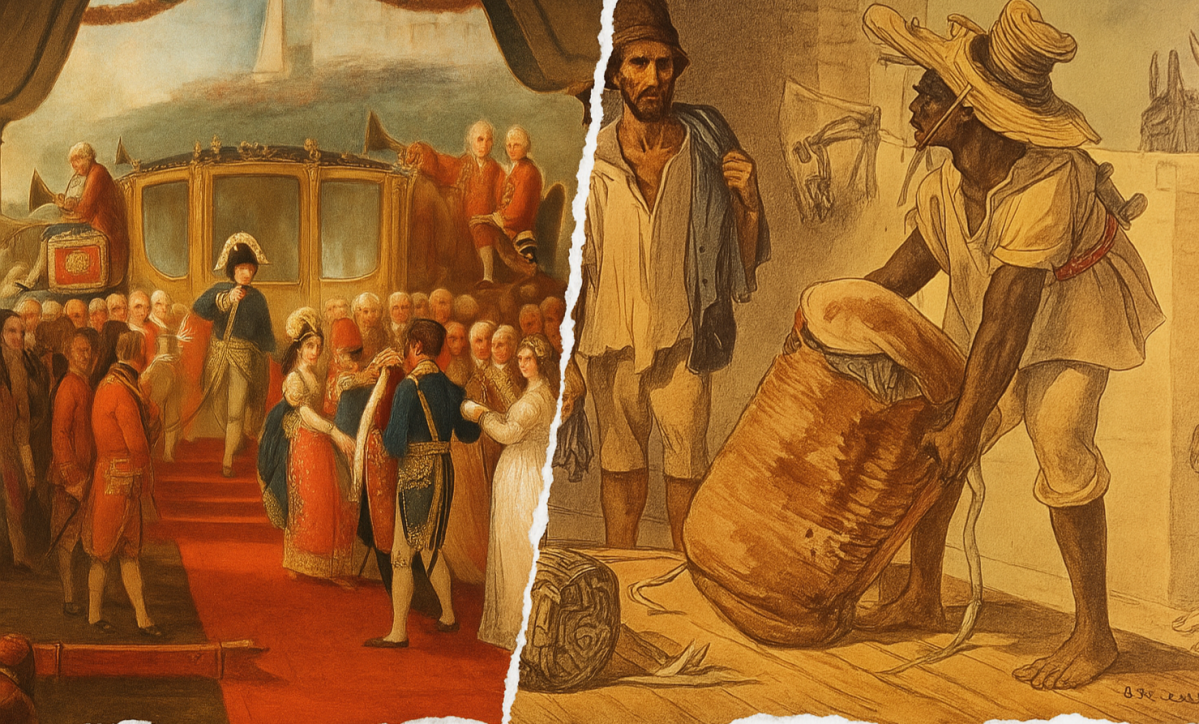
Jean-Baptiste Debret captured the stark contrast in Luso-Brazilian society, juxtaposing the opulence of royal ceremonies with the hardships of everyday labor
A historian shows how the fiscal breakdown of the João VI era corroded the monarchy’s legitimacy, drove the Bank of Brazil into insolvency, and opened the way for the fall of absolutism.
By Brazil Stock Guide – When the Portuguese royal family arrived in Rio de Janeiro in 1808, it carried with it the pomp of the Old Regime. Stables, the royal kitchen (ucharia), parties and ceremonies multiplied the expenses of the Royal Household, which within a few years consumed between 21% and 40% of public revenues—six times more than the court of Louis XVI before the French Revolution. Between 1808 and 1820, these expenses jumped from 456 contos de réis to 1,706. Even the royal pharmacy multiplied its costs twentyfold.
According to historian Carlos Frederico Alves Carneiro Vianna of the University of São Paulo (USP), who presented a study on the subject at the XVI Brazilian Economic History Congress, held in Campinas last month, this pattern of excessive spending was compounded by a costly war. The offensive against José Artigas in the Banda Oriental (1816–1820), which resulted in the annexation of Cisplatina (today the territory of Uruguay), drained half the budget and caused the army to nearly triple in size in a single decade.
The interpretation of the fiscal crisis has gained strength in recent times compared with traditional historiography, which has generally attributed the fall of absolutism to military uprisings and the spread of liberal ideas. The study reinforces the thesis that the fiscal crisis was the central mechanism of the transition during the João VI period, creating the conditions for liberal ideas to spread throughout the Luso-Brazilian Empire.
The Bank as Lifeline—and Trap
Faced with permanent deficits, the Crown resorted to a new instrument: the Banco do Brasil, created in 1808. Officially private, it was supposed to stimulate trade, but from its founding charter its function was clear: to support the monarchy and pay soldiers. The problem was attracting capital. As investors resisted, the government resorted to royal favors, titles, and the so-called “Bank Tax” (1812), which levied charges on carriages, shops and vessels. Forced adherence worked: between 1816 and 1819, subscribed shares rose from 609 to 2,037.

Amortization Fund Building, 1866. The site housed the headquarters of the first Banco do Brasil until the late 1820s. Georges Leuzinger/Instituto Moreira Salles Collection
But with more capital, expenditures also increased. In 1821, the Treasury’s debt to the bank had already reached 4,800 contos de réis. To finance expenses, note issues rose from 1.86 million réis in 1816 to 8.55 million in 1820. The impact was explosive: manioc flour, the staple food of the poor and the enslaved, rose from 700 réis in 1806 to 1,932 in 1819 (+176%). Dried beef, the staple of the popular diet, jumped from 640 réis to 2,000 in the same period (+213%). The exchange rate fell from 68 in 1816 to 47 in 1822, a loss of 30%.
While the population suffered from the rising cost of living, the shareholders of Banco do Brasil enriched themselves. In 1817, the institution distributed dividends of 17%, fed by loans to the State itself.
The Machinery of the Absolutist Crisis
In March 1821, after revolts in Rio, a commission was created to assess the real situation of the bank. For the first time, it became public that there were 8.55 million réis in notes issued, against capital and reserves of only 2.47 million—more than three times the capital. The diagnosis was clear: the Banco do Brasil was insolvent.
The announcement provoked panic. Account holders crowded in front of the institution demanding the conversion of their notes into gold and silver. Guards were deployed to contain the crowd. The government tried to calm tempers by declaring that the bank’s debts would be honored with public revenues and even with diamonds from the Treasury. A decree in March ordered the negotiation of a foreign loan of 2,400 contos (six million cruzados), offering as collateral not only precious stones, but also the revenue from the kingdom’s four main customs houses. The operation failed.
To make matters worse, in April 1821, King João VI sailed for Lisbon taking with him part of the Banco do Brasil‘s gold and silver, piled up in the holds of the royal fleet. The episode forced the government, months later, to impose restrictive rules on conversions, limiting the exchange of notes for metallic coins. It was the tacit recognition that there was no longer sufficient backing to sustain paper circulation.
The fiscal collapse, uncontrolled note issuance and rising prices created an atmosphere of discontent that exploded in revolts in Porto, Lisbon, Belém, Salvador and Rio de Janeiro. It was the spark of liberal ideas spreading in Europe in 1820 that found in the Luso-Brazilian empire a terrain already undermined by crisis.
Banco do Brasil survived as a weakened institution until 1829, when it was liquidated by decree of Pedro I. Its trajectory encapsulates that of Luso-Brazilian absolutism itself: conceived as a model of innovation, it ended as the symbol of an entire regime’s failure.