By Rodrigo Uchoa, special for Brazil Stock Guide
“How can anyone govern a nation that has two hundred and forty-six different kinds of cheese?” sighed Charles de Gaulle about France. The line is perhaps the most overworked of journalistic clichés, wheeled out whenever someone wants to talk about cheese—or to poke fun at French bureaucracy. But if the general were alive today, he might be surprised to find a new contender for ingovernability emerging south of the equator: Brazil, and in particular the dairy-obsessed state of Minas Gerais.
A Quiet Tradition Becomes a Market Force
For centuries, cheese in Brazil was a quiet, domestic affair, rooted in Portuguese colonial know-how and tied to farm kitchens rather than export statistics. Minas Gerais became the country’s dairy engine: it is now estimated to account for roughly a quarter of Brazil’s cheese production. Brazil as a whole turned out 1.2 million tonnes of cheese in 2020, with some 70 recognised types. Industrial mozzarella, prato and parmesan still dominate 60% of output, but artisanal cheeses have grown from rustic curiosity to booming niche.

Within this space, Minas holds a special place. Recent research suggests that artisanal cheeses generate income for 30,000 families in the state, producing around 85,000 tonnes a year. The world has noticed. In 2024, UNESCO inscribed the “Methods of Making Artisanal Minas Cheese” onto its Intangible Cultural Heritage list—the first Brazilian food tradition to receive such recognition.
The Ten Microregions of Minas
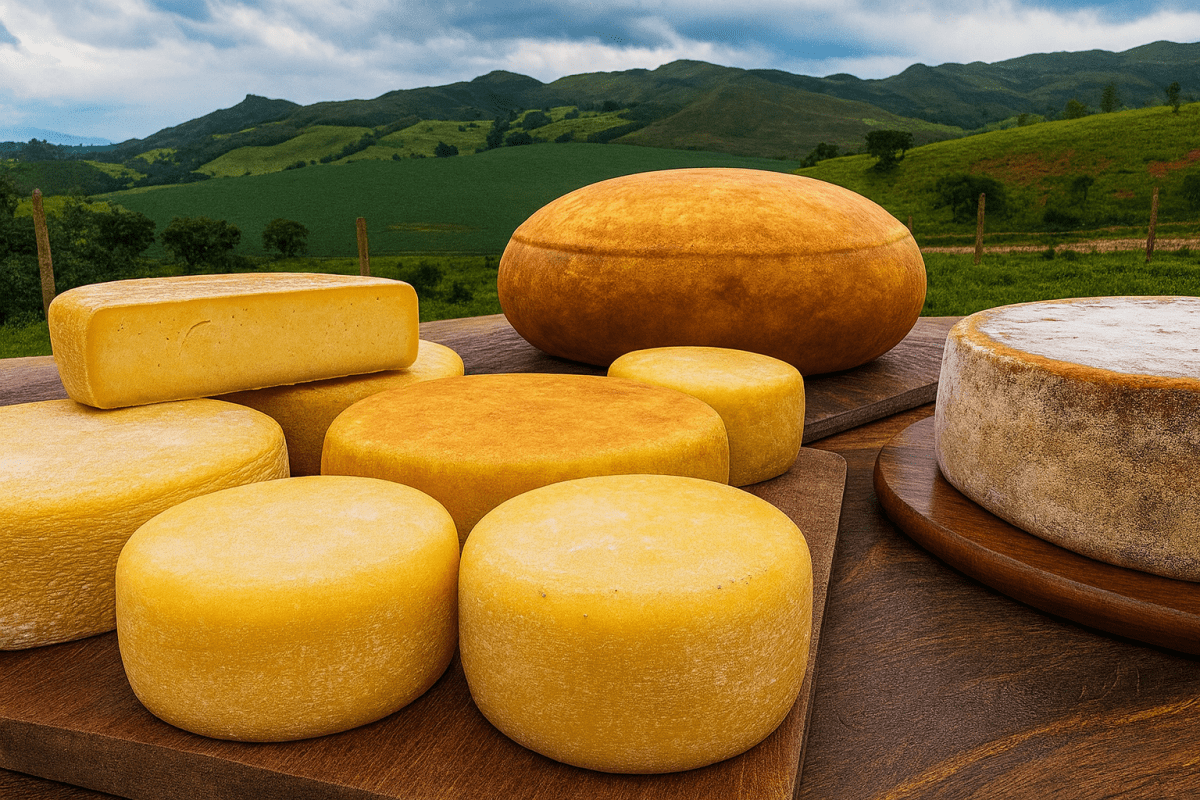
Behind the romantic language lies surprising structure. Minas Gerais officially recognises ten microregions of Queijo Minas Artesanal: Araxá, Campo das Vertentes, Canastra, Cerrado, Diamantina, Entre Serras da Piedade ao Caraça, Serra do Salitre, Serras da Ibitipoca, Serro e Triângulo Mineiro. Several enjoy Indicação Geográfica (IG) status: Canastra since 2012, Serro since 2011, Cerrado since 2023.
Each region refines a shared recipe. Canastra cheeses are semi-hard with a buttery core and nut-and-hay aromas. Serro wheels are more acidic and crumbly. Araxá cheeses lean mild and creamy. Cooler Campos das Vertentes and Ibitipoca yield firmer, longer-aged wheels. The Cerrado, now the largest producer—19 municipalities, over 30% of Minas’s artisanal output—tends to produce drier, herbal cheeses shaped by native grasslands.
Pairings: From Cachaça to Coffee
This diversity invites pairings. Canastra matches structured Brazilian reds or its own high-altitude coffees. Serro shines with sparkling wines or fruity whites. Araxá fits lagers or filtered coffees. Mature Cerrado cheeses stand up to full-bodied specialty coffees or aged cachaça. As The Economist might warn: such experiments risk turning an evening of “food sovereignty” into a morning of sovereign regret.
Awards and Soft Power
Awards turbocharged visibility. In 2017, Senzala, from Araxá, won a super-gold at the Mondial du Fromage, beating 700 cheeses from 47 countries. Brazilians returned with 57 medals in 2021 and 81 in 2023. At the World Cheese Awards, Minas producers took home several top prizes. ExpoQueijo Brasil, held in Araxá, judged 1,000 cheeses from 16 countries in 2025; Minas won 40 golds, and a cheese from Alagoa claimed “Super Ouro”.
Medals don’t guarantee income, but they help consumers navigate a bewildering counter. Abroad, they challenge the stigma of supermarket prato. When President Luiz Inácio Lula da Silva gifted French President Emmanuel Macron a curated basket of Brazilian cheeses in 2024, dairy briefly became a piece of Brazilian soft power.

Economics: A Slow-Growing Market
Brazilian consumers eat only 5 kg of cheese per year on average, far below France’s 27 kg, limiting domestic pull for premium niches. The market was 789,000 tonnes in 2025 and may reach 929,000 tonnes by 2034. Artisanal cheese—perhaps 200,000 tonnes—remains a minority but is gaining traction as middle-class consumers trade up.
Producers face classic emerging-market hurdles. For decades, national rules discouraged raw-milk cheese. Only in 2019 did regulations open space for broader sales. Compliance remains costly: hygiene upgrades, lab tests and traceability often overwhelm small farms. In Canastra, 800 producers exist, but only 11 reportedly hold the certifications needed to sell nationwide.
Health Rules and Infrastructure Gaps
Sanitary concerns are real. Studies often detect microbiological risks—including Brucella—and stress the importance of proper maturation. Although state decrees set rules and extension programmes support farmers, enforcement is uneven. Logistics—cold chains, refrigerated transport, export documentation—also lag.
From Valleys to Global Counters
A decade ago, Minas cheeses rarely left their valleys. Today they line the shelves of São Paulo’s A Queijaria and Mestre Queijeiro, appear on Rio tasting menus, and increasingly show up in Paris and London. In Rio, Queijo com Prosa sells only Brazilian artisanal cheeses and ships nationwide. At CADEG, shops like Mei Mineiro specialise in Minas wheels, cachaças and sweets.
A Final Word from De Gaulle
De Gaulle, confronted with Brazil’s proliferating wheels, might update his line. Governing a country of many cheeses is hard; governing one that only recently discovered it is a cheese country may be harder still. For consumers, though, life is simpler. With a slice of Canastra and a cup of strong Minas coffee, the wisest move is not to fret about governance—but to surrender.