By Brazil Stock Guide – Brazilian chemical maker Unipar Carbocloro SA reported a return to profit in the first quarter, helped by stronger PVC sales and cash generation, even as margins remained under pressure from weaker international prices and currency effects.
Unipar, whose shares trade on B3 under the tickers UNIP3, UNIP5 and UNIP6, posted net income of R$37 million in the first quarter of 2026, reversing a R$7 million loss in the previous quarter. The company’s operating cash flow reached R$316 million, compared with R$296 million in the fourth quarter and R$156 million a year earlier, according to its earnings release.
Recurring adjusted Ebitda fell to R$145 million, down 20% from the fourth quarter and 59% from a year earlier. The recurring adjusted Ebitda margin narrowed to 12%, from 16% in the previous quarter and 26% in the first quarter of 2025. Adjusted Ebitda, including non-recurring effects, reached R$174 million.
Net revenue was little changed sequentially at R$1.24 billion, but declined 10% from the same period last year. On an adjusted basis, revenue rose 4% from the fourth quarter to R$1.22 billion, driven mainly by higher PVC sales volumes in Brazil and Argentina and a 4% increase in international PVC prices. Those gains were partly offset by lower caustic soda prices.
The company said PVC sales volumes rose 29% from the previous quarter, supported by the use of inventories built in earlier periods. International caustic soda prices fell 5% from the fourth quarter and 11% from a year earlier, while PVC prices remained 13% below the level of the first quarter of 2025.
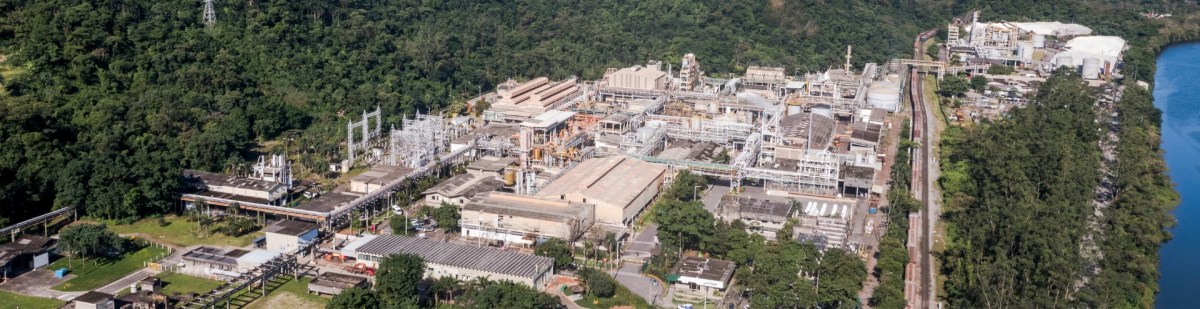
Operational performance was affected by the preparation and ramp-up of the technological modernization project at the Cubatão plant in São Paulo state. Consolidated electrolysis utilization stood at 73%, with 72% in Brazil and 73% in Argentina. The company said the project marked the conclusion of the largest capex cycle in its history.
Unipar also reported net debt of R$2.39 billion at the end of March, down 2% from December. Gross debt was R$3.6 billion, while cash and financial investments totaled R$1.2 billion. The net debt-to-Ebitda ratio rose to 2.58 times, from 2.20 times at the end of 2025.
The average debt maturity was 70 months, and the company said its cash position covered 30 months of debt amortization. In February, Unipar received another R$46 million disbursement from BNDES financing for the Cubatão modernization project, bringing total disbursement to 88% of the contracted amount.
Capital expenditure reached R$167 million in the quarter. The company said accelerated tax depreciation linked to the Cubatão investment should reduce income tax and social contribution payments over the next 30 months, supporting deleveraging.
Unipar’s renewable-energy strategy remained a focus. In February, the company signed a long-term agreement with Casa dos Ventos to buy 33 average megawatts of renewable self-produced power from 2028. The agreement includes the right to acquire a 9.8% stake in a joint venture tied to the Paraíso Solar complex in Mato Grosso do Sul.
Self-produced renewable power represented 63% of consumption at the Cubatão and Santo André plants in Brazil, down from 68% in the fourth quarter. The reduction reflected curtailment by Brazil’s grid operator, operational unavailability and weaker resources during the period.
In capital markets, UNIP3 closed March at R$59.70, up 3% from the end of 2025. UNIP5 closed at R$59.75, down 4%, while UNIP6 rose 8% to R$62.39. Unipar’s market value reached R$6.85 billion at the end of the quarter, up 6% from December.