
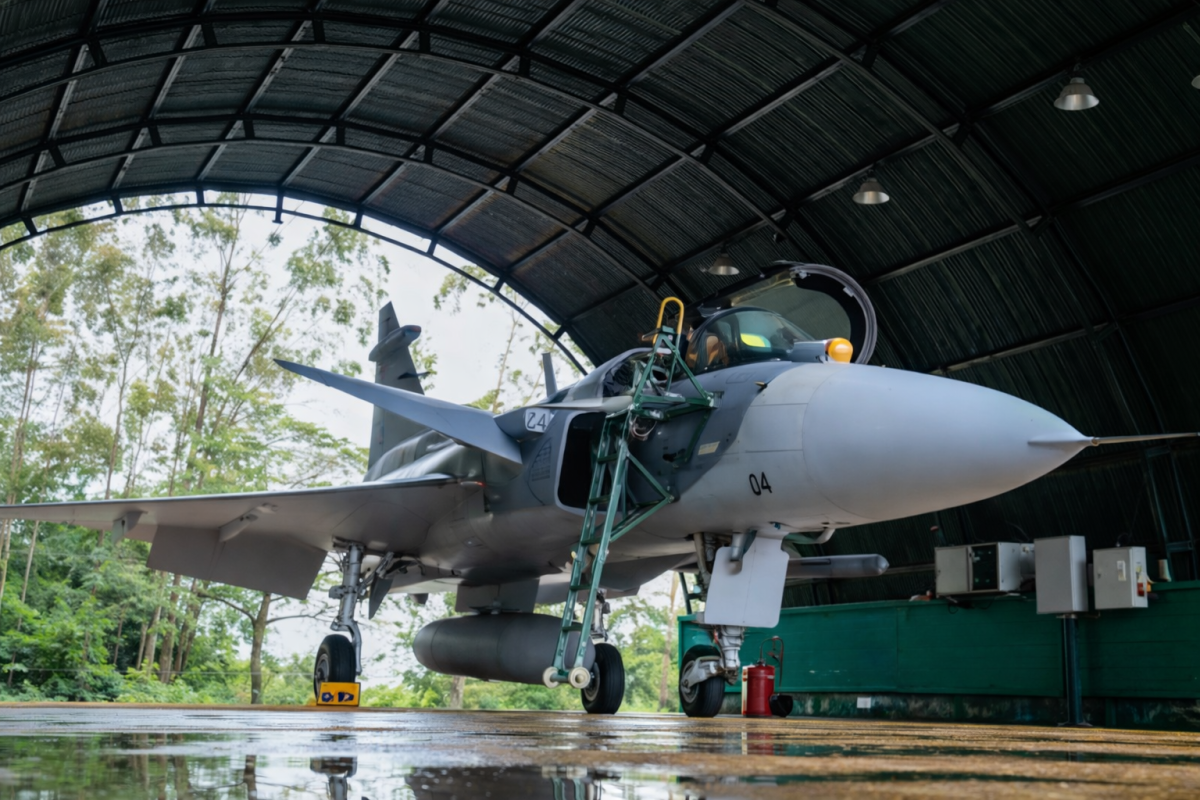
By Brazil Stock Guide – Brazil’s Air Force has placed its F-39 Gripen fighter jet on permanent Air Defense Alert duty for the first time, marking a key step in making the aircraft fully operational. The jet is now part of the country’s 24-hour rapid-response system, ready to take off within minutes to intercept unidentified or irregular aircraft entering Brazilian airspace.
The deployment is based at the Base Aérea de Anápolis (Anápolis Air Base), near the nation’s capital, Brasília. From there, crews remain on standby every day of the year. If radar systems detect an aircraft that fails to follow air traffic rules, a siren sounds at the base and the pilot rushes to the jet. Within a few minutes, the aircraft can be airborne.
The mission is coordinated by the Comando de Operações Aeroespaciais (Aerospace Operations Command), which oversees Brazil’s air defense network. The Gripens are operated by the Primeiro Grupo de Defesa Aérea (1st Air Defense Group – Jaguar Squadron), the unit responsible for protecting central Brazil and the federal capital.
What Changed Now
Although the F-39 has been flying in Brazil since 2022, it had not yet been certified for full alert service. That changed after a series of operational tests completed in late 2025 and early 2026.
These included mid-air refueling with the KC-390 Millennium (Embraer), live firing of the long-range Meteor missile, cannon firing exercises and safe release trials for bombs. Together, these certifications confirmed that the jet can perform both air defense and multi-role combat missions under real conditions. The aircraft is now fully combat-ready.
More Than a Fighter Purchase
Brazil selected the Swedish-built Saab JAS 39 Gripen under the FX-2 program. The contract signed with Saab included not only the aircraft acquisition but also a broad technology transfer package. Brazilian engineers and technicians trained in Sweden, and part of the fleet is assembled in Brazil under joint supervision. Today, the Brazilian Air Force operates ten Gripens.
The move to permanent alert status means Brazil now has a modern, radar-equipped, beyond-visual-range fighter permanently guarding its skies. For international readers, this is comparable to how NATO countries maintain fighter jets on quick reaction alert to intercept unknown aircraft approaching their airspace.
With the F-39 fully integrated into Brazil’s defense system, the country strengthens both its military readiness and its domestic defense industry — marking the transition of the Gripen program from implementation to full operational maturity.